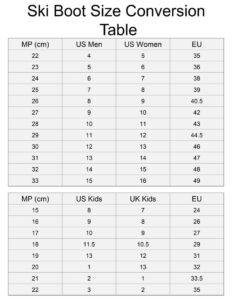
A size 28 ski boot usually means a 28.0 Mondopoint size. It is made for a foot about 28 centimeters long, or roughly 11 inches.
In U.S. sizing, ski boot size 28 often matches:
- U.S. men’s: about 10
- U.S. women’s: about 11 to 11.5
- EU: about 43.5 to 44
- UK: about 9
These conversions are only estimates. Ski boot brands may use slightly different charts, and the best fit depends on foot length, foot shape, shell design, and how tightly you want the boot to fit.


What does size 28 mean in ski boots?
Size 28 refers to the Mondopoint system, the standard sizing method used for most ski boots. Mondopoint is based on the length of your foot in centimeters.
Therefore:
- Mondo 28.0 = about a 28 cm foot
- 28 cm = 280 millimeters
- 28 cm = about 11 inches
The number describes the intended foot length. It does not directly describe the outside length of the boot or the width of the shell.
Ski boot sizing differs from regular shoe sizing. A person who wears a U.S. men’s size 10 street shoe may need a 27.5, 28.0, or even a different ski boot size. Street shoes often have extra space for comfort. Ski boots should hold the foot more firmly so the skier can control the ski.
Size 28 versus 28.5
Many ski boots group 28.0 and 28.5 into one shell size, often called a 28/28.5 shell. The outer shell may be the same, while the liner or internal fit changes slightly.
This matters when you compare a 28.0 with a 28.5:
- The shell may not become longer.
- The liner may offer a little more room.
- The boot may feel different even when the outer shell is identical.
- A thicker or thinner liner can change the fit.
Check the boot’s shell label and the manufacturer’s chart before assuming that 28.0 and 28.5 are separate shell sizes.
What U.S. shoe size is a 28 ski boot?
A size 28 ski boot is usually close to a U.S. men’s size 10. For women, it is often close to a U.S. women’s size 11 or 11.5.
The following table gives a practical estimate:
| Ski boot size | Foot length | Approx. U.S. men’s size | Approx. U.S. women’s size | Approx. EU size |
|---|---|---|---|---|
| 27.0 | 27 cm / 10.6 in | 9 | 10 | 42 |
| 27.5 | 27.5 cm / 10.8 in | 9.5 | 10.5 | 43 |
| 28.0 | 28 cm / 11 in | 10 | 11–11.5 | 43.5–44 |
| 28.5 | 28.5 cm / 11.2 in | 10.5 | 11.5–12 | 44–45 |
| 29.0 | 29 cm / 11.4 in | 11 | 12 | 45 |
This table is a guide, not a guarantee. Brands such as Atomic, Salomon, Tecnica, Nordica, and Lange may show small differences in their conversion charts.


The Mondopoint measurement is more useful than the U.S. shoe conversion. If your foot measures 28 centimeters, start by trying a 28.0 ski boot. Then check the shell and liner fit.
How do you measure your foot for a size 28 ski boot?
Measure both feet while standing, because your feet can lengthen slightly under body weight. Measure at the end of the day if your feet tend to swell.
You need:
- A sheet of paper
- A pencil
- A ruler or tape measure
- The ski socks you plan to wear
Follow these steps:
- Place the paper on a hard floor with one edge against a wall.
- Stand on the paper with your heel lightly touching the wall.
- Keep your weight evenly spread across the foot.
- Mark the end of your longest toe.
- Measure from the wall edge to the toe mark.
- Repeat with the other foot.
- Use the longer measurement.
If your longer foot measures close to 28 centimeters, a Mondo 28 ski boot is a reasonable starting point.
Do not measure while sitting. A seated measurement can make the foot seem shorter than it is. Also, do not add extra space for thick socks. Ski boots should be fitted with one thin ski sock, not several layers.
Example measurement
Suppose your feet measure:
- Left foot: 27.8 cm
- Right foot: 28.1 cm
Your right foot is longer, so you should begin with a 28.0 ski boot. You may need adjustments for width, instep height, or toe shape, but sizing for the shorter foot could create pressure on the longer one.
How should a size 28 ski boot fit?
A correct size 28 ski boot should feel snug, firm, and controlled. It should not feel like a roomy winter boot.
When you first put the boot on:
- Your toes may lightly touch the front while standing upright.
- Your toes should pull back slightly when you bend your knees.
- Your heel should stay mostly in place.
- Your foot should not slide from side to side.
- You should be able to flex the boot without sharp pain.
- Your toes should not become numb or cold.
The liner often packs out as you ski. A boot that feels comfortably loose in the store may become too large after several days on snow.
The toe-touch check
With the buckles open, slide your foot into the boot and stand upright. Your toes may gently touch the front of the liner.
Now bend your knees into a skiing position. Your heel should move back, and your toes should have a little more room.


This is normal. The fit should not cause strong pressure, tingling, or numbness. If your toes remain tightly crushed even in a flexed stance, the boot may be too short, too narrow, or shaped poorly for your foot.
The shell-fit check
A ski boot technician can remove the liner and place your foot inside the empty shell. Your toes should approach the front, while the heel remains held by the rear of the shell.
Shell fitting is more reliable than judging the fit of a new, stiff liner. A trained boot fitter should perform this check, especially if you feel pressure at the toes, ankles, or instep.
Is a size 28 ski boot the same as a size 10 shoe?
No. A size 28 ski boot is not exactly the same as a U.S. men’s size 10 shoe.
A U.S. shoe size is based on a different scale. Shoe brands also vary widely in length and width. Ski boots use Mondopoint because foot length is more useful for technical fit.
A person who wears a U.S. men’s 10 may need:
- A 27.5 ski boot for a close performance fit
- A 28.0 ski boot for a standard fit
- A 28.5 fit if the foot is wide or the skier prefers more room
The correct choice depends on more than length. Two people with 28 cm feet may need different boots because one has a narrow heel and the other has a high instep.
Do not size up just because your regular shoes feel comfortable with extra room. In a ski boot, excess room can reduce control and cause heel lift.
What is the difference between 28 and 28.5 ski boots?
The difference between 28.0 and 28.5 is usually small. In many brands, both sizes use the same outer shell. The 28.5 may have a slightly roomier liner or a different internal fit.
Choose 28.0 when:
- Your foot measures near 28 cm.
- You want a precise fit.
- Your heel lifts in the larger size.
- You ski often and value control.
Consider 28.5 when:
- Your foot measures closer to 28.5 cm.
- Your toes are strongly compressed in 28.0.
- You have more foot volume.
- A boot fitter confirms that the smaller size cannot be adjusted safely.
Do not use 28.5 to solve a width problem without checking the shell. A longer boot may still be too narrow across the forefoot. A boot fitter may be able to stretch or modify the shell instead.


What if a size 28 ski boot feels too tight?
A new ski boot can feel firm, but sharp pain is a warning sign. First, identify where the pressure occurs.
Toes hit the front
Possible causes include:
- The boot is too short.
- The liner is not fully seated.
- The heel is sliding forward.
- The boot has the wrong shape for your foot.
Flex the boot and check whether your toes pull back. If they do, the length may be acceptable. If they remain crushed, ask a boot fitter to check the shell.
The forefoot feels squeezed
The boot may be too narrow rather than too short. A wider model or professional shell modification may help.
The instep feels painful
The boot may have too little height over the top of the foot. Loosen the lower buckle slightly and have the fit checked. Do not ski with numbness or severe pain.
The heel feels locked too tightly
Some heel pressure is useful, but strong pain may result from a narrow heel pocket or poor shell shape. A different model may work better than a larger size.
Do not rely on thick socks to fix a bad fit. Thick socks can create pressure points and reduce warmth by restricting circulation.
What if a size 28 ski boot feels too loose?
A loose ski boot can reduce control and create blisters. Common signs include:
- Your heel lifts when you flex forward.
- Your foot slides inside the liner.
- You must over-tighten the buckles.
- Your toes curl to keep the boot on.
- Your shin moves independently from the boot.
First, wear one thin ski sock and check that the liner is seated correctly. Then try the boot in a skiing stance.
If the boot still feels loose, a professional may use:
- A properly fitted footbed
- A spoiler or heel-retention device
- A different liner
- Shell or liner adjustments
Do not automatically move down to size 27.5. A smaller shell may be too short or may create unsafe pressure. The right solution depends on where the extra space is located.
Does foot width affect size 28 ski boots?
Yes. Foot width is one of the main reasons a standard size conversion fails.
Ski boots often have different last widths. The last is the mold that determines the general shape of the boot. Models may be described as narrow, medium, or wide, although the exact width differs by brand and size.


A 28 cm foot may need:
- A narrow, close-fitting shell
- A medium-volume shell
- A high-volume or wide shell
Measure the widest part of your foot, but do not choose a boot by width alone. Heel shape, instep height, ankle position, and calf shape also matter.
A boot that is too wide can cause movement even when the length is correct. A boot that is too narrow can cause pain, numbness, and poor circulation. A professional boot fitter can assess these issues and make controlled changes.
Common mistakes when choosing a size 28 ski boot
Avoid these errors:
-
Using street-shoe size as the final answer
Use Mondopoint and a proper fit check instead. -
Sizing up for comfort
Extra space may become worse as the liner packs out. -
Wearing thick socks
Use one thin ski sock during fitting. -
Ignoring the larger foot
Fit the longer foot first, then adjust the smaller foot if needed. -
Judging the boot while sitting
Stand and flex the boot in a skiing position. -
Assuming every 28.0 shell is the same
Shell shape, width, and volume vary by brand and model. -
Tightening buckles as hard as possible
Over-tightening can create pain without improving fit. -
Buying a used boot without checking the liner
A packed-out liner may make the boot feel larger than its printed size.
Frequently asked questions
Is size 28 in ski boots an adult size?
Usually, yes. Mondo 28 is generally an adult ski boot size. It is commonly associated with a U.S. men’s size 10, but the correct fit still depends on the skier’s actual foot measurements.


Is Mondo 28 the same as 280 millimeters?
Yes. Mondo 28 corresponds to a foot length of about 280 millimeters, or 28 centimeters. The number does not necessarily describe the boot’s outside sole length.
Can a woman wear a size 28 ski boot?
Yes. A size 28 ski boot may fit a woman with a foot around 28 centimeters long. The skier should choose based on foot shape and fit, not on the men’s or women’s label alone.
Should ski boots feel tight at first?
They should feel snug and firm, but not painfully tight. Light toe contact while standing can be normal. Numbness, sharp pain, or restricted circulation means the boot needs attention.
Can ski boots be made wider?
Many ski boots can be adjusted by a qualified boot fitter. Shell stretching, punching, liner work, and footbed changes may improve fit. The amount of adjustment depends on the shell material and the location of the pressure.
Final answer: what is size 28 in ski boots?
Size 28 in ski boots is a 28.0 Mondopoint size for a foot about 28 centimeters long. It usually converts to about a U.S. men’s 10, U.S. women’s 11 to 11.5, or EU 43.5 to 44.
Use the conversion only as a starting point. Measure both feet, begin with the longer foot, try the boot with thin ski socks, and test the fit while standing and flexing. If the boot causes pain or excessive movement, consult a professional ski boot fitter before skiing in it.
Madison Clark is a footwear expert and the voice behind MyStyleGrid.com. She specializes in honest shoe reviews, style tips, and practical guides to help readers find the perfect pair for any occasion. With years of experience in blogging and content creation, Madison makes footwear knowledge simple, stylish, and easy to follow.