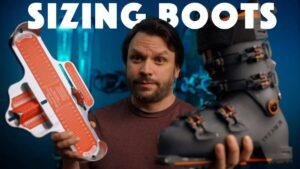
Usually, no—you should not size up in ski boots. Most skiers need a snug fit that holds the heel and ankle in place without causing pain, numbness, or loss of circulation.
Ski boots are not sized like regular shoes. A boot that feels comfortable and roomy in a store may become loose on the mountain. Extra space can let your foot move inside the shell, reduce control, and force you to overtighten the buckles.
For skiers in the United States, the best approach is to use your Mondopoint size, check the shell fit, and have the boots assessed by a qualified ski boot fitter when possible.

How Should Ski Boots Fit?
Ski boots should feel firm, close-fitting, and supportive—not spacious like everyday footwear.
When you first stand in a new boot, your toes may lightly touch the front. Once you bend your knees into a skiing stance, your toes should pull back slightly. Your heel should stay seated, and your foot should not slide from side to side.
A good ski boot fit usually has these traits:
- Your toes lightly touch the end when you stand upright.
- Your toes move back slightly when you flex forward.
- Your heel stays in place when you bend your knees.
- Your ankle and instep feel supported.
- You can flex the boot without sharp pain.
- Your foot does not go numb after several minutes.
- You do not need to crank the buckles tightly to prevent movement.
A ski boot that feels loose can be just as problematic as one that feels too tight. A tight boot may cause pressure points and numbness. A loose boot can create heel lift, delayed turning, blisters, and weak power transfer.
Why ski boots feel smaller than shoes
Ski boots must transfer movement from your legs to your skis. They need a close connection to your feet and lower legs. Running shoes and casual shoes, by contrast, have extra room for walking comfort and foot expansion.
That difference makes ski boots feel unusually snug, especially when you first try them on. A snug feel is not automatically a sign that you need a larger size.
What Does “Sizing Up” Mean in Ski Boots?
Sizing up means choosing a ski boot that is larger than the size suggested by your measured foot length or larger than the size that gives you a proper shell fit.
In the U.S., ski boots are commonly labeled in Mondopoint, often written as “Mondo.” Mondopoint is based on foot length in centimeters.
For example:
- A 26.5 Mondo boot is designed around a foot length of about 26.5 centimeters.
- A 27.5 Mondo boot is about one centimeter longer.
- A half-size often shares the same shell with the full size above it, but may use a different liner or footboard.
The exact fit varies by brand, model, shell shape, liner, and foot width. A 26.5 boot from one brand may not feel the same as a 26.5 boot from another.
Do not convert directly from street shoe size
Your ski boot size may be smaller than your U.S. street shoe size. Street shoes often include extra length, and brands use different sizing systems.
Use your street shoe size only as a rough starting point. Measure both feet instead.
A simple home measurement can help:
- Place a sheet of paper on a hard floor.
- Stand on it with your heel lightly against a wall.
- Mark the end of your longest toe.
- Measure from the wall to the mark in centimeters.
- Repeat for the other foot.
- Use the longer foot as your starting Mondo size.
This measurement does not replace a professional fitting. Foot width, instep height, arch shape, ankle position, and toe shape also affect the result.
How to Tell If Your Ski Boots Are Too Big
The clearest sign of an oversized ski boot is movement inside the shell. Your heel may rise when you flex, or your foot may slide forward when you stop.
Check for these symptoms:
- Your heel lifts noticeably when you bend your knees.
- Your toes hit the front while skiing downhill.
- You must overtighten the top buckles.
- Your ankle moves from side to side.
- You feel delayed when turning.
- You develop blisters around the heel.
- Your feet feel cold because the buckles restrict circulation.
- Your toes curl to keep your foot from sliding.
- Your lower legs feel tired from trying to control the boot.
A common mistake is to solve looseness by tightening the buckles hard. This can compress the top of the foot and reduce blood flow without fixing the extra space inside the shell.
A quick heel-hold test
Put on the boots with the same thin ski socks you plan to wear on the mountain. Buckle them as you would for skiing, then bend your knees forward.
Your heel should remain mostly planted. A small amount of movement can occur, especially with a new liner, but obvious lifting suggests a fit problem.
You can also lift your toes while keeping your heel down. If the boot allows your foot to slide forward and backward easily, it may be too large or may need professional adjustment.
How to Check Ski Boot Size at Home
A home fit check can identify obvious problems, but it cannot replace an in-person fitting for difficult feet, high-performance boots, or persistent pain.
Step 1: Wear the right socks
Use one pair of thin or medium-thin ski socks. Avoid cotton socks and avoid wearing two pairs.
Thick socks do not reliably make a large boot fit better. They can create pressure, reduce warmth by restricting circulation, and hide the real fit problem.
Step 2: Remove the liner
Take the liner out of the shell. Place your foot inside the empty shell with your toes lightly touching the front.
Have someone check the space behind your heel. Many boot fitters use a shell-fit check to estimate length.
A very rough guide is:
- About 10 to 15 millimeters of space: snug performance fit.
- About 15 to 20 millimeters: moderate comfort fit for many recreational skiers.
- More than about 20 millimeters: potentially too large, depending on the shell and skier.
These numbers are guidelines, not universal rules. A race boot, beginner boot, wide boot, and touring boot may require different targets. The shell shape also matters.
Step 3: Put the liner and footbed back in
Put the liner back into the shell and insert the footbed. Stand upright first, then bend forward into a skiing stance.
Your toes may touch the front while standing. They should move away from the front as your knees bend.
Step 4: Buckle without excessive force
Close the buckles with normal pressure. Do not pull them as tight as possible.
Pay close attention to:
- Heel lift
- Pressure over the instep
- Toe contact
- Ankle movement
- Pain or numbness
- Ability to flex forward
Step 5: Wear the boots for 15 to 20 minutes
Walk carefully indoors and stand in a skiing stance. New liners often feel firm, but sharp pain is not something you should ignore.
If your feet become numb, remove the boots and reassess the fit. Do not assume the boots will “break in” enough to correct a major size problem.
Should Beginner Skiers Size Up for Comfort?
Beginner skiers should not automatically size up. They may prefer a softer, more forgiving boot, but the boot still needs to hold the foot securely.
A larger boot can feel comfortable in the rental shop because it allows more room to move. On snow, that space can make turning harder. Beginners often benefit from a boot that is comfortable but close-fitting, rather than one that feels roomy.
For a first pair, focus on:
- A correct length
- A suitable width
- A flex appropriate for your height, weight, and ability
- Easy buckling without over-tightening
- Good heel retention
- No sharp pressure points
Rental boots create an extra challenge because their liners may already be packed out. A rental boot that feels loose may have been used by many skiers. Tell the rental technician if your heel lifts or if you need to tighten every buckle fully.
When a slightly roomier fit may make sense
A comfort-oriented fit can be reasonable for:
- Casual skiers who ski only a few days each season
- Skiers with medical foot concerns
- People who need extra room because of swelling
- Skiers using thick orthopedic footbeds
- Older boots with very dense liners
- Certain touring setups where foot volume changes during long climbs
Even in these cases, the boot should not allow major heel movement. A boot fitter can often create comfort through shell shaping, a better footbed, or a different last instead of simply increasing the length.
What If Ski Boots Feel Too Small?
Do not size up immediately if the boots feel tight. First determine where and when the pressure occurs.
Toes touch the front
Toes touching the front while standing is often normal. Bend your knees forward. If your toes pull back and your heel stays secure, the length may be correct.
If your toes remain jammed against the front while skiing, the boot may be too short, the liner may be positioned incorrectly, or your foot may be sliding forward because the heel is not held well.
The boot feels narrow
A narrow feeling may come from the boot’s last, which is the shape and width of the shell. Moving to a longer boot does not always solve a width problem. It may create extra length while the tight area remains tight.
A boot fitter may be able to:
- Stretch or punch the shell
- Adjust the liner
- Change the footbed
- Select a wider model
- Modify pressure around the instep or ankle
The instep feels compressed
Pressure over the top of the foot can come from the buckle, tongue, footbed, liner, or shell height. Loosen the buckle slightly and check whether the pressure changes.
Do not ski with persistent numbness. It can signal excessive pressure or poor circulation.
Your feet hurt only after skiing
Pain that develops after several runs may result from swelling, poor foot position, cold temperatures, or buckles that are too tight. A professional fitting is worthwhile if the problem continues.
Sharp pain, persistent numbness, color changes, or loss of feeling are reasons to stop using the boots and seek qualified help.
A Simple Ski Boot Sizing Decision Table
Use this table as a starting point, not as a replacement for a shell check.
| What you notice | Most likely issue | What to do |
|---|---|---|
| Toes touch the front while standing but pull back when flexing | Normal close fit | Keep testing heel hold and comfort |
| Heel lifts clearly when flexing | Boot may be too large or too wide | Try a smaller shell or consult a boot fitter |
| Toes stay crushed while skiing | Boot may be too short or foot slides forward | Check shell fit and heel retention |
| Forefoot feels tight but length seems right | Boot may be too narrow | Consider shell work or a wider model |
| You need every buckle very tight | Excess internal space or poor shape | Do not simply tighten more; reassess the fit |
| Feet become numb quickly | Pressure or restricted circulation | Loosen safely, stop if it continues, and get help |
| Boot feels stiff but foot is secure | Flex or liner issue, not necessarily size | Ask about flex and break-in |
| Boot feels loose after several ski days | Liner may be packing out | Consider liner adjustment, volume reduction, or replacement |
The main distinction is between a length problem and a shape problem. Sizing up changes length, but it may not solve pressure caused by width, instep height, or ankle shape.
Can Insoles, Socks, or Liners Fix a Large Ski Boot?
They can improve a small fit issue, but they cannot reliably fix a ski boot that is fundamentally too large.
A supportive footbed may improve alignment and reduce foot movement. A volume-reducing insole or pad may take up a small amount of extra space. A replacement liner can restore hold in an older boot.
However, these fixes have limits:
- Thick socks may create pressure and reduce circulation.
- Extra insoles can change the height of your foot inside the boot.
- Heel lifts may affect stance and ankle comfort.
- Foam pads can alter fit but may not last.
- A new liner cannot always correct an oversized shell.
- A heat-molded liner must be used according to the manufacturer’s instructions.
If the shell is more than one size too large, replacement is often more sensible than adding layers inside the boot. A boot fitter can measure the shell and tell you whether the problem is fixable.
When Should You See a Ski Boot Fitter?
See a professional boot fitter when you have persistent pain, major heel lift, numbness, or uncertainty between sizes.
A boot fitter is especially useful when:
- One foot is larger than the other.
- You have a high instep or unusually wide forefoot.
- You use custom orthotics.
- You have bunions, previous injuries, or foot pain.
- You are buying high-performance or race boots.
- You are replacing boots after several seasons.
- You cannot find a comfortable fit in standard models.
- You are unsure whether to change size, width, or shell shape.
Bring the socks and footbeds you plan to use. Wear the boots long enough for the fitter to see how your feet respond. Fitters can work with shell shape, liner volume, footbeds, buckles, and alignment. They may also recommend a different model rather than a different size.
Do not let a salesperson convince you to accept pain or major movement simply because the boot is expensive. A proper fit matters more than the brand name or the printed size.
Common Mistakes When Choosing Ski Boot Size
Buying the same size as your street shoes
Street shoe sizes vary widely. Use foot length and shell fit instead.
Choosing a large boot for warmth
Cold feet are often caused by poor circulation, wet socks, tight buckles, or an improper liner. A larger boot may make control worse without keeping your feet warmer.
Wearing two pairs of socks
Two pairs can bunch up and restrict circulation. Use one quality ski sock.
Judging fit while standing straight
Ski boots behave differently when you flex. Always test them in a forward skiing stance.
Ignoring the smaller foot
Fit the larger foot first, then use a footbed or minor adjustment for the smaller foot. Do not buy a boot that is too large for both feet just because one foot feels different.
Assuming discomfort is always normal
New boots can feel firm. They should not cause sharp pain, ongoing numbness, or loss of circulation.
Using buckle pressure to hide poor fit
Buckles should secure the boot, not crush the foot. Excessive tightening often points to the wrong size or shell shape.
Buying without checking the return policy
Ski boots can feel different after several minutes than they do in a quick store fitting. Check whether the retailer allows returns before molding or skiing in the boots.
Frequently Asked Questions
Should my toes touch the end of my ski boots?
They may lightly touch the front when you stand upright. When you bend your knees into a skiing stance, your toes should pull back slightly. Constant pressure while flexing may indicate a length or fit problem.
Is it better for ski boots to be tight or loose?
They should be snug, not painfully tight. A secure heel and ankle are essential for control. A loose boot can cause heel lift and poor response, while an overly tight boot can restrict circulation.
Should I size up if I wear thick ski socks?
Usually not. Choose one thin or medium-thin ski sock and fit the boot around that sock. Thick socks can create pressure and make your feet colder.
Do ski boots stretch as you use them?
The liner often compresses with use, and some shells can be modified by a professional. Because the boot may become roomier, do not buy a large boot expecting the fit to improve.
Can I make a ski boot smaller?
A boot fitter may reduce volume with a footbed, liner adjustment, padding, or a replacement liner. These changes work best for small fit problems. They may not correct a shell that is substantially too large.
Key Takeaways
- Do not size up in ski boots just because they feel snug at first.
- Measure your feet in centimeters and use Mondopoint as a starting point.
- Your toes may touch the front while standing but should pull back when you flex.
- Your heel should remain secure without extreme buckle pressure.
- Width and shell shape problems are not always solved by choosing a longer boot.
- Thin ski socks and a proper footbed help more than extra socks.
- Persistent pain, numbness, or major heel lift calls for a professional boot fitting.
Conclusion
For most U.S. skiers, the right answer to “Should I size up in ski boots?” is no—not unless a proper shell and fit check shows that your current size is too short.
Start with your measured foot length, test the boots in a skiing stance, and focus on heel retention, comfort, and control. If the boot feels tight in one area, investigate width and shell shape before choosing a longer size. A snug, well-fitted boot should connect you to the ski without causing pain or cutting off circulation.
Rubel Miah is the Senior Editor at MyStyleGrid.com, where he brings a sharp editorial eye and an unshakable love for fashion to everything he does. A true style addict, Rubel lives and breathes trends, from streetwear to high fashion, and has a knack for turning inspiration into impactful stories. With years of experience in fashion journalism and digital media, he curates content that empowers readers to express themselves through style. When he’s not editing features or forecasting the next big thing, you’ll find him hunting down vintage pieces or capturing street style moments around the city.