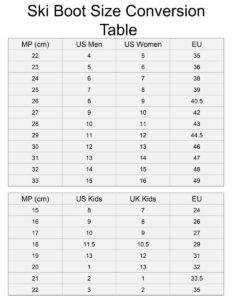
If you wear a US men’s size 10 shoe, you will usually start with a 28.0 or 28.5 mondo ski boot. If you wear a US women’s size 10 shoe, begin with about a 27.0 or 27.5 mondo ski boot.
Ski boots do not use regular US shoe sizing as their main system. They use Mondopoint, often called Mondo sizing. Mondo size is based on foot length in centimeters, so a 28.0 ski boot is made for a foot about 28 centimeters long.
Your final size may change by brand, shell shape, foot width, and how snugly you want the boot to fit. Use your measured foot length—not your street-shoe label—as the starting point.


Quick answer: US size 10 converts to what ski boot size?
For most adult alpine ski boots in the United States, these are useful starting points:
| Regular US shoe size | Approximate Mondo ski boot size | Approximate foot length |
|---|---|---|
| Men’s US 10 | 28.0–28.5 | 28.0–28.5 cm |
| Women’s US 10 | 27.0–27.5 | 27.0–27.5 cm |
| Unisex chart with no gender label | Check the brand chart | Measure first |
These conversions are estimates. A US shoe size is not a precise measurement because shoe brands use different lasts, shapes, and size standards. Ski boots also fit more closely than everyday shoes.
For many men, a US 10 ski boot search will lead to Mondo 28.0. Some brands list the same shell as 28.0/28.5, because ski boots often use one shell for two half sizes.
For many women, a US 10 ski boot search will lead to Mondo 27.0. A wider foot, thick sock, or a brand with different conversion charts may point to 27.5.
What does Mondo Point mean in ski boots?
Mondo Point is the length of your foot in centimeters. A Mondo 28.0 boot is designed around a foot that measures about 28 centimeters from heel to longest toe.
The system is tied to the metric length of the foot, not the length of the boot’s outer shell. The number on the liner or boot label is therefore a sizing guide, not a promise that the inside measures exactly 28 centimeters.
For example:
- Mondo 26.0 is intended for a foot about 26 cm long.
- Mondo 27.0 is intended for a foot about 27 cm long.
- Mondo 28.0 is intended for a foot about 28 cm long.
- Mondo 28.5 is intended for a foot about 28.5 cm long.
Ski boots are commonly made in half-size labels, such as 27.5 or 28.5. However, many models use the same plastic shell for two adjacent sizes. The liner or internal padding may create the difference between the two fit options.
This is why moving from 28.0 to 28.5 does not always mean buying a larger outer shell. In some boots, the change is mainly in the liner thickness or footbed space.


How to measure your ski boot size at home
Measuring both feet is more reliable than converting a street-shoe size. You need a sheet of paper, a pencil, a ruler or tape measure, and the socks you expect to wear while skiing.
Follow these steps:
- Place the paper on a hard, flat floor.
- Stand on the paper with your heel lightly touching a wall.
- Keep your weight evenly balanced on both feet.
- Mark the end of your longest toe. It may be your big toe or your second toe.
- Measure from the edge of the paper at your heel to the toe mark.
- Repeat the process for the other foot.
- Use the longer foot as your starting measurement.
- Convert the result from millimeters to centimeters if needed.
If your longer foot measures 27.8 cm, begin by looking at Mondo 28.0. Do not automatically round up to 28.5. A skilled boot fitter may use the smaller shell and adjust the liner, shell, or footbed if the shape allows it.
Example measurement
Imagine these results:
- Left foot: 27.7 cm
- Right foot: 28.0 cm
- Foot width: 105 mm
Your starting point would be around Mondo 28.0. The width measurement then helps determine whether you need a narrow, medium, or high-volume boot.
Foot length chooses the starting size. Foot shape determines whether that size actually works.
Why your US size 10 shoe may not equal a size 10 ski boot
Regular shoes usually leave extra room in front of the toes. That space helps with walking comfort and allows the foot to move naturally.
Ski boots need a closer fit. Your heel should stay secure, your foot should not slide forward, and your shin should contact the tongue when you flex into the boot. Too much empty space can reduce control and make the boot feel soft or unstable.
A properly fitted new ski boot may feel snug at first. Your toes may lightly touch the front when you stand upright. When you bend your knees and flex forward, your toes should pull back slightly from the front.
This is called the shell-fit effect. The liner compresses with use, so a boot that feels roomy in the store may become too loose after several ski days.
A ski boot that feels tight in one spot is not always too small. The problem may come from:
- A narrow shell shape
- A high instep
- A wide forefoot
- A low or high ankle
- An incorrectly positioned footbed
- A liner that needs heat molding
- Buckles adjusted too tightly
- Socks that are too thick
Do not solve every pressure point by going up a size. A larger shell may remove pressure in one area while creating heel lift and poor control.
US men’s and women’s size 10 ski boot conversion
The answer changes depending on whether the US size 10 refers to a men’s or women’s shoe.


Men’s US size 10
A men’s US 10 shoe commonly converts to approximately:
- Mondo 28.0
- Mondo 28.5, depending on the brand and fit
Start with Mondo 28.0 when your measured foot is close to 28 cm. Consider 28.5 only if your measurement, foot shape, or the manufacturer’s chart supports it.
Women’s US size 10
A women’s US 10 shoe commonly converts to approximately:
- Mondo 27.0
- Mondo 27.5, depending on the brand
Women’s ski boots may also have a different cuff height, heel pocket, liner shape, and flex pattern. Those features affect fit, but they do not replace accurate length and width measurements.
Why the numbers seem different
US men’s and women’s shoe sizes use different scales. A women’s US 10 is not the same physical length as a men’s US 10. That is why using the wrong conversion chart can lead to a boot that is much too large or too small.
Always check whether the chart says US men’s, US women’s, or simply US before choosing a size.
Ski boot size 10 conversion chart
The table below gives a practical starting range. It is not a substitute for the specific brand’s chart or an in-person shell fit.
| US shoe size | Likely Mondo range | Foot-length starting point | Notes |
|---|---|---|---|
| Men’s 9.5 | 27.5–28.0 | About 27.5–28 cm | Check shell length |
| Men’s 10 | 28.0–28.5 | About 28–28.5 cm | Common starting range |
| Men’s 10.5 | 28.5–29.0 | About 28.5–29 cm | Brand charts may differ |
| Women’s 9.5 | 26.5–27.0 | About 26.5–27 cm | Check women’s chart |
| Women’s 10 | 27.0–27.5 | About 27–27.5 cm | Measure both feet |
| Women’s 10.5 | 27.5–28.0 | About 27.5–28 cm | Width still matters |
The most useful column is foot length. The US shoe size is only a rough reference.
If you are buying used boots, inspect the actual Mondo marking, shell size, liner condition, and model year. A worn liner can make a correctly sized boot feel much larger.
How ski boot width affects a size 10 fit
Length alone does not determine comfort. Ski boot manufacturers also describe fit by last width, which is the approximate width of the boot’s forefoot area.
Common categories include:
- Narrow fit: often about 96–98 mm
- Medium fit: often about 98–102 mm
- Wide or high-volume fit: often about 102–106 mm or more
These ranges are general. Brands measure lasts in different ways, and the same listed width can feel different because of the toe box, instep height, liner, and shell shape.
For a Mondo 28.0 boot, a 98 mm last may feel very different from a 104 mm last. If your foot is wide, choosing a longer boot may create too much empty space without solving the pressure across the forefoot.


A better approach is to choose the correct length first, then match the boot’s width and volume to your foot. A boot fitter can also make some shells wider through professional boot work.
How to tell if a size 10 ski boot fits correctly
A correctly sized boot should hold your foot firmly without causing numbness, sharp pain, or loss of circulation.
Check the fit in this order:
1. Check the toe position
Stand upright with your heel seated. Your toes may gently touch the front of the liner.
Now bend your knees and flex forward as if skiing. Your toes should move slightly away from the front. If your toes stay jammed against the shell while flexed, the boot may be too short.
2. Check the heel
Your heel should remain mostly planted when you flex forward. A small amount of movement may be normal, especially in a new liner, but obvious lifting can reduce control.
Heel lift may come from:
- A shell that is too large
- A loose ankle pocket
- Poor buckle adjustment
- A missing or incorrect footbed
- A packed-out liner
3. Check the instep and forefoot
The boot should feel firm across the foot, not painfully tight. Numbness, tingling, or cold toes are warning signs.
Loosen the buckles and walk around for a few minutes. If the pain remains sharp or your foot loses feeling, stop and reassess the fit.
4. Check the shin and cuff
Your shin should make even contact with the boot tongue. The cuff should not cut into one side of your leg or create a painful gap on the other side.
Ski socks should be thin, smooth, and free of folds. Thick socks often make a boot feel too small without improving warmth.
Common mistakes when choosing a size 10 ski boot
The most common mistake is choosing ski boots by the number printed on everyday shoes. Street-shoe sizing varies too much to provide a reliable final answer.
Other mistakes include:


- Buying a boot one or two sizes larger for comfort
- Wearing thick socks to fill extra space
- Ignoring the longer foot
- Confusing US men’s and women’s charts
- Assuming every 28.0 boot has the same internal fit
- Testing boots only while standing upright
- Ignoring width and instep height
- Buying based only on the boot’s flex rating
- Assuming a painful boot will always “break in”
- Treating numb toes as normal
A liner can soften and pack out over time, but it cannot fix every shell mismatch. Severe pressure, persistent numbness, or circulation problems deserve attention from a qualified ski boot fitter.
What to do if a size 10 ski boot feels too tight or too loose
If the boot feels too tight, first identify where the pressure occurs.
Tight at the toes
Check whether your heel is fully seated and whether the boot is too short. Do not rely on a larger size until you complete a shell fit.
Tight across the forefoot
The boot may be too narrow or too low in volume. A wider model or professional shell work may help.
Tight over the top of the foot
The instep may be too low for the boot. A footbed, liner adjustment, or shell modification may improve the fit.
Loose at the heel
The shell may be too large, or the heel pocket may not match your foot. A footbed and proper shell fit should be checked before adding random padding.
Loose after several ski days
The liner may have packed out. A boot fitter can assess whether the liner can be adjusted or whether the shell is simply too large.
Do not drill, grind, heat, or reshape a ski boot at home unless you understand the risks. Poor modifications can damage the shell or change how the boot holds your foot.
Do ski boot brands size the same?
No. Mondo sizing gives brands a common length reference, but brands can differ in shell shape, liner volume, last width, cuff design, and conversion charts.
A 28.0 boot from one brand may feel shorter, wider, lower, or tighter than a 28.0 boot from another brand. Even two models from the same brand can fit differently.
Use this order when comparing boots:
- Measure your longer foot.
- Confirm the brand’s Mondo chart.
- Compare last width and volume.
- Check the shell size.
- Test the boot with thin ski socks.
- Perform a shell fit if possible.
- Have a boot fitter adjust the fit before moving to a larger size.
The label provides a starting point. The shell and your foot provide the real answer.


Can you use a regular shoe size to buy ski boots online?
You can use a regular shoe size to narrow your search, but you should not use it as the final size decision.
For a US men’s size 10, begin by checking Mondo 28.0 and 28.5. For a US women’s size 10, begin with Mondo 27.0 and 27.5. Then compare your measured foot length with the manufacturer’s chart.
Before ordering online, check:
- The retailer’s return policy
- Whether the boot is new or used
- The brand’s size chart
- The listed last width
- The shell size
- Whether the liner is heat moldable
- Whether professional fitting is available nearby
Many ski boots cannot be returned after heat molding or skiing. Try them indoors and follow the seller’s return conditions.
Frequently asked questions
Is a men’s size 10 the same as a 28.0 ski boot?
Not always, but Mondo 28.0 is a common starting point for a US men’s size 10. Your measured foot length and the brand’s chart should decide between 28.0 and 28.5.
Is a women’s size 10 the same as a 28.0 ski boot?
Usually not. A US women’s size 10 often starts around Mondo 27.0 or 27.5. A 28.0 boot may be too long unless your measured foot supports it.
Should ski boots be the same size as regular shoes?
No. Ski boots use Mondo sizing and should fit more closely than regular shoes. Your everyday shoe size is only a rough guide.
Should your toes touch the front of ski boots?
Your toes may lightly touch the front when you stand upright. When you flex forward, they should pull back slightly. Constant toe pressure while skiing can indicate that the boot is too short or that your heel is not seated correctly.
Is 28.5 bigger than 28.0 in ski boots?
Usually, yes, but the difference may be small. Some brands use one shell for 28.0 and 28.5, with changes mainly in the liner or internal fit. Check the model’s shell-size chart.
Final answer: what size ski boot should a US size 10 wear?
A US men’s size 10 should usually begin with a Mondo 28.0 or 28.5 ski boot. A US women’s size 10 should usually begin with a Mondo 27.0 or 27.5 ski boot.
Measure both feet, use the longer measurement, and compare it with the exact brand’s chart. Then check width, instep height, heel hold, and shell fit. If the boot causes numbness, sharp pain, or major heel lift, stop sizing up blindly and ask a qualified ski boot fitter to assess the fit.
Madison Clark is a footwear expert and the voice behind MyStyleGrid.com. She specializes in honest shoe reviews, style tips, and practical guides to help readers find the perfect pair for any occasion. With years of experience in blogging and content creation, Madison makes footwear knowledge simple, stylish, and easy to follow.