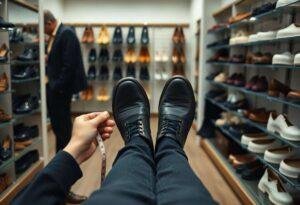
The best way to know if your shoes fit is to check length, width, toe room, heel hold, and comfort while standing and walking. Your toes should not touch the front, your heel should stay mostly in place, and the shoe should not pinch, rub, or force your foot into an odd position.
If you are buying shoes in the United States, do not rely on the number printed on the box alone. U.S. shoe sizes can vary by brand, style, and gender category. Fit matters more than the size label.
Introduction
A well-fitting shoe should feel comfortable when you first try it on. You should not need to “break in” severe pressure, pain, numbness, or rubbing. Shoes may soften with use, but they should not need to change shape to make room for your foot.
Try shoes later in the day, when feet may be slightly larger than in the morning. Wear the socks, braces, or orthotics you plan to use with the shoes. Then stand, walk, bend, and check both feet before you decide.

The Quick Fit Test
Use this short test before you buy or keep a pair of shoes:
- Stand up in both shoes. Feet spread and lengthen under body weight.
- Check the longest toe. Leave about 3/8 to 1/2 inch of space between it and the end of the shoe.
- Check the width. Your foot should not bulge over the sole or feel squeezed at the sides.
- Move your toes. You should be able to wiggle them without pressing against the upper.
- Check the heel. A small amount of movement may be normal, but your heel should not slide up and down with every step.
- Walk on a firm surface. Look for pressure, rubbing, slipping, or pain.
- Compare both feet. Fit the larger foot. Most people have one foot that is slightly longer or wider.
The 3/8- to 1/2-inch space is a useful guide, not a medical rule. Some shoes need more room, such as running shoes or winter boots. Other shoes, such as snug climbing shoes, follow different design goals. For everyday shoes, comfort and natural movement should guide the final choice.
How Much Room Should Be at the Front?
Your longest toe should sit short of the shoe’s end. For many everyday shoes, about half an inch of space gives the foot room to move without letting it slide too far forward.
Do not judge this space while sitting. Stand up and press down on the front of the shoe, or remove the insole and stand on it if the insole is removable. Your longest toe should not hang over the insole or touch its edge.
Your longest toe may be your second toe rather than your big toe. Check both feet. A shoe that fits the shorter foot may press against the longer one.
Signs the shoe is too short
- Your toes touch the front when you stand.
- Your toes curl or claw to make room.
- You feel pressure under or around the toenails.
- Your foot slides forward and jams into the toe box.
- You develop blisters or sore spots at the toes.
- Your toes feel numb after walking.
A short shoe can create repeated pressure. Over time, that pressure may contribute to blisters, thick nails, corns, or other foot problems. Do not expect a shoe to stretch enough to fix a serious length problem.
Signs the shoe is too long
- Your foot slides forward during each step.
- Your heel lifts sharply.
- You need to over-tighten the laces.
- Your toes grip the floor inside the shoe.
- Your foot feels unstable on turns or stairs.
If the length seems right but the shoe feels loose, try a different width, lacing method, or shoe shape. Do not solve a loose heel by choosing a much shorter shoe.
How Can I Tell If the Shoe Is Wide Enough?
A shoe fits the width when your foot rests naturally on the sole without side pressure. The upper should touch your foot lightly, but it should not create a tight band across the ball of your foot.
The widest part of your foot should line up with the widest part of the shoe. This point is often near the ball of the foot. If the shoe bends far behind the ball of your foot, the shape may not match your foot.
A shoe may be too narrow if:
- Your little toe presses against the side.
- Your forefoot bulges over the edge of the sole.
- You feel pressure across the ball of the foot.
- The upper leaves red marks after a short walk.
- Your toes overlap or cannot spread.
- The shoe causes burning, tingling, or numbness.
A wider shoe is not always the answer. Some feet are wide in the front but narrow at the heel. In that case, look for a shoe with a roomy toe box and a secure heel, rather than simply sizing up.
A shoe may be too wide if:
- Your foot slides from side to side.
- The shoe creases in the wrong place.
- You must tighten the laces until they press into the top of your foot.
- Your heel slips even when the shoe is tied.
- You feel unstable while walking.
U.S. widths use letters and labels that vary by brand. “Wide” in one model may not feel the same as “wide” in another. Try the actual shoe whenever possible.
How Should the Heel Fit?
Your heel should stay mostly in place while you walk. A small amount of heel movement can happen in a new shoe, especially in a stiff boot. Excess movement can cause blisters and may make you change the way you walk.
Tie the shoe in your normal way. Walk several steps, climb stairs if possible, and stop quickly. The heel should not pop out with every step.
A heel that feels loose may result from:
- A shoe that is too wide.
- A heel cup that is too large.
- A long shoe that lets your foot slide forward.
- Laces that do not hold the midfoot.
- Socks that are too smooth or thin.
- A shoe shape that does not match your heel.
Try the “heel-lock” or “runner’s loop” lacing method if the shoe has suitable eyelets. This can reduce heel movement without crushing the front of the foot. If the heel still slips, choose a different shape rather than tightening the laces until your foot feels numb.
A little movement is less concerning if there is no rubbing and the shoe remains stable. Painful or repeated friction means the fit needs attention.
How Should Shoes Fit Across the Top of the Foot?
The top of the shoe should hold your foot without pressing hard on the tendons or bones. You should be able to slide a finger under the laces or straps with light pressure, though the exact amount depends on the shoe.
Pressure across the top may come from:
- A low shoe opening.
- Laces tied too tightly.
- A high instep.
- Swelling.
- A tongue or seam in the wrong place.
- A shoe with too little volume.
Loosen the laces near the pressure point and walk again. If the pressure remains, try a shoe with more vertical room. Do not ignore numbness or sharp pain simply because the shoe is the correct length.
Shoes with adjustable laces, straps, or stretchy uppers can help when foot size changes during the day. They should still hold the foot securely. Stretch alone should not be used to excuse painful compression.
How Do I Check the Fit at Home?
You can test most shoes at home if the retailer allows returns. Wear clean socks and walk on a clean indoor surface.
Follow these steps:
- Measure both feet. Trace or measure them while standing, preferably later in the day.
- Put on both shoes. Use your usual socks, inserts, or braces.
- Stand for one minute. Notice pressure, balance, and toe position.
- Walk for five to ten minutes. Use stairs or a firm floor if available.
- Bend and turn. Check whether your foot slides or the shoe folds into your toes.
- Remove the shoes. Look for red marks, hot spots, or pressure lines.
- Repeat later. A shoe that feels fine for one minute may feel tight after longer wear.
Do not use pain as a test. If the shoe causes discomfort during the first fitting, stop and reassess. A new shoe may feel firm, but it should not cause sharp pain, tingling, numbness, or a growing hot spot.
When Should You Measure Your Feet?
Measure your feet when you are shopping for a new type of shoe or when your foot size may have changed. Feet can change with age, pregnancy, injury, weight changes, swelling, and some health conditions.
For the most useful measurement:
- Measure while standing.
- Measure both feet.
- Measure near the end of the day.
- Wear the socks you will use.
- Record length and width.
- Use the brand’s size chart as a starting point.
A store employee can measure your feet with a device, but the measurement is only a starting point. Your foot shape, the shoe’s construction, and your intended activity still affect fit.
Do not assume that a size 9 in one U.S. brand equals a size 9 in another. Shoe sizes are not perfectly uniform across brands or styles. Use the size label to narrow your choices, then judge the actual fit.
How Should Running Shoes Fit?
Running shoes usually need more front room than casual shoes because feet may swell and move during longer activity. Many runners prefer about a thumb’s width between the longest toe and the end of the shoe, but the best amount depends on your foot, distance, and shoe design.
A running shoe should:
- Hold the heel without painful slipping.
- Let the toes spread.
- Avoid pressure on the top of the foot.
- Bend near the ball of the foot.
- Stay secure when walking and jogging.
- Feel comfortable with your running socks.
Try running shoes later in the day and with the socks you use for training. Jog briefly if the store or return policy permits. Pay attention to toenail pressure, forefoot burning, heel rubbing, and sliding on downhills.
Do not choose a running shoe only because it feels tight and secure at the heel. A tight toe box can become painful during longer runs.
How Should Work Boots, Hiking Shoes, and Dress Shoes Fit?
Different shoes have different fit needs, but none should cause pain.
Work boots
Work boots should leave enough room for your toes to move while keeping the heel secure. Check the fit with your work socks. If you use safety-toe boots, make sure the toe cap does not press on your toes when you stand.
A safety toe should protect the toes without touching them. If the cap causes pressure, try another size, width, or toe shape.
Hiking shoes
Hiking shoes should hold the heel and midfoot while leaving room in front of the toes. Walk downhill or use a ramp if possible. Your toes should not strike the front as your foot moves forward.
Lace the lower and upper sections separately when the shoe allows it. This can provide toe room while keeping the heel secure.
Dress shoes
Dress shoes should not be painful to look narrow or sleek. Check the toe box while standing. Pointed styles often provide less room than rounded or square designs.
If a dress shoe pinches, causes numbness, or forces your toes together, a different shape is safer than simply wearing it for short periods.
What If My Shoes Feel Tight but the Size Seems Right?
The problem may be shape rather than length. A shoe can have enough length but too little width, depth, or toe-box volume.
Try these changes in order:
- Remove thick insoles, if the shoe allows it.
- Adjust the laces around the pressure point.
- Try a wider or higher-volume model.
- Try a different toe shape.
- Compare another brand or style.
- Stop wearing the shoe if pain or numbness continues.
Do not use a shoe stretcher to solve a shoe that is too short. Stretching may create a little more width in some materials, but it will not reliably add useful length or correct a poor shape.
If one foot needs a different size, fit the larger foot. You may be able to use a thin insert or heel grip for the smaller foot, but it should not create new pressure.
Common Shoe-Fit Mistakes
Choosing the size you usually wear
A familiar size is only a starting point. Brand patterns and shoe shapes differ.
Trying on only one shoe
Your feet may not match exactly. Always try both shoes and fit the larger foot.
Shopping while sitting
Feet spread when you stand. Test shoes under body weight.
Ignoring the toe box
A shoe can feel soft while still pressing the toes. Move and spread your toes before deciding.
Expecting painful shoes to break in
Mild stiffness may improve. Pain, numbness, and rubbing are warning signs, not normal steps.
Wearing the wrong socks
Thick socks can make a shoe feel too small. Thin socks can hide a loose fit. Test with the pair you plan to wear.
Tightening laces to fix every problem
Laces can improve heel hold, but they cannot correct a shoe that is too long, too wide, or the wrong shape.
Judging fit by appearance
A stylish shoe may still be a poor match for your foot. Comfort, stability, and room matter more than a narrow silhouette.
When Should You Stop Wearing a Pair?
Stop wearing the shoes and reassess if you develop persistent pain, blisters, numbness, tingling, skin damage, or swelling. A mark that fades quickly may result from normal contact, but repeated marks show that the shoe is applying pressure or friction.
If you have diabetes, reduced feeling in your feet, poor circulation, neuropathy, or a history of foot ulcers, take pressure and skin changes seriously. Check your feet after wearing new shoes and ask your clinician or podiatrist for personal guidance. Reduced sensation can make a harmful fit harder to notice.
Seek prompt medical care for an open sore, spreading redness, warmth, drainage, severe swelling, or pain that does not improve. General shoe-fitting advice cannot diagnose the cause of foot pain.
Key Takeaways
- Fit shoes by comfort and function, not by the size number alone.
- Try shoes while standing and later in the day.
- Leave room for the longest toe, usually about 3/8 to 1/2 inch in everyday shoes.
- Make sure the width does not pinch or let the foot spill over the sole.
- Keep the heel secure without painful pressure.
- Try both shoes and fit the larger foot.
- Do not rely on painful “break-in” time.
- For persistent pain, numbness, skin damage, diabetes, or reduced feeling, seek professional advice.
FAQs
Should my toes touch the end of my shoes?
No. Your toes should not touch the front when you stand or walk. Leave a small gap, often about 3/8 to 1/2 inch for everyday shoes. Running shoes and boots may need more room, especially for long use or downhill walking.
Is some heel slipping normal in new shoes?
A small amount can be normal, especially in stiff boots. Repeated or painful slipping is not a good fit. Try different lacing, socks, or a shoe with a better heel shape.
Should shoes feel tight at first?
They may feel firm, but they should not cause pain, numbness, tingling, or rubbing. Do not count on severe tightness improving with wear.
How do I know if shoes are too wide?
Your feet may slide from side to side, your heel may lift, or you may need to over-tighten the laces. Try a narrower width or a shoe with a more secure heel rather than choosing a shorter size.
Do shoe sizes differ between brands?
Yes. U.S. shoe sizing is not perfectly consistent between brands and styles. Use the brand’s chart, measure both feet, and judge the fit while standing and walking.
Can I make shoes fit better with insoles?
Sometimes. An insole can change volume and support, but it may make a tight shoe tighter. Test the complete setup—shoe, insole, socks, and braces—before wearing it for long periods.
Conclusion
You know your shoes fit when your toes can move, the longest toe has space in front, the sides do not pinch, and your heel stays secure as you walk. Test both shoes while standing, use your normal socks and inserts, and pay attention to how your feet feel after several minutes.
If a pair causes pain, numbness, repeated rubbing, or skin damage, choose a different fit instead of forcing the shoe to work. Your next step is simple: try on both shoes later in the day and walk long enough to test comfort, room, and stability.
Rubel Miah is the Senior Editor at MyStyleGrid.com, where he brings a sharp editorial eye and an unshakable love for fashion to everything he does. A true style addict, Rubel lives and breathes trends, from streetwear to high fashion, and has a knack for turning inspiration into impactful stories. With years of experience in fashion journalism and digital media, he curates content that empowers readers to express themselves through style. When he’s not editing features or forecasting the next big thing, you’ll find him hunting down vintage pieces or capturing street style moments around the city.