Shine a UV light through the lens or ask an optician to test.
You want to know how to test sunglasses for UV protection without guesswork. I’ve spent years fitting and testing eyewear for athletes and travelers. In this guide, I’ll show you how to test sunglasses for UV protection the right way. You’ll see simple checks, pro-grade methods, buying tips, and real lessons learned. If you care about your eyes, this is worth a few minutes.

Why UV protection matters
UV light harms eyes over time. UVB can burn the cornea fast. UVA goes deeper and adds to cataracts and macular damage. Dark lenses without UV defense are risky because pupils open wider and let in more UV.
Good sunglasses should block 99 to 100 percent of UVA and UVB. Look for UV400 on the label. That means it stops light up to 400 nm. That covers the full UVA and UVB range.
Trusted standards help too. ANSI Z80.3 and ISO 12312-1 set lab rules for UV tests. Lenses that meet these pass strict checks. If you want a simple rule, buy UV400 and verify.
This is the heart of how to test sunglasses for UV protection. We will use that phrase a lot so you see each method in context.

What counts as proper UV protection
Not all features protect from UV. Color and darkness do not prove UV safety. Polarization cuts glare, not UV. Mirror coatings help with glare and heat, but they are not a UV pass.
Look for these signs of real UV defense:
- UV400 label: Blocks up to 400 nm. This is ideal.
- Standard marks: ANSI Z80.3, ISO 12312-1, AS/NZS 1067. Good signs of lab tests.
- Brand data sheet: Look for UVA/UVB 99 to 100 percent blocked.
- Retail test station: Some stores have a UV meter at the counter.
When you learn how to test sunglasses for UV protection, you learn what to ignore. Do not trust only a dark tint, a fancy mirror, or a high price.
Quick at-home checks you can do now
These checks do not prove UV safety on their own. But they help spot fakes and poor build. Think of them as filters before a real test.
Try these:
- Read the label closely: Look for UV400 or 100% UV protection and a standard mark. If it says only “blocks glare,” be careful.
- Check polarization with a phone: Rotate the glasses over your phone screen. It should darken at about 60 to 90 degrees if polarized. This is not a UV test, but it checks one real feature.
- Inspect lens reflections: Good lenses often show green or purple reflections from quality coatings. Not proof. But cheap coatings show odd, uneven tints.
- Look for sloppy build: Rough edges, paint bleed, and loose hinges are red flags. Quality makers also care about UV.
- Compare comfort outdoors: If your eyes still squint in bright sun, the tint may be cosmetic. That raises a flag to test further.
These steps help when you ask how to test sunglasses for UV protection at home. Use them to spot junk before you spend time or money on a lab test.

Reliable methods: how to test sunglasses for UV protection with tools
If you want real answers, use real tools. Here are methods I trust, ranked by accuracy and ease.
Method 1: Ask an optician to test
- Most opticians have a lensmeter or spectrophotometer with a UV unit.
- They can read UVA and UVB transmission across the spectrum.
- Many will do it in minutes. Some will print or show the result.
Method 2: Handheld UV meter at home
- Buy a meter that reads UVA and UVB transmission for lenses.
- Measure baseline UV from the source. Then measure with the lens in place.
- Look for 0 to 1 percent transmission or 99 to 100 percent blocked.
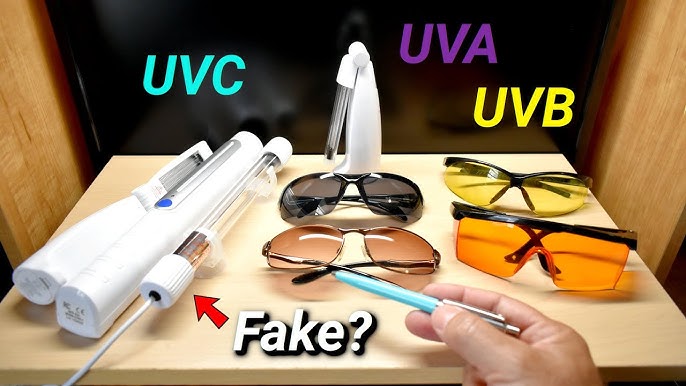
Method 3: UV flashlight plus UV-reactive target
- Use a 365 nm UV flashlight and a UV-reactive card or UV beads.
- Shine the light on the card without the lens to see it glow or change.
- Place the sunglass lens between the light and the card.
- If the effect drops a lot, the lens blocks UVA. This is a strong clue, not a lab grade number.
Note: Phone apps cannot detect UV. Phone cameras have UV filters. A “UV test card” is useful with a real UV light, but it does not give you a percent rating. It is still one of the best cheap checks for how to test sunglasses for UV protection at home.

Step-by-step: visiting an optician or lab
A pro test is fast and clear. Here is what to expect.
- Call first: Ask if they can test sunglasses for UV and if there is a fee.
- Bring your glasses clean: Wipe dust so the reading is not affected by grime.
- Ask for numbers: You want UVA and UVB transmission, or a pass against a standard.
- Confirm UV400: Ask if protection reaches 400 nm. Some labels stop at 380 nm, which misses part of UVA.
- Keep records: Take a photo of the result or get a note.
This is the gold standard for how to test sunglasses for UV protection. It gives clear numbers you can trust.
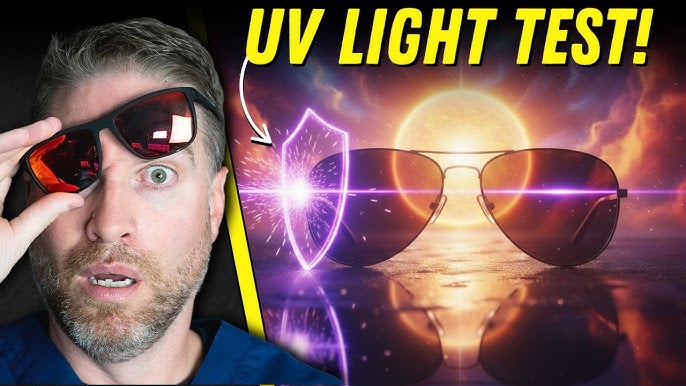
Using a handheld UV meter at home
You can get good repeatable results with the right meter. Set up matters a lot.
Follow this simple process:
- Choose a stable UV source: A 365 nm UVA flashlight works well. Keep distance fixed.
- Get a baseline reading: Measure UV at a set distance with no lens.
- Place the lens: Hold the sunglass lens between the light and the sensor.
- Read transmission: Aim for 0 to 1 percent. Repeat three times and average.
- Validate the setup: Test a known good lens and a known bad sample to check your system.
Limitations: This reads at one wavelength. UV protection should cover the full UVA and UVB band. Still, it is a very practical way for how to test sunglasses for UV protection without a lab.

Red flags and common myths
There is a lot of bad advice online. Here is what to avoid.
- Myth: Dark lenses always protect from UV. Reality: Darkness affects visible light only.
- Myth: Polarized means UV safe. Reality: Polarization reduces glare. It is not a UV filter.
- Myth: Expensive equals safe. Reality: Many low-cost models meet standards. Some luxury fakes do not.
- Myth: Blue light test cards prove UV safety. Reality: Blue light is not UV.
- Myth: Mirror coatings guarantee UV. Reality: Mirrors reflect visible and near IR. They are not proof.
If you keep asking how to test sunglasses for UV protection the right way, you will skip these traps.
Care and maintenance that affect UV protection
UV protection is often in the lens material, not just the coating. But some budget lenses rely on a coating. Care still matters.
Do this:
- Clean with mild soap and water: Avoid ammonia and strong cleaners that can strip coatings.
- Use a soft microfiber cloth: Paper towels scratch lenses.
- Avoid high heat: Car dashboards can reach high heat that warps coatings and frames.
- Store in a case: Scratches can expose areas if UV protection is coating-based.
If you are unsure how to test sunglasses for UV protection after years of use, retest them. It takes minutes and gives peace of mind.
Buying guide checklist to avoid testing hassles
You can skip a lot of testing by buying smart.
Use this checklist:
- Look for UV400 or 100% UVA/UVB on the lens or spec sheet.
- Check for standards like ANSI Z80.3 or ISO 12312-1.
- Buy from a trusted retailer with a return policy.
- Ask if the store can test UV on-site.
- Prefer brands that publish lab results.
This is the easiest path for how to test sunglasses for UV protection without stress. Good sourcing is half the job.
Real-world stories and pro tips
I once tested two pairs that looked identical. One was a gift from a street market. The other was a mid-range brand. The market pair was very dark but failed a UV meter at 360 to 400 nm by a wide margin. My client thought dark meant safe. It did not.
Another time, a cyclist’s old lenses passed a quick UV card test but failed at the edges under a lab meter. The center was fine. The edges had micro cracks. We replaced them. If you ride or ski, retest each season. This is a smart way for how to test sunglasses for UV protection when gear takes a beating.
Pro tips:
- Keep a small 365 nm UV light in your travel kit with a UV-reactive card.
- Ask your local optician for a five-minute check each year.
- If the result is unclear, do not guess. Your eyes work hard for you. Treat them well.
Frequently Asked Questions of how to test sunglasses for uv protection
How can I quickly check if my sunglasses block UV?
Shine a 365 nm UV light at a UV card with and without the lens. If the effect drops a lot with the lens, it likely blocks UVA. For a precise result, visit an optician.
Do polarized lenses mean UV safe?
No. Polarization cuts glare from water, roads, and snow. It does not prove UV protection.
What does UV400 mean?
UV400 blocks wavelengths up to 400 nm. That covers both UVA and UVB for full protection.
Can I use a phone app to test UV?
No. Phone sensors and cameras filter out UV. Use a UV meter, a UV flashlight with a reactive card, or see an optician.
Will scratches ruin UV protection?
If UV defense is in the lens material, small scratches may not reduce UV blocking. If it’s a surface coating, deep scratches can expose unprotected areas.
Do darker lenses protect better from UV?
Not by default. Darkness affects visible light only. UV protection depends on the lens material and coatings.
How often should I retest my sunglasses?
Test when you buy, then once a year, or after heavy use or heat exposure. A quick check takes minutes and prevents risk.
Conclusion
Testing sunglasses is simple when you know what to do. Use a UV meter or a 365 nm light with a UV card for quick checks. When in doubt, ask an optician for a lab-grade read. Aim for UV400 and look for trusted standards to stay safe.
Take the next step today. Pick one pair you wear most and test it this week. If you found this guide on how to test sunglasses for UV protection helpful, share it, subscribe for more field-tested tips, or leave a question and I’ll help you choose the best path.

Rubel Miah is the Senior Editor at MyStyleGrid.com, where he brings a sharp editorial eye and an unshakable love for fashion to everything he does. A true style addict, Rubel lives and breathes trends, from streetwear to high fashion, and has a knack for turning inspiration into impactful stories. With years of experience in fashion journalism and digital media, he curates content that empowers readers to express themselves through style. When he’s not editing features or forecasting the next big thing, you’ll find him hunting down vintage pieces or capturing street style moments around the city.