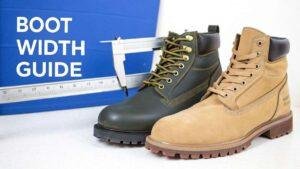
Boot width is determined by measuring the widest part of your foot and matching that measurement with the boot brand’s U.S. width chart. For the best fit, measure both feet while standing, wear the socks you plan to use, and check the brand’s width code—such as B, D, EE, or 4E.
A boot should hold your heel in place, let your toes move, and feel snug across the widest part of your foot without pressure or numbness. Width labels can vary by brand, so your measurement is a starting point, not a guarantee.

What Do Boot Width Letters Mean?
Boot width letters describe how much room a boot has across the forefoot. The same letter does not always mean the same physical width in every brand, boot style, or U.S. size.
Common U.S. boot width codes include:
| Width code | Common men’s meaning | Common women’s meaning |
|---|---|---|
| AAA or 3A | Extra narrow | Very narrow |
| AA or 2A | Narrow | Narrow |
| A | Narrow in some brands | Narrow in some brands |
| B | Narrow in many men’s boots | Standard or medium |
| C | Medium or wide, depending on brand | Wide in some brands |
| D | Standard or medium | Wide in many brands |
| E | Wide | Extra wide in some brands |
| EE or 2E | Wide to extra wide | Extra wide |
| EEE or 3E | Very wide | Very wide |
| 4E | Extra wide | Extra wide in some brands |
For men’s boots, D is often the standard width. For women’s boots, B is often the standard width. These are common U.S. conventions, not universal rules.
A brand may label a boot as wide, but still use a different code system. Some companies use “W,” “XW,” or “EW” instead of E widths. Always check the manufacturer’s chart for the exact boot model.
Width is not the same as the toe-box shape
A boot can have a wide measurement at the ball of the foot but still feel tight at the toes. This happens when the boot has a pointed or tapered toe box.
Boot shape also affects fit:
- Round toe: Usually gives moderate room for the toes.
- Square toe: Often gives more space across the front.
- Pointed toe: May feel narrow even in a wide width.
- Moc toe: Can have a roomy front, but the fit depends on the last.
- Safety toe: Has a firm toe cap that does not stretch like leather.
The last is the form used to shape a boot. It controls the boot’s length, width, arch shape, heel fit, and toe shape. Two boots with the same marked width can feel very different because they use different lasts.
How to Measure Your Boot Width at Home
You can measure your foot width at home with paper, a pen, a ruler, and the socks you will wear with the boots. Measure late in the day because feet often expand after walking and standing.
What you need
Gather:
- Two sheets of paper larger than your feet
- A pencil or pen
- A ruler or tape measure
– The socks you plan to wear - A hard, flat floor
- Someone to help trace your foot, if possible
Avoid measuring on carpet. Soft flooring can change how much your foot spreads.
Follow these steps
-
Put on your boot socks.
Use the socks you expect to wear. Thick work socks can change the fit. -
Place one foot on the paper.
Stand with your weight spread evenly over both feet. Do not measure while sitting. -
Trace the foot.
Keep the pen upright rather than angled under the foot. A tilted pen can make the outline too large. -
Mark the widest points.
The widest part is usually across the ball of the foot, near the base of the big toe and little toe. -
Measure straight across.
Measure from the widest point on the inside edge to the widest point on the outside edge. Do not follow the curve of the tracing. -
Repeat for the other foot.
Most people have one foot that is slightly longer or wider. -
Record the larger measurement.
Choose boots that fit the larger foot. A small difference is common, but a major difference may need professional fitting or an insert.
Do not pull the tape around your foot
For a basic width measurement, measure the straight distance across the forefoot. Wrapping a tape around the foot measures girth, or circumference. Girth can be useful, but it is not the same as width.
Some boot makers provide both width and ball-girth information. If they do, follow that brand’s instructions. Otherwise, use the flat width measurement and the brand’s size chart.
How to Match Your Measurement to a Boot Width Chart
Your measured width must be compared with the chart for your foot length and the specific boot brand. A width measurement by itself does not identify a U.S. width letter.
For example, a foot that measures 4 inches wide may need a different width in a small shoe size than in a large shoe size. As shoe length increases, the standard width also changes. That is why a fixed rule such as “4 inches equals wide” can lead to a poor fit.
Use this process:
- Measure your foot length and width.
- Find the brand’s U.S. size chart.
- Locate your foot length in the chart.
- Compare your width with the listed values.
- Check whether the chart refers to men’s, women’s, or unisex sizing.
- Confirm the width option for the exact boot model.
- Read the brand’s fit notes for toe shape, arch height, and recommended socks.
A hypothetical example
Suppose your larger foot measures:
- 10.6 inches long
- 4.2 inches wide
You should not assume that this equals D, EE, or another width. Instead, find the 10.6-inch length row in the brand’s chart. If the chart lists 4.2 inches as standard, choose the standard width. If it lists 4.2 inches as wide, choose wide.
This method matters because width codes are relative to shoe length and the brand’s design.
Use the brand’s chart over a general chart
A general U.S. width chart can help you understand the letters. It should not replace the manufacturer’s chart.
The Brannock Device measures foot length, width, and arch length. It is widely used in shoe fitting, but a boot brand may build its product on a shape that differs from the Brannock measurement. Treat the device or chart as a strong starting point, then confirm the fit by trying on the boots.
How Boots Should Feel When the Width Is Correct
A correctly sized boot should feel secure without squeezing the foot. The widest part of your foot should sit near the widest part of the boot.
Look for these signs:
- Your toes can spread and move slightly.
- The sides of your forefoot touch the boot without painful pressure.
- Your little toe does not press against the sidewall.
- Your foot does not slide over the edge of the sole.
- Your heel stays mostly in place when you walk.
- You do not feel burning, tingling, or numbness.
- The boot does not leave deep, painful marks after wear.
Some heel movement can occur in a new lace-up boot, especially during the break-in period. However, severe heel slip can mean the boot is too large, too wide, or shaped poorly for your heel.
Signs the boot is too narrow
A boot may be too narrow if:
- The ball of your foot feels pinched.
- Your little toe is pushed inward.
- Your toes overlap or feel crowded.
- The sides of your foot bulge over the sole.
- Your feet go numb after a short walk.
- The boot creates hot spots near the widest part of the foot.
- You cannot wear normal socks without pressure.
Leather may soften with use, but it will not reliably add a full width size. A boot that causes pain in the store is unlikely to become comfortable through break-in alone.
Signs the boot is too wide
A boot may be too wide if:
- Your foot slides from side to side.
- Your heel lifts sharply with each step.
- You must over-tighten the laces.
- Your foot moves forward inside the boot.
- Your arch does not line up with the boot’s support.
- The boot feels unstable on uneven ground.
Do not solve a clearly oversized boot by wearing several pairs of socks. Extra socks can create pressure, heat, and friction while still failing to secure the foot.
How to Tell Whether You Need Wide or Extra-Wide Boots
You may need a wide or extra-wide boot when your foot length fits well, but the sides or toe area feel cramped. The correct width is the one that holds the foot without squeezing it.
Consider a wider boot when:
- Your length is correct but your forefoot is painful.
- Your toes need more room to spread.
- Your foot extends beyond the edge of the insole.
- You have a naturally broad forefoot.
- You need thick socks for cold or outdoor work.
- Your feet swell during long periods of standing.
- A standard boot creates pressure even after proper lacing.
Choose extra-wide rather than wide only when the wide option still causes pressure or when the brand’s chart places your measurement in the extra-wide range.
A wider boot is not always better. Too much space can allow the foot to slide, which may increase rubbing and reduce stability.
Width and foot conditions
Foot shape can change because of swelling, bunions, hammertoes, pregnancy, injury, or other conditions. If one foot is much wider than the other, or if footwear causes ongoing pain, a podiatrist or qualified shoe fitter can help assess the problem.
People with diabetes, reduced sensation, poor circulation, or a history of foot ulcers should not rely only on trial and error. A poorly fitted boot may cause skin damage without an early pain warning.
How to Check Boot Width During a Fitting
Try boots indoors on a clean floor so you can return them if the seller allows it. Walk for several minutes and test both feet.
Use this fitting sequence:
-
Check the toe room.
Your toes should not touch the front when you stand or walk downhill. -
Check the widest part.
The ball of your foot should rest at the boot’s widest point. -
Check side pressure.
The upper should not press hard against the big-toe joint or little-toe joint. -
Check the heel.
A small amount of movement may be normal, but the heel should not lift dramatically. -
Check the instep.
Laces should secure the foot without causing pressure across the top. -
Walk on an incline if possible.
This reveals forward sliding and toe pressure. -
Wear the intended socks.
Test the boots under the conditions in which you will use them.
Lace-up boots and pull-on boots fit differently
Lace-up boots allow you to adjust the instep and heel hold. They can work well when your forefoot and heel need different levels of room.
Pull-on boots have less adjustment. They must fit the instep, ankle, heel, and forefoot at the same time. If the boot is loose at the heel but tight across the front, changing socks may not solve the problem.
Work boots with a safety toe need extra care. The toe cap must not touch or compress your toes, and you should not expect the cap to stretch. Check the boot’s safety rating and workplace requirements separately from its width.
What Can Change Your Boot Width Measurement?
Your foot width can vary during the day and under different conditions. A measurement is most useful when it reflects how you will actually wear the boots.
Factors that can change the fit include:
- Time of day: Feet may be larger after standing or walking.
- Socks: Wool and work socks take up more space than thin dress socks.
- Weather: Heat can increase swelling for some people.
- Activity: Hiking, work, and long shifts may increase foot volume.
- Orthotics: An insole can reduce internal space and raise the foot.
- Foot shape: A high instep may create pressure even when forefoot width is correct.
- Boot construction: A stiff safety toe or thick lining reduces usable room.
- Leather and materials: Some uppers soften, but structural parts do not expand much.
- Right and left foot differences: One foot may require more room.
Measure in the socks you plan to use and compare both feet. If your feet swell during work or travel, fit the boots for that condition rather than for your smallest morning measurement.
Insoles can change the fit
Replacing a removable insole can alter the volume inside a boot. A thicker insole may reduce room across the top and sides. A thinner insole may create more space but can change arch support and stability.
If you use custom orthotics, bring them when trying on boots. Do not assume that a boot’s standard insole will work with them.
Common Mistakes When Measuring Boot Width
The most common mistake is choosing a width from a general chart without checking the brand’s chart. Width letters are not perfectly standardized across U.S. footwear brands.
Avoid these errors:
- Measuring while sitting down
- Measuring only one foot
- Measuring in bare feet when thick socks will be worn
- Using a soft carpet
- Tilting the pen under the foot
- Measuring the arch instead of the forefoot
- Wrapping a tape around the foot and calling it width
- Assuming wide boots also have a wider toe box
- Buying a longer boot to gain width
- Expecting leather to stretch enough to fix severe pressure
- Tightening laces until the foot goes numb
- Ignoring the boot’s return policy
- Choosing a width based only on a past shoe size
Buying a longer boot to gain width can cause the heel and arch to sit in the wrong place. A properly fitted wide boot is usually better than an overly long standard-width boot.
What to Do If Your Boot Width Feels Wrong
If the boot feels tight, first check whether the length, socks, insole, and toe shape are also suitable. Width may not be the only cause.
Use this troubleshooting order:
-
Remove the extra insole, if safe and appropriate.
Check whether the insole is taking up too much space. Do not remove a required safety component. -
Try the correct socks.
Test the boots with the socks you will actually use. -
Adjust the lacing.
A different lacing pattern may reduce pressure over the instep, but it cannot fix a boot that is fundamentally too narrow. -
Compare both feet.
The larger foot may need the next width. -
Check the return period.
Stop wearing the boots outdoors if you may need to return them. -
Try a different width or last.
A different boot shape may solve the problem better than simply going wider. -
Seek professional help for persistent pain.
Ongoing pain, numbness, blisters, or swelling deserves attention from a qualified foot-care professional.
Do not use heat, water, heavy stretching, or force to enlarge a boot. These methods can damage materials and may not produce an even or safe fit.
Key Takeaways
- Measure boot width at the widest part of the forefoot.
- Measure both feet while standing and use the larger measurement.
- Wear the socks you plan to use with the boots.
- Match your measurement with the exact brand and model chart.
- D is often standard for men’s boots, while B is often standard for women’s boots.
- Width codes vary, so do not treat them as universal.
- A wide boot is not automatically a wide toe-box boot.
- The boot should feel secure, not painful or numb.
- Safety-toe boots and custom orthotics need extra fitting care.
- Return or exchange boots that cause pressure rather than hoping they will stretch enough.
Frequently Asked Questions
Is boot width the same as shoe width?
Boot width uses the same basic idea as shoe width, but boots may fit differently because of their last, lining, shaft, toe protection, and construction. A D-width shoe may not feel the same as a D-width boot.
How do I know if I need EE boots?
You may need EE boots if your forefoot feels tight in standard width and remains tight in a wide width, or if the brand’s chart places your measurement in the EE range. Confirm the fit across the ball of the foot and at the toes.
Can leather boots stretch in width?
Leather may soften and flex with wear, but it usually cannot safely stretch enough to correct a major width problem. Do not depend on break-in to fix pain, numbness, or severe pressure.
Should boot width match my regular shoe width?
Not always. Different brands, lasts, socks, and boot styles can change the fit. Use your regular width as a starting point, then check the brand chart and try on the boots.
Are wide boots wider in the toe box?
Not necessarily. A wide marking may add room across the forefoot without changing the toe shape enough for your feet. If your toes feel crowded, look for a boot with a roomier toe design as well as the correct width.
What if one foot is wider than the other?
Fit the larger foot. If the difference is small, a suitable insole or thin adjustment may help. If the difference is large or causes pain, ask a qualified shoe fitter or podiatrist for guidance.
Conclusion
To determine boot width, measure the widest part of both feet while standing, use your normal boot socks, and compare the larger measurement with the manufacturer’s U.S. width chart. Then confirm the fit by checking toe movement, side pressure, heel hold, and comfort while walking.
The best width is not simply the largest option. It is the width that supports your foot without squeezing it or allowing excessive movement.
Madison Clark is a footwear expert and the voice behind MyStyleGrid.com. She specializes in honest shoe reviews, style tips, and practical guides to help readers find the perfect pair for any occasion. With years of experience in blogging and content creation, Madison makes footwear knowledge simple, stylish, and easy to follow.