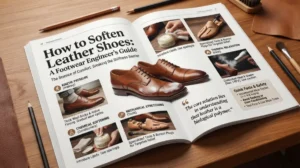
You can soften leather shoes by wearing them in gradually, applying a small amount of suitable leather conditioner, and using a shoe stretcher for tight areas. Start slowly. Too much moisture, oil, alcohol, or heat can stain, weaken, or permanently change the leather.
This guide applies to leather shoes commonly sold and worn in the United States, including dress shoes, boots, loafers, work shoes, and casual leather sneakers. The best method depends on the leather finish, where the shoe feels tight, and whether the shoe is new or already dry.

What Makes Leather Shoes Feel Stiff?
Leather shoes feel stiff when the leather is new, dry, thick, tightly constructed, or shaped differently from your feet. Leather is a natural material made of interwoven fibers. These fibers can flex with use, but they can also dry out, crack, or lose their finish when treated poorly.
A stiff shoe is not always too small. It may simply need time to bend at the toe box or ankle. However, softening will not fix a shoe that is clearly too short or narrow.
Signs the shoes need softening
- The heel counter rubs or causes blisters.
- The vamp, or top part of the shoe, does not bend comfortably.
- The tongue presses against the top of your foot.
- The leather creases sharply when you walk.
- The shoe feels dry, dull, or slightly brittle.
- A seam or edge causes pressure in one small area.
Pain across the whole foot often points to poor sizing. Softening can make leather more flexible, but it cannot create much extra length. A shoe that presses your toes against the front should usually be exchanged rather than forced to stretch.
The Safest Way to Soften Leather Shoes
The safest approach is a gradual process: clean the shoes, test a conditioner, apply a thin layer, let the leather rest, and wear the shoes for short periods.
What you need
- A soft cloth
- A horsehair brush or clean shoe brush
- Leather cleaner, if the shoes are dirty
- A leather conditioner made for the shoe’s finish
- Clean socks
- A shoe tree or adjustable shoe stretcher
- Newspaper or unprinted paper, if needed
Avoid using a conditioner until you know what type of leather you have. Smooth finished leather, suede, nubuck, patent leather, and faux leather need different care.
Step 1: Check the shoe’s material and care label
Look inside the shoe, on the box, or on the manufacturer’s care page. “Leather” does not describe one single finish.
- Smooth or full-grain leather: Usually responds well to a suitable cream or leather conditioner.
- Top-grain leather: Often has a finish that needs gentle, compatible products.
- Suede: Needs a suede brush and suede-specific products.
- Nubuck: Needs nubuck cleaner and conditioner.
- Patent leather: Has a glossy coating and should not be treated like unfinished leather.
- Synthetic leather: May soften slightly with wear but does not absorb leather conditioner in the same way.
- Oil-tanned or waxed leather: May need a product designed for that specific finish.
When the material is unclear, use the manufacturer’s instructions. The wrong product can darken light leather or leave a greasy film.
Step 2: Remove surface dirt
brush away dust and grit before applying any product. Dirt can act like fine sandpaper when rubbed into the leather.
If the shoes need more cleaning, use a small amount of cleaner designed for the leather type. Do not soak the shoes. Let them dry at room temperature before conditioning.
Step 3: Test the product
Apply a small amount of conditioner to a hidden area, such as the inside edge near the heel. Wait until it dries.
Check for:
- Darkening
- Uneven color
- A sticky or oily feel
- A change in texture
- Cracking or flaking of the finish
If the test area changes in a way you do not want, do not use the product on the visible parts of the shoe.
Step 4: Apply a thin layer
Use a soft cloth to spread a very small amount of conditioner over the smooth leather. Work in light, even strokes.
A thin coat is safer than a heavy one. Leather can absorb only so much product. Excess conditioner may make the surface greasy, attract dirt, weaken some finishes, or prevent polish from bonding well.
Pay extra attention to areas that bend, such as:
- The vamp
- The toe flex point
- The area around the ankle
- The sides near the widest part of the foot
Avoid coating the outsole, welt, or inside of the shoe unless the product instructions specifically allow it.
Step 5: Let the shoes rest
Leave the shoes at room temperature for several hours. Overnight is reasonable when the product label allows it.
Do not place leather shoes on a radiator, near a heater, in a clothes dryer, or in direct summer sun. Fast drying can pull natural oils from the leather and cause stiffness or cracking.
Step 6: Wear them for short periods
Wear the shoes indoors with the socks you normally use. Start with about 15 to 30 minutes. If the shoes feel comfortable, increase the time over several days.
Stop if you feel sharp pain, numbness, burning, or strong pressure. A little stiffness is normal. Pain is a sizing or fit warning, not a challenge to endure.
How to Soften Tight Leather Shoes
If the shoe fits in length but presses in one area, use controlled stretching rather than soaking or forcing it.
Use a shoe stretcher
A shoe stretcher is the most controlled home method for a tight toe box or narrow width. Choose a stretcher made for the type of shoe and adjust it slowly.
- Insert the stretcher into the shoe.
- Turn the handle until it makes light contact.
- Add small amounts of pressure rather than forcing it.
- Leave it in place for several hours.
- Remove it and test the fit.
- Repeat only if the leather remains tight.
Some stretchers include plugs for pressure points, such as bunions or a raised toe joint. Place the plug carefully so you stretch only the problem area.
A stretcher can help with width and small pressure points. It cannot safely add meaningful length.
Ask a shoe repair professional
A cobbler can stretch leather with specialized equipment and controlled moisture. This is often the best option for expensive shoes, delicate finishes, boots with unusual construction, or shoes that need stretching in one exact location.
Professional help is also wise when:
- The leather is exotic or highly finished.
- The shoes have a valuable painted or delicate surface.
- The shoes have glued decorations.
- The lining is already separating.
- You need a large adjustment.
- Home methods have already caused discoloration.
Use a gradual break-in routine
For shoes that are only mildly stiff, wear them around the house for short sessions. Thick socks can provide a small amount of padding, but they should not create painful pressure.
Rotate the shoes with another pair. This gives the leather time to dry and recover between wears. Shoe trees can help maintain the shape while the shoes rest, but they should not be expanded so aggressively that they distort the upper.
How to Soften Leather Shoes Without Damaging Them
Avoid viral shortcuts that use high heat, heavy water, or harsh chemicals. These methods can produce a quick feeling of flexibility while causing long-term damage.
Do not use a hair dryer or clothes dryer
Heat can dry leather unevenly. It may shrink the upper, damage adhesives, harden the finish, or cause cracks. If wet shoes need drying, remove the insoles, absorb water with paper, and let the shoes dry naturally at room temperature.
Do not soak the shoes
Water can stain leather, swell some components, weaken adhesives, and change the shape of the shoe. Dampening leather is sometimes part of professional stretching, but uncontrolled soaking is not a reliable home method.
Be careful with rubbing alcohol
Alcohol may soften some finishes for a short time, but it can also strip color, dry the fibers, and create permanent stains. It is not a general-purpose leather softener.
Avoid cooking oils and petroleum products
Olive oil, coconut oil, vegetable oil, and similar products are poor substitutes for leather conditioner. They may darken the leather, become rancid, attract dust, or leave an uneven surface.
Petroleum-based products can also affect adhesives and finishes. Use a product labeled for the specific leather instead.
Do not over-condition
Conditioning does not work like moisturizing human skin. More product is not automatically better. If the leather feels wet, greasy, tacky, or unusually dark, too much has likely been applied.
Wipe away excess with a clean cloth and allow the shoes to rest. Do not add another product to correct the problem.
How to Soften Different Types of Leather
The correct method changes with the leather’s surface.
| Leather type | Suitable approach | Avoid |
|---|---|---|
| Smooth finished leather | Thin coat of compatible conditioner, followed by gradual wear | Heavy oil, soaking, strong heat |
| Full-grain leather | Conditioner made for smooth leather and slow break-in | Over-conditioning and forced stretching |
| Suede | Suede brush and product labeled for suede | Wax, standard shoe cream, oily conditioner |
| Nubuck | Nubuck brush and compatible nubuck treatment | Smooth-leather polish and household oils |
| Patent leather | Patent-leather cleaner and gentle flexing | Standard conditioner, alcohol, heat |
| Oil-tanned leather | Product made for oil-tanned leather | Products that remove its intended finish |
| Faux or synthetic leather | Gradual wear and manufacturer-approved care | Assuming leather conditioner will absorb properly |
Suede and nubuck
Suede and nubuck have a textured surface. Standard smooth-leather conditioner can flatten the nap, darken the material, or leave permanent marks.
Brush suede or nubuck gently with the correct brush. For tight areas, use a professional stretcher or shoe repair service. A suede-safe stretching spray may help, but test it first because color changes are possible.
Patent leather
Patent leather has a glossy coating over the base material. It may soften slightly with wear, but ordinary leather conditioner is not the right choice. Use a product made for patent leather, and keep the shoes away from heat that could make the coating crack.
Exotic leather
Crocodile, ostrich, snakeskin, and other exotic leathers can have special finishes and care needs. Follow the maker’s instructions or consult a repair professional. A product that works on cowhide may not be suitable for an exotic skin.
How Long Does It Take to Soften Leather Shoes?
Most mildly stiff smooth-leather shoes become more comfortable over several wears. The exact time depends on leather thickness, finish, construction, and how often you wear the shoes.
A simple schedule is:
- Day 1: Wear indoors for 15 to 30 minutes.
- Day 2: Wear for 30 to 60 minutes if there is no pain.
- Days 3 to 7: Increase wear time slowly.
- After one week: Assess the fit, pressure points, and leather condition.
This is a practical break-in schedule, not a guaranteed timeline. Thick work boots may take longer than soft leather loafers. A shoe that still causes strong pain after several short sessions may be the wrong size or shape for your foot.
Signs the process is working
- The shoe bends at the normal flex point.
- Pressure decreases without new damage.
- The leather feels flexible but not greasy.
- The upper keeps its shape.
- You can walk without rubbing or sharp pain.
Signs to stop
- Blisters form repeatedly.
- Your toes feel numb or cramped.
- The leather becomes sticky or very dark.
- The finish begins to peel or crack.
- The sole starts separating.
- The shoe changes shape in an uneven way.
What to Do If Leather Shoes Are Still Uncomfortable
First, identify whether the problem is stiffness, pressure, or size.
| Symptom | Likely cause | Best next step |
|---|---|---|
| Toe touches the front | Shoe is too short | Exchange or replace the shoes |
| Sides pinch evenly | Shoe is too narrow | Try a wider size or careful stretching |
| One small area rubs | Local pressure point | Use a stretcher plug or see a cobbler |
| Heel slips | Shape or size mismatch | Try a different fit, heel grip, or lacing method |
| Top of foot feels tight | Low instep space or stiff tongue | Loosen lacing and break in gradually |
| Leather feels dry and cracks | Dehydrated or damaged finish | Stop harsh treatments; seek repair advice |
| Sole separates | Adhesive or construction failure | Contact the seller or a shoe repair shop |
Do not keep wearing shoes that cause numbness or open blisters. A leather shoe should become more comfortable as it breaks in, not steadily more painful.
If the shoe is new and the fit is wrong, check the retailer’s return policy before applying conditioner or stretching it. Treatments can make a return harder.
Key Takeaways
- The safest way to soften leather shoes is gradual wear plus a thin layer of compatible conditioner.
- Test every product on a hidden area first.
- Use a shoe stretcher for small width or pressure adjustments.
- Do not use high heat, soaking, rubbing alcohol, or household cooking oils.
- Suede, nubuck, patent, synthetic, and exotic leathers need different care.
- Softening cannot fix shoes that are too short or badly sized.
- Stop if you feel pain, numbness, or burning.
- Take valuable or delicate shoes to a professional cobbler.
Frequently Asked Questions
Can I soften leather shoes overnight?
You can apply a thin layer of suitable conditioner and let the shoes rest overnight, but this may not make them fully comfortable by morning. Gradual wear is still needed. Do not leave the shoes near a heater or apply a heavy coat of product.
Does wearing thick socks soften leather shoes?
Thick socks can add padding and create mild pressure while you break in the shoes. They do not replace a proper shoe stretcher. If thick socks make your toes numb or cause pain, stop using them.
Can I use petroleum jelly to soften leather shoes?
Petroleum jelly is not a reliable choice for most leather shoes. It can leave a greasy surface, attract dirt, darken some leather, and affect certain finishes. Use a conditioner labeled for the leather type instead.
Will water make leather shoes softer?
Water may temporarily make leather feel more flexible, but soaking can cause stains, shrinkage, shape changes, and adhesive problems. Controlled moisture is best left to a trained shoe repair professional.
Can a shoe repair shop soften leather shoes?
Yes. A cobbler can stretch specific pressure points and work with equipment suited to the shoe’s material and construction. Professional service is especially useful for expensive, delicate, exotic, or badly fitted shoes.
Final Recommendation
Start with the least aggressive method: clean the shoes, test a compatible conditioner, apply a thin layer, and wear the shoes for short periods. If one area remains tight, use a shoe stretcher carefully. If the shoe is too short, badly painful, or made from a delicate finish, stop experimenting and exchange it or consult a professional shoe repair shop.
Rubel Miah is the Senior Editor at MyStyleGrid.com, where he brings a sharp editorial eye and an unshakable love for fashion to everything he does. A true style addict, Rubel lives and breathes trends, from streetwear to high fashion, and has a knack for turning inspiration into impactful stories. With years of experience in fashion journalism and digital media, he curates content that empowers readers to express themselves through style. When he’s not editing features or forecasting the next big thing, you’ll find him hunting down vintage pieces or capturing street style moments around the city.