For people in the United States, mirrored sunglasses can make bright days feel more comfortable because their outer coating reflects some light away from the eyes. But mirrored sunglasses do not always block more light than regular sunglasses. The amount of light they block depends on the lens tint, lens material, and mirror coating—not the mirror finish alone.
A mirror coating may reduce glare and visible light. It does not automatically mean the glasses provide better UV protection. For eye safety, look for a label that says “100% UV protection,” “UV400,” or compliance with applicable U.S. eyewear standards, such as ANSI Z80.3.

What are mirrored sunglasses?
Mirrored sunglasses have a thin reflective coating on the outside of each lens. This coating acts like a small reflector. It sends part of the incoming light away before it passes through the lens and reaches your eyes.
The coating may appear silver, gold, blue, green, red, or another color. The visible color of the mirror does not reliably tell you how much light the lens blocks.
A mirrored lens still has a base tint underneath the coating. That tint usually does much of the work that controls visible light transmission. The mirror layer adds another level of reflection, but its effect can vary by design.
Key terms to know
- Visible light transmission (VLT): The percentage of visible light that passes through the lens. A lower VLT means a darker lens.
- UV protection: The lens’s ability to block ultraviolet A and ultraviolet B radiation. This is separate from how dark the lens looks.
- Glare: Harsh, scattered light that makes it harder to see.
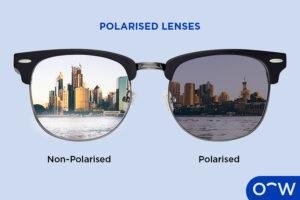
- Polarization: A filter that reduces certain types of reflected glare, such as glare from roads, water, and snow.
- Mirror coating: A reflective layer placed on the lens surface.
A dark lens can have poor UV protection, while a light-looking lens can have strong UV protection. These are separate features.
Do mirrored sunglasses block more light than regular sunglasses?
Sometimes, but not always. A mirrored coating can reflect additional visible light, yet the total amount of light blocked depends on the full lens design.
For example, compare these two lenses:
| Lens type | Likely light control | What determines the result |
|---|---|---|
| Light-tint mirrored lens | Low to moderate | Light base tint and mild mirror coating |
| Dark-tint non-mirrored lens | Moderate to high | Dark base tint |
| Dark-tint mirrored lens | High | Dark tint plus reflective coating |
| Polarized mirrored lens | High glare control | Tint, mirror coating, and polarizing filter |
This means a dark, non-mirrored lens may block more visible light than a lightly tinted mirrored lens. The mirror finish alone does not provide a dependable ranking.
Manufacturers measure this performance through visible light transmission. A lens that allows 15% of visible light through blocks more visible light than one that allows 40% through. The product specification is more useful than the color or shine of the coating.
Why the mirror coating can help
A mirror coating may:
- Reflect some incoming sunlight before it enters the lens
- Reduce the brightness of intense outdoor scenes
- Make bright environments feel more comfortable
- Help in settings with strong sun, such as beaches, deserts, ski areas, and open water
The coating may be especially useful when sunlight is intense from several directions. Still, it does not remove every source of glare, and it does not replace polarization.
Why mirror color does not tell you the answer
A blue mirror does not automatically block more light than a silver mirror. The visible color may come from the coating, the base tint, or both. Without a VLT rating or a reliable product specification, you cannot determine the lens’s exact light-blocking ability by appearance.
Do mirrored sunglasses block UV light?
They can, but the mirror coating is not proof of UV protection. UV protection comes from the lens material, UV-absorbing additives, or a specific UV-blocking treatment.
The U.S. Food and Drug Administration regulates sunglasses as medical devices and requires manufacturers to meet applicable performance and labeling rules. The American Academy of Ophthalmology also advises consumers to choose sunglasses that block 99% to 100% of UVA and UVB rays.
When shopping, look for:
- 100% UV protection
- UV400
- Blocks 99% to 100% of UVA and UVB
- A reputable manufacturer’s clear UV specification
Do not assume a very dark or highly reflective lens blocks UV. A dark lens without proper UV protection may reduce visible brightness while allowing harmful UV exposure. That combination can cause the pupils to open more, potentially allowing more UV into the eye than with no dark lens at all.
A product label that only says “mirrored,” “smoke,” “blue,” or “dark” does not provide enough information about UV performance.
Are mirrored sunglasses better for glare?
Mirrored sunglasses can reduce brightness, but polarized sunglasses usually do more to reduce reflected glare.
Light reflected from flat surfaces often becomes partly polarized. A polarizing filter can reduce much of this reflected light before it reaches the eye. This can improve comfort and visual clarity near:
- Water
- Wet pavement
- Snow
- Glass buildings
- Vehicle hoods
- Sandy beaches
A mirrored lens may reflect some of that light, but it does not filter glare in the same way. Some sunglasses combine both features: a polarized lens with a mirror coating.
Mirror coating versus polarization
| Feature | Main job | Best use |
|---|---|---|
| Mirror coating | Reflects some light | Very bright outdoor conditions |
| Polarization | Reduces selected reflected glare | Driving, boating, fishing, snow, and wet roads |
| Dark tint | Lowers overall brightness | General sun exposure |
| UV filter | Blocks UVA and UVB radiation | Eye protection in all outdoor settings |
These features can work together. For example, a polarized, mirrored, dark-tint lens may be useful on a bright lake. However, the best choice depends on the activity and the lens quality.
How much light should sunglasses block?
The right amount depends on the setting. Very dark lenses are not always better, and they may be unsafe for low-light conditions.
A useful measure is visible light transmission, or VLT:
- A higher VLT lets more light through.
- A lower VLT creates a darker lens.
- The exact VLT range may vary by manufacturer and standard.
- Dark lenses are generally intended for stronger sunlight.
For ordinary daytime use, many people prefer a medium or dark tint. Very bright settings may call for a darker lens. Night driving, indoor use, and low-light weather require clear or lightly tinted lenses.
Do not use very dark sunglasses at night. Avoid using them in dim conditions unless a qualified eye-care professional has recommended a specific lens for your needs.
A practical choice guide
| Situation | Useful features |
|---|---|
| Daily outdoor errands | 100% UV protection and a comfortable medium tint |
| Driving in bright sun | UV protection, good optics, and optional polarization |
| Fishing or boating | UV protection, polarization, and a suitable dark tint |
| Skiing or snow travel | UV protection, strong glare control, and side coverage |
| Cycling or hiking | UV protection, impact-resistant lenses, and secure fit |
| Night driving | Clear lenses or approved night-driving eyewear, not dark mirrored lenses |
For driving, polarization can reduce road glare, but it may also make some digital displays harder to read at certain angles. Test the sunglasses during the day before relying on them for long trips.
Do mirrored sunglasses protect your eyes better?
Mirrored sunglasses may improve comfort in strong sunlight, but the mirror coating alone does not make them safer or healthier for your eyes.
Good eye protection depends on several features:
- Verified UV protection: The most important factor for sun exposure.
- Suitable visible-light control: The lens should be dark enough for the setting but not too dark for safe vision.
- Good optical quality: The lens should not create distortion, waves, or blurred areas.
- Proper fit: A close fit can reduce sunlight entering around the edges.
- Impact resistance: This matters for sports, cycling, work, and other active uses.
- Side coverage: Wraparound frames can reduce light from the sides.
The Federal Trade Commission has also addressed deceptive or unsupported claims in eyewear marketing. A brand’s wording should not replace clear performance information.
Children need sunglasses with proper UV protection as well. Their eyes receive substantial lifetime sun exposure, so inexpensive glasses are acceptable if they provide trustworthy UV-blocking information and fit well.
Common mistakes when buying mirrored sunglasses
The most common mistake is choosing sunglasses based only on how dark or reflective they look.
Mistake 1: Assuming darker means safer
Darkness measures visible brightness, not UV protection. Check the UV label instead.
Mistake 2: Treating mirror color as a performance rating
Silver, blue, gold, and red mirrors can all be made with different lens designs. Color is not a reliable measure of light blocking.
Mistake 3: Confusing polarization with UV protection
Polarization can reduce glare, but it does not automatically block UV rays. Confirm both features separately.
Mistake 4: Ignoring lens quality
Cheap lenses can have uneven tint or optical distortion. Look through the center and edges of the lens. If straight lines appear bent or the view shifts when you move the glasses, choose another pair.
Mistake 5: Wearing very dark lenses in low light
A dark mirrored lens can reduce contrast and make hazards harder to see. Use sunglasses suited to the light level.
Mistake 6: Forgetting scratches
Scratches can scatter light and reduce visual comfort. Replace sunglasses when damage affects your view. Do not rely on a damaged lens for demanding activities.
How can you test whether mirrored sunglasses block more light?
You cannot accurately measure UV protection or VLT at home by looking through the lens. A simple side-by-side comparison can show which lens appears darker, but it cannot prove which one provides better UV protection.
For a reliable comparison:
- Check each product’s UV claim.
- Look for a VLT percentage or lens category.
- Confirm whether the lens is polarized.
- Compare the same lens size and tint type.
- Inspect the glasses for distortion, scratches, and poor fit.
- Ask an optician to test the lenses if the specifications are unclear.
An optical shop may have instruments that measure UV transmission and visible light transmission. This is more dependable than online photos or a flashlight test.
Frequently asked questions
Do mirrored sunglasses make your eyes safer in bright sunlight?
They can make bright conditions more comfortable, but safety depends mainly on verified UV protection, suitable tint, good optics, and proper fit. A mirrored finish alone is not enough.
Are mirrored sunglasses good for driving?
They can work well in bright daytime conditions if they provide clear vision and proper UV protection. Polarization may reduce road glare, but some vehicle displays can look darker or less clear through polarized lenses. Do not use dark mirrored sunglasses at night.
Do mirrored sunglasses block blue light?
Some tinted or coated lenses reduce portions of visible blue light, but a mirror finish does not guarantee a specific blue-light reduction level. Check the manufacturer’s measured transmission data if blue-light filtering matters to you.
Can mirrored sunglasses help with snow blindness?
They may reduce bright visible light, but snow and high-altitude conditions also require strong UV protection and good coverage. Snow reflects a large amount of sunlight, so use eyewear designed for those conditions. Seek urgent medical care for eye pain, light sensitivity, blurred vision, or a gritty feeling after intense exposure.
Do cheap mirrored sunglasses provide UV protection?
Some do, and some do not. Price alone does not prove performance. Choose glasses with a clear, credible claim of 100% UVA and UVB protection or UV400, and replace them if the lenses are badly scratched or distorted.
The bottom line
Mirrored sunglasses may block more visible light than a similar non-mirrored lens, but the mirror finish does not guarantee it. The base tint, visible light transmission, and lens design determine how dark the glasses are.
For the best protection, choose sunglasses with verified 100% UVA and UVB protection, a tint suited to the conditions, and good optical quality. Add polarization when reflected glare is a major problem. If the label does not state UV performance, do not assume the shiny coating provides it.
Rubel Miah is the Senior Editor at MyStyleGrid.com, where he brings a sharp editorial eye and an unshakable love for fashion to everything he does. A true style addict, Rubel lives and breathes trends, from streetwear to high fashion, and has a knack for turning inspiration into impactful stories. With years of experience in fashion journalism and digital media, he curates content that empowers readers to express themselves through style. When he’s not editing features or forecasting the next big thing, you’ll find him hunting down vintage pieces or capturing street style moments around the city.