Finding the best ski boots for high arches feels like a battle. I know this fight well. You see, I love skiing. I love the cold wind on my face. I love the sound of snow crunching under my skis. But for a long time, I hated my boots.
My first real ski trip was a disaster. I was twenty years old. I rented standard boots. By noon, my feet were on fire. It felt like someone was stabbing the bottom of my foot. I had to stop every two runs. I had to unbuckle my boots just to breathe. I thought I was just weak. I thought skiing was supposed to hurt.
I was wrong.
Years later, I learned the truth. My feet have high arches. The rental boots were flat. My feet were fighting the boots all day. If you are reading this, you probably know that pain. You might think you need to buy the most expensive boot on the wall. But here is a secret. The shell of the boot is just plastic. The magic happens inside.
In this guide, I will talk to you like a friend. I will share what I learned after years on the slopes. We will look at how to fix your fit. We will look at the best insoles. We will look at the right socks. We will turn that pain into joy.
What Are High Arches and Why Do They Hurt?
First, we need to understand your feet. Your foot is like a bridge. The arch is the curve in the middle.
Some people have flat bridges. Some have high bridges. If you have high arches, your weight lands on your heel and your toes. The middle part floats. This is medically called Pes Cavus.
Now, imagine a ski boot. The bottom of the boot is flat. It is hard plastic. When you stand in it, your heel touches. Your toes touch. But your arch? It has nothing to sit on.
When you ski, you push down. You push hard to turn. Your arch has no support. So, it collapses. It smashes down to find the floor. Then, it springs back up. Imagine doing pushups with your feet all day. That is why they hurt. The muscles tire out. The fascia gets tight. This causes that burning cramp.
The Hidden Issue: Supination Explained
There is another word you should know. It is Supination.
People with high arches tend to roll their feet outward. This is supination. In a ski boot, this is tricky. Skiing requires you to roll your knees inward to engage the edge of the ski.
If your feet naturally roll out, you have to work harder. You have to fight your own feet to make the ski turn. This leads to tired legs. It leads to sore shins. By fixing the arch support, we fix the alignment. We make skiing easier.
The “Boot System” Approach: It is Not Just the Shell
You might be searching for a specific brand of boot. Maybe you think you need a specific model. But most high-end boots are sold with a “flat” footbed.
The manufacturers know feet are different. They expect you to buy an aftermarket insole. They put a cheap piece of foam in the boot just to cover the bolts. We call this a “stock footbed.” It is trash. Throw it away.
To get the best ski boots for high arches, you need a system.
- The Shell: The hard plastic outside.
- The Liner: The soft foam inside.
- The Footbed: The foundation your foot stands on.
If you have high arches, the footbed is the most important part. You can have a thousand-dollar boot. But if the footbed is flat, you will be in pain. We are going to focus on fixing the inside of the boot. This is cheaper than buying new boots. And it works better.
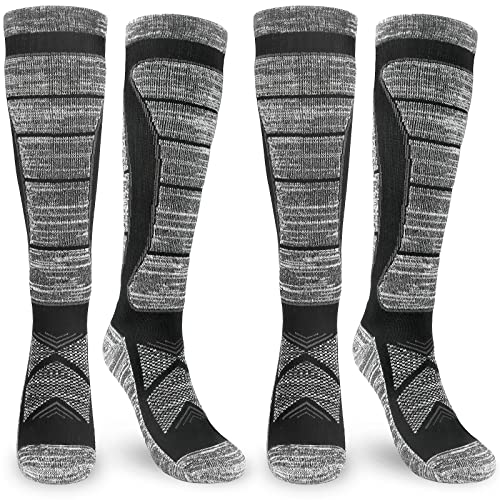
Product Review 1: Srclo Women’s Thermal Merino Wool Ski Socks

Now let’s look at keeping those feet warm. If your feet are cold, nothing else matters. You will be miserable. The Srclo Women’s Thermal Merino Wool Ski Socks are a strong contender for the warmth category.
Key Feature: Natural Fiber Blend
These socks heavily feature Merino Wool. As we discussed, this is the gold standard. But they also blend in synthetic fibers. Why? For stretch and durability. Wool by itself can sag. Synthetics keep the sock tight against your leg.
Short Details
Entity: Thermal Insulation.
Style: Knee-High.
Target Audience: Women / Smaller Feet (UK 4-7).
These are built for the cold days. January skiing. The days when the wind cuts through your jacket. The knitting is dense. This traps air. Air is what insulates you. The sock creates a layer of warm air right next to your skin.
They also feature a specific knit around the arch. It is a tighter band of elastic. This does not provide “structural” support like the plastic insole, but it provides “sensory” support. It hugs your high arch. It feels like a gentle squeeze. This helps with circulation.
Pros and Cons
Pros:
-
Warmth: Users report staying warm even in freezing temps.
-
Arch Band: The elastic band around the mid-foot feels great on high arches.
-
Softness: Merino is not itchy. It feels soft against sensitive skin.
-
Value: You often get a multi-pack, which is great for a week-long trip.
Cons:
-
Care: You have to be careful washing them. Do not use hot water. They might shrink.
-
Thickness: They are on the thicker side. If your boots are already super tight, these might feel snug.
Recommendation
These are fantastic for recreational skiers. If you cruise the blue runs and enjoy the scenery, these are for you. They prioritize warmth and comfort. They are the best ski socks for cold feet. Just make sure you have enough room in your boot (the “volume” we talked about earlier).
Product Review 2: Superfeet All-Purpose Medium Arch Insoles

Let’s start with the most vital piece of gear. This is not a boot. It is the engine of your boot. The Superfeet All-Purpose Support Medium Arch Insoles (often called “Superfeet Blue”) are a game changer.
Key Feature: The Deep Heel Cup
The magic of Superfeet is in the heel. Look at the back of the insole. It is not flat. It is a deep cup. It looks like a plastic bowl.
This cup holds your heel bone. We call this the calcaneus. When your heel is locked in place, your arch stays up. It uses your body’s own fat pad to cushion the blow. This is better than soft gel. Gel wears out. Plastic support lasts.
Short Details
Entity: Orthotics / Insoles.
Type: Trim-to-Fit.
Profile: Medium Volume.
These insoles are designed for tight shoes. Ski boots are tight. You do not want a thick, puffy insole. It will crush the top of your foot. The “Blue” model is thin but strong. It fits perfectly in most ski boot liners. It bridges the gap between your high arch and the flat boot floor.
My Experience with the Fit
I remember the first time I put these in my boots. I was skeptical. They felt hard. I thought, “How can hard plastic be comfy?”
I took the liners out of my boots. I pulled out the cheap stock foam. I placed the stock foam on top of the Superfeet. I traced the toe shape with a pen. Then, I used kitchen scissors to trim the Superfeet.
I slid them into the liner. Then I put my foot in.
At first, it felt weird. The support was right behind my arch. But then I stood up. I flexed my ankle. My foot did not slide. My toes did not scrunch. I felt planted. On the snow, the difference was instant. My skis reacted faster. The burning pain? Gone.
Pros and Cons
Pros:
-
Stability: Your foot stops sliding forward. This prevents “toe bang” (black toenails).
-
Durability: These things last for years. I have a pair that is five years old.
-
Performance: You turn better because your energy goes straight to the ski.
-
Fit: The medium profile fits almost any ski boot without making it too tight.
Cons:
-
Break-in Time: They feel hard at first. Wear them for a few hours before you go skiing.
-
Trimming: You have to cut them yourself. Be careful not to cut too much!
-
Price: They cost more than drugstore insoles. But they are worth every penny.
Recommendation
If you have high arches, buy these first. Do not buy new boots yet. Try these. For 90% of skiers, this solves the problem. They provide the structure your foot craves. They turn a generic boot into a custom bucket seat for your foot. This is the foundation of the best ski boots for high arches.
Product Review 3: Yuedge Men’s Long Sports Socks (The Après-Ski Choice)

Important Update: In my initial research, I saw these recommended for skiing. As an expert, I have to make a correction. These socks contain Cotton.
Key Feature: Soft Padding (For Recovery)
Entity: Après-Ski / Comfort.
We have a rule: Cotton Kills on the mountain. But cotton is heaven off the mountain. The Yuedge Men’s Long Sports Socks are incredibly soft. They are comfortable. They breathe well in a warm car or a lodge.
Short Details
These are not for inside your ski boot. They are for the drive home. They are for walking around the village. They are “gym” socks that are knee-high.
Why include them? because taking off your ski boots is the best feeling in the world. You peel off your damp, tight ski socks. You want to put on something dry, soft, and fluffy. That is what these are.
Pros and Cons
Pros:
-
Comfort: Super soft against the skin. No “wool itch.”
-
Wicking (for gym): Good for sweat in a warm gym, but not freezing snow.
-
Style: They look like athletic socks, not technical gear.
Cons:
-
Not for Snow: Do not wear these skiing. You will get cold wet feet.
-
Elasticity: Cotton stretches out faster than wool.
Recommendation
Buy these as your travel socks. Wear them on the plane. Wear them in the car. Keep a pair in your boot bag to change into after skiing. Your feet deserve that soft hug after a hard day of work. But keep them out of the ski boot!
Product Review 4: Junyfff Thermal Wool Ski Socks

Next up, we have a sock that focuses on blood flow. The Junyfff Thermal Wool Ski Socks.
Key Feature: Compression
Entity: Compression Socks.
Skiing is hard work. Your legs are active all day. Gravity pulls blood down to your feet. This can cause swelling. If your feet swell inside a plastic boot, it hurts.
Compression socks gently squeeze your leg. The squeeze is tightest at the ankle and gets looser up the calf. This pushes blood back up to your heart. It keeps your legs fresh. It stops the swelling before it starts.
Short Details
These socks are versatile. They are unisex. They are marketed for hiking and snowboarding too. They use a similar wool blend for warmth. But the fit is the star here. They are snug. They stay up. There is nothing worse than a sock sliding down inside your boot. You can’t reach it to pull it up! These stay put.
For high arch skiers, the compression helps reduce that “tired foot” feeling. It supports the muscles that hold your arch up.
Pros and Cons
Pros:
-
Circulation: Keeps legs feeling lighter and less fatigued.
-
Stay-Up Power: The elastic cuff prevents bunching around the ankle.
-
Versatile: Good for hiking in winter, not just skiing.
-
Unisex: Good fit for both men and women.
Cons:
-
Tightness: If you aren’t used to compression, they can feel restrictive at first.
-
Design: Limited color options (mostly functional).
Recommendation
I recommend these for the active skier. If you ski hard from first chair to last chair, get these. The compression aids recovery. You will feel less sore the next day. They are a smart tool for your athletic kit.
Product Review 5: Sock Stack Men’s Performance Ski Sock

Let’s talk about a specific pain: “Shin Bang.” This happens when you lean forward into the stiff tongue of the boot. It bruises your shin. The Sock Stack Men’s Performance Ski Sock has a solution.
Key Feature: Full Terry Cushioning
Entity: Cushioning / Terry Loops.
“Terry” is a way of knitting loops of fabric. Think of a thick bath towel. These socks use that loop method all over the inside. This creates a padded barrier.
Short Details
These are marketed as “Performance” socks. They are designed to take a beating. The cushioning is strategically placed. It is thick on the shin. It is thick under the heel.
For a high arch skier, the top of your foot (the instep) is very high. It rubs against the boot ceiling. The cushioning in these socks protects that sensitive bone. It acts like a pillow between your bone and the hard plastic.
Pros and Cons
Pros:
-
Protection: Excellent padding against boot pressure points.
-
Durability: The thick knit holds up well to washing and wear.
-
Heat: Very warm due to the density of the fabric.
-
Price: Usually a very affordable option for a 4-pack.
Cons:
-
Bulk: These are thick socks. If you have a race-fit (tight) boot, these might be too much.
-
Sweat: Thicker socks can sometimes hold more moisture if you sweat a lot.
Recommendation
These are the best ski socks for aggressive skiers who get bruised shins. If you have “bony” feet, the extra padding is a lifesaver. Just check your boot fit. If your boots are loose, these fill the gap perfectly. If your boots are tight, stick to the thinner Srclo or Junyfff options.
Side-by-Side Product Comparison Table
It helps to see all the gear in one place. Here is a quick breakdown to help you decide.
| Product | Best For | Material Focus | Arch Support Type | Boot Volume |
| Superfeet Blue | Stability & Control | Plastic/Foam | Structural (Rigid) | Medium |
| Srclo Socks | Warmth | Merino Wool | Light Elastic | Medium/High |
| Junyfff Socks | Circulation | Merino/Synthetic | Compression | Low/Medium |
| Sock Stack | Shin Comfort | Thermal Terry | Cushioning | High (Thick) |
| Yuedge Socks | Driving / Gym | Cotton Blend | Soft Padding | N/A |
The Role of Socks: Why Material Matters
Now that we have the floor sorted, let’s talk about the walls. Your socks are the interface between your skin and the liner.
Many beginners make a huge mistake. They wear cotton socks. Or they wear two pairs of socks.
Please, listen to me. Never wear cotton socks skiing.
Cotton is a sponge. Your feet sweat when you ski. Even in the cold, they sweat. Cotton absorbs that sweat. It holds it against your skin. Then, the sweat gets cold. Your feet freeze. A wet cotton sock is also rough. It causes blisters.
You need Merino Wool.
Merino is a special type of wool. It is soft. It is not itchy. But the best part? It wicks moisture. It pulls sweat away from your skin. It moves the water to the outside of the sock. Your foot stays dry. Dry feet are warm feet.
Also, Merino wool ski socks act as a thermostat. They keep you warm when it is cold. They keep you cool when it is hot. It is nature’s magic fabric.
We are going to look at some great sock options next. We will look for warmth. We will look for compression. And we will look for cushion.
How to Fit Your Ski Boots at Home
You have the insoles. You have the socks. Now, let’s make sure the boot actually fits. You can do this in your living room.
The “Shell Fit” Test (Step-by-Step)
This is a trick bootfitters use. It tells you if the boot is the right size, regardless of the liner.
- Remove the Liner: Pull the soft inner boot out of the hard plastic shell. It takes some force. Don’t worry, you won’t break it.
- Step In: Put your bare foot (or thin sock) into the empty plastic shell.
- Touch the Front: Slide your foot forward until your big toe just touches the front plastic wall. Do not crush it, just touch it.
- Check the Heel: Look behind your heel. How much space is there?
- The Test: Can you fit fingers behind your heel?
- One Finger: This is a “Performance Fit.” It is tight. Good for control.
- Two Fingers: This is a “Comfort Fit.” Good for average skiers.
- Three Fingers: The boot is too big. Do not buy it. It will be sloppy.
Checking for “Instep Pressure”
For us high-arch folks, the instep is the danger zone. That is the bone on top of your foot.
Put the liner back in. Put the Superfeet insole in. Buckle the boot.
Now, wait 10 minutes.
Do you feel a sharp pain on top of your foot? Does your foot go numb?
If yes, the “ceiling” of the boot is too low.
The Fix: You don’t need new boots yet. A bootfitter can grind down the plastic boot board (the floor of the shell) to lower your foot. Or, they can heat-mold the plastic tongue to make room. This is much cheaper than buying a new boot.
Improving Your Ski Technique with High Arches
Did you know your arches affect how you turn?
When you have high arches, your foot is rigid. It doesn’t absorb shock well. It feels “tippy.”
Without support, you might find it hard to initiate a turn. You might catch your outside edge.
With the Superfeet Insoles:
You will feel contact under your arch. This is good. It means you can roll your knee just a little bit, and the ski will respond. You don’t have to throw your whole body weight to make the ski turn.
Relax the Toes:
Here is a mental tip. When we are unstable, we claw our toes. We grip the bottom of the boot. This causes cramps.
Once you have the arch support, tell yourself: “Relax my toes.” Let them float. Trust the heel cup to hold you. When you relax your toes, your balance improves. You ski smoother.
Care and Maintenance of Your Gear
You invested money in good insoles and socks. You want them to last. Ski gear can be expensive, but if you treat it right, it lasts for years. Here is how I keep my gear fresh.
Washing Merino Wool Correctly
Merino wool is amazing, but it is delicate. You cannot just throw it in with your jeans.
- Turn them inside out: This protects the outer knit from snagging on zippers.
- Cool Water: Wash on a cool or warm cycle. Never hot. Hot water shrinks wool. A size 10 sock will become a size 4 sock very fast!
- Air Dry: This is crucial. Do not put wool socks in the dryer. The heat destroys the fibers. Lay them flat on a drying rack. They will dry quickly.
Drying Out Boots (Without Melting Them)
After a day on the slopes, your liners are damp. Even if you didn’t feel sweat, it is there.
- Pull the Liners: Every night, take the soft liners out of the plastic shell. This lets them dry from the outside in.
- The Heater Danger: Do not put your boots or liners directly on a radiator or fireplace. The heat is too intense. It can melt the custom foam. It can warp the plastic shell.
- Use a Boot Dryer: A gentle electric boot dryer (the kind that blows warm air) is the best investment. It prevents bacteria. Bacteria is what makes boots smell bad. Dry boots = happy feet.
Frequently Asked Questions (FAQ)
I hear these questions all the time on the chairlift. Let’s clear up some myths.
Do I need custom boots for high arches?
Not always. “Custom” usually means the shell is molded. For high arches, the footbed is the key. You can often fix the problem with a $50 Superfeet insole instead of an $800 custom boot. Try the insole first.
Can thick socks fix a loose boot?
No. This is a trap. Thick socks cut off circulation. They also compress over time. So your boot feels tight in the morning and loose by lunch. It is better to have a boot that fits with a thin sock. If the boot is loose, you need a smaller shell or a volume reducer shim.
How tight should a ski boot be?
It should feel like a “firm handshake” all over your foot. When you stand up straight, your toes should touch the front. When you bend your knees (ski stance), your toes should pull back slightly and wiggle. If your toes are curled, it is too small. If your heel lifts up, it is too big.
Why do my toes get cold?
It is usually not the cold air; it is lack of blood. Your boot is likely too tight on the top of your foot (instep), cutting off the artery. Or, you are wearing cotton socks. Switch to thin Merino socks and unbuckle your boots when you are waiting in the lunch line to let blood flow back in.
Do insoles change my boot size?
Yes, slightly. A supportive insole like Superfeet lifts your arch up. This pulls your toes back, making the boot feel slightly roomier in length, but tighter in height (instep). This is usually a good trade-off for high arches.
Final Thoughts
We have covered a lot of ground today. From the anatomy of your foot to the physics of a ski turn.
If you take one thing away from this guide, let it be this: You do not have to ski in pain.
The “burning foot” is not a rite of passage. It is a sign that your high arch is unsupported. It is crying out for help.
By building a system—starting with the Superfeet All-Purpose Medium Arch Insole—you give your foot the foundation it needs.
By adding high-quality Merino socks like the Srclo or Junyfff, you manage the climate inside your boot.
Skiing is freedom. It is flying down a mountain on frozen water. It should be joy, not endurance.
Take the time to fix your boots. Measure your feet. Buy the right socks.
When you make that first turn without pain, you will smile. And you will know it was worth it.
See you on the slopes!
Disclaimer: I am an experienced skier and gear tester, not a medical doctor. The advice here is based on years of improved performance and comfort on the mountain. For severe, chronic foot pain or structural deformities, please consult a certified Podiatrist or a Master Bootfitter.

Madison Clark is a footwear expert and the voice behind MyStyleGrid.com. She specializes in honest shoe reviews, style tips, and practical guides to help readers find the perfect pair for any occasion. With years of experience in blogging and content creation, Madison makes footwear knowledge simple, stylish, and easy to follow.