Introduction
Boot width sizes show how much room a boot gives your foot across the ball and toe area. In the United States, width letters work with your shoe size. For example, D may be a standard men’s width, while B is often a standard women’s width. A wider foot may need EE, and a narrow foot may need B for men or AA for women.
Width letters are not fully universal. One brand’s D width may feel different from another brand’s D width. The boot style, toe shape, leather, insole, and measurement system also affect fit. This guide explains U.S. boot width sizes, how to measure your feet, and how to choose the right width without relying on guesswork.

What Do Boot Width Letters Mean?
Boot width letters describe the fit across the widest part of the foot, usually near the ball of the foot. They do not describe the length of the boot or the height of the shaft.
A boot size may look like 10D, 8B, or 11EE:
- 10, 8, or 11 = the U.S. length size
- B, D, or EE = the width
- The same length can come in several widths
For example, a size 10D and a size 10EE have the same stated length. The 10EE boot should provide more room across the forefoot.
Common U.S. boot width letters
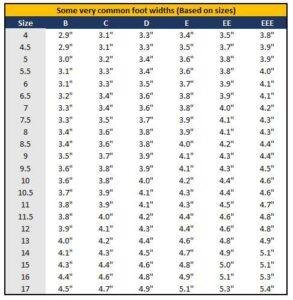
The chart below shows common width labels. It is a general guide, not a rule for every brand.
| Width label | Common men’s meaning | Common women’s meaning |
|---|---|---|
| AAA or AA | Very narrow | Extra narrow or narrow |
| A | Narrow in some brands | Narrow in some brands |
| B | Narrow | Standard or medium |
| C | Narrow to medium | Wide in some brands |
| D | Standard or medium | Wide or extra wide in some brands |
| E | Wide | Extra wide in some brands |
| EE or 2E | Extra wide | Extra wide in some brands |
| EEE or 3E | Very wide | Very wide in some brands |
| 4E and above | Extremely wide | Available in select brands |
The letters can shift by brand and by gender sizing. For this reason, treat the chart as a starting point. Always check the brand’s own width chart when one is available.
According to the Brannock Device Company, foot width is measured with the foot’s length and the width at the ball of the foot. That measurement helps guide size selection, but it does not replace trying on the actual boot.
Is D a wide boot?
Usually, D is a standard men’s width in U.S. footwear. In many women’s boot lines, D is wide. However, some brands use different labels or offer only one width.
The letter alone is not enough. Check whether the boot is listed in a men’s, women’s, or unisex size system.
Is EE wider than D?
Yes. In most U.S. boot sizing systems, EE is wider than D. Some brands also use 2E for the same general width category.
The increase is not always identical from one brand to another. A 10EE may feel only slightly wider than a 10D in one boot, but much roomier in another.
Boot Width Sizes vs. Boot Shaft Width
Boot width and shaft width measure two different parts of a boot.
Boot width refers to the foot section. It affects room around the toes, ball, and sides of the foot.
Shaft width refers to the upper part of the boot that surrounds the ankle or calf. It affects how the boot fits your lower leg.
A boot can have a wide foot width but a narrow calf opening. It can also have a regular foot width with a wide shaft. This matters most with cowboy boots, riding boots, work boots, and tall winter boots.
Look for separate terms such as:
- Foot width
- Calf circumference
- Shaft circumference
- Shaft height
- Ankle width
- Opening circumference
Do not choose a wider foot size just to gain more calf room. A wider footbed may leave your heel or arch in the wrong position. If the calf is the problem, look for a boot with a wider shaft or an adjustable panel.
Why boot shape changes the fit
The same width letter can feel different because boots use different toe shapes. Common shapes include:
- Round toe: Usually gives balanced room across the front
- Square toe: May give more space for the toes
- Pointed toe: Can feel tight, even in a wide width
- Moc toe: Often has a roomy front, but the exact fit varies
- Almond toe: Tapers more than a round toe
A wide width cannot always fix a narrow toe box. If the toe shape is the main problem, a different boot design may work better than moving from D to EE.
How to Measure Your Boot Width at Home
You can measure your feet at home, but use the result as a guide. Brand charts remain the final reference because width standards vary.
What you need
You will need:
- A sheet of paper larger than your foot
- A pen or pencil
- A ruler or measuring tape
- The socks you expect to wear with the boots
- A flat floor
Follow these steps
- Measure both feet. Many people have one foot that is slightly longer or wider.
- Put on your usual boot socks. Thick work socks can change the fit.
- Stand on the paper. Keep your weight evenly spread across both feet.
- Trace the foot or mark its outline. Keep the pen upright rather than angled under the foot.
- Measure the widest part. This is usually across the ball of the foot.
- Measure both feet in inches or millimeters.
- Compare the results with the boot brand’s chart.
- Use the larger measurement when the feet differ.
Do not measure while sitting. Your foot can spread under body weight, so a seated measurement may suggest a smaller width than you need.
A simple example
Suppose your left foot measures 4.1 inches at its widest point and your right foot measures 4.25 inches. The right foot is the larger foot, so use the right-foot measurement when reviewing a brand’s width chart.
This number does not automatically convert to one universal width letter. The correct label depends on the boot maker’s chart, the foot length, and the boot style.
Use a professional fitting device when needed
A shoe store with a Brannock Device can measure length, width, and arch length. This may help if:
- Your feet have very different sizes
- You often develop pressure points
- You need orthopedic footwear
- You are buying expensive work or safety boots
- You are unsure whether the issue is width or toe shape
How Should Boots Fit Across the Width?
A correctly sized boot should hold the foot securely without squeezing it. Your toes should not feel crushed, and the sides should not bulge over the sole.
Use these fit checks:
- The widest part of your foot should sit near the widest part of the boot.
- Your toes should have room to move.
- The sides should not press hard against the boot walls.
- The heel should stay mostly in place when you walk.
- The arch should feel supported in the right area.
- Your foot should not slide forward into the toe box.
Some heel movement is normal in new pull-on boots. Leather boots may soften and flex as they break in, but they should not need to stretch around severe pressure.
Signs the boot is too narrow
A boot may be too narrow if:
- Your little toe presses against the side
- The ball of your foot feels squeezed
- Your toes overlap or go numb
- Your foot spills over the edge of the sole
- You feel hot spots after a short walk
- The upper creases sharply across the forefoot
Pain, numbness, or tingling is a reason to stop wearing the boot and reassess the fit. Do not assume that painful pressure will always disappear with break-in.
Signs the boot is too wide
A boot may be too wide if:
- Your foot slides from side to side
- Your heel lifts excessively
- You must tighten the laces fully to feel secure
- Your toes grip the floor to keep the boot on
- The boot creases in the wrong place
- Your arch does not line up with the insole
A thicker sock may slightly improve a loose fit, but it should not be used to compensate for a clearly incorrect width.
How to Choose Between Regular, Wide, and Extra-Wide Boots
Choose the width that supports the widest part of your foot without leaving excess movement. Start with your measured width, then adjust for the boot’s toe shape, socks, and intended use.
Regular width
Regular width may work when:
- Your foot fits the brand’s standard width chart
- The boot feels secure without tight spots
- Your toes can move freely
- The foot does not slide sideways
For many men’s boots, regular means D. For many women’s boots, regular means B. Confirm the label before ordering.
Wide width
Wide boots may suit you when:
- Standard widths press at the ball of the foot
- Your foot is broad but your heel is fairly narrow
- You need room for thicker socks
- The upper leaves pressure marks after short use
A wide boot is not automatically better for a high instep. If the pressure is across the top of the foot, look for more instep volume or adjustable lacing.
Extra-wide width
Extra-wide boots may be useful when:
- Wide boots still pinch the forefoot
- Your foot is broad from heel to toe
- You need additional room for swelling during long workdays
- The boot’s upper presses even with thin socks
Extra-wide sizing may not be available in every style. Do not assume that a longer boot will provide the correct width. Going up in length can cause heel slip and poor support.
Work boots and safety toes
Safety-toe boots need careful width selection. A safety toe has a fixed protective shell, so it may not stretch like soft leather. Check the manufacturer’s fit instructions and make sure your toes do not touch the protective toe cap.
If a safety boot feels tight at the toe, do not rely on break-in. Choose a different width or toe shape. For job-specific requirements, also confirm that the boot meets your employer’s and applicable workplace safety rules.
Why Boot Width Charts Do Not Always Match
Width labels vary because footwear brands do not use one perfectly uniform fit across all boot styles. The label may reflect the brand’s last, or the mold used to shape the boot.
Fit can change because of:
- Brand sizing practices
- Men’s, women’s, or unisex sizing
- Toe shape
- Leather thickness
- Insulation
- Removable insoles
- Sock thickness
- Boot construction
- Foot swelling during the day
The American Podiatric Medical Association provides general foot-care information, but a medical organization’s advice does not replace a boot maker’s size chart. For persistent foot pain or problems related to a foot condition, consult a qualified health professional.
Should you size up for a wider foot?
Usually, do not size up in length just to gain width. A longer boot may cause heel slip, toe sliding, and poor flex points.
Instead, try these options in order:
- Check whether the same length comes in a wider width.
- Try a roomier toe shape.
- Compare the brand’s width chart.
- Consider a different model with more forefoot volume.
- Ask a qualified fitter if the problem continues.
Can boots be stretched wider?
Leather boots can sometimes be stretched a small amount by a professional shoe repair specialist. Stretching has limits. It cannot safely add a full width category to every boot, and it cannot change the shape of a rigid safety toe.
Do not use heat, water, or forceful home methods on valuable boots. These methods can damage leather, adhesives, finishes, or waterproof layers.
Common Mistakes When Selecting Boot Width
The most common mistake is treating the width letter as a universal measurement. It is not. Use the letter, the brand chart, and the actual fit together.
Other mistakes include:
- Measuring only one foot
- Measuring while sitting
- Wearing thin socks to test boots meant for thick socks
- Confusing calf size with foot width
- Assuming leather will stretch a lot
- Choosing a longer boot instead of a wider boot
- Ignoring toe shape
- Judging fit after only a few seconds
- Buying based on width alone without checking length
Try boots later in the day when feet may be slightly larger from normal activity. Walk on a clean surface, and check the fit with the socks and inserts you plan to use.
If buying online, review the return policy before ordering. Width charts help, but the return option matters because two boots with the same stated width may fit differently.
Frequently Asked Questions About Boot Width Sizes
What is the most common boot width?
The most common standard width is often D for men’s boots and B for women’s boots in U.S. sizing. These labels can differ by brand, so confirm the product’s width guide.
What does 2E mean in boot sizes?
2E usually means EE, or extra wide. Some brands write 2E, while others write EE. The exact fit still depends on the brand and boot style.
Is wide width the same as extra wide?
No. Wide and extra wide are separate categories. A wide boot usually adds less room than an extra-wide boot, although the amount varies by manufacturer.
Do wide boots have a wider toe box?
Not always. A wider width adds room to the foot section, but a pointed or tapered toe shape may still feel tight. Look at both the width label and the toe design.
Should I choose a wide boot if my feet swell?
A wider boot may help if swelling causes pressure across the forefoot. However, swelling that is painful, sudden, or persistent should be discussed with a qualified health professional. A boot should not cause numbness or restrict circulation.
Conclusion
Boot width sizes describe the space across the foot, not the boot’s length or calf opening. In U.S. sizing, D is commonly standard for men and B is commonly standard for women, while EE or 2E usually indicates extra width.
For the best fit, measure both feet while standing, compare the larger foot with the brand’s chart, and test the boot with your normal socks. Pay attention to toe shape, heel movement, instep room, and shaft size. If a boot causes pain, numbness, or strong pressure, choose a different width or style rather than hoping break-in will solve the problem.
Madison Clark is a footwear expert and the voice behind MyStyleGrid.com. She specializes in honest shoe reviews, style tips, and practical guides to help readers find the perfect pair for any occasion. With years of experience in blogging and content creation, Madison makes footwear knowledge simple, stylish, and easy to follow.