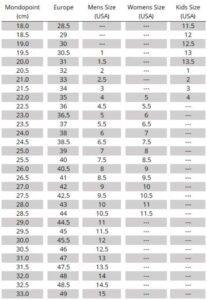
For skiers in the United States, a 28.5 ski boot size usually equals a US men’s 10.5. It is a Mondopoint size, which means the boot is made for a foot about 28.5 centimeters long.
A 28.5 ski boot may also appear as:
- US men’s: About 10.5
- US women’s: About 11.5 to 12
- EU: About 44.5
- UK: About 9.5
- Foot length: About 28.5 cm, or 11.22 inches
These conversions are only a starting point. Ski boot brands use different shells, liners, and size charts. Your foot shape and shell fit matter more than the street-shoe number.


What Does 28.5 Mean in Ski Boots?
A 28.5 ski boot is a Mondopoint 28.5 boot. Mondopoint, often called Mondo sizing, measures foot length in centimeters.
The number is not the inside length of the boot. It is a size category based on the skier’s foot length. A skier with a 28.5 cm foot may fit a 28.5 boot, but the final choice depends on foot width, volume, instep height, and skiing ability.
A 28.5 boot usually shares the same shell size as a 28.0 boot. Many ski boot brands group half sizes together. The difference may come from the liner, footbed, or small fit changes rather than a larger plastic shell.
This matters because going from 28.5 to 29.5 may move you into a larger shell. That can create too much space and reduce control.
Mondopoint size compared with US shoe size
| Ski boot size | Approximate US men’s size | Approximate EU size | Foot length |
|---|---|---|---|
| 27.5 | 9.5 | 42.5 | 27.5 cm |
| 28.0 | 10 | 44 | 28.0 cm |
| 28.5 | 10.5 | 44.5 | 28.5 cm |
| 29.0 | 11 | 45 | 29.0 cm |
| 29.5 | 11.5 | 45.5 | 29.5 cm |
This table gives common conversions. It does not replace the chart for a specific boot model.
Is a 28.5 Ski Boot the Same as a US 10.5?
Usually, yes for men’s ski boots. A 28.5 ski boot commonly matches a US men’s 10.5. However, a US shoe size and a ski boot size measure different things.
Street shoes often have extra space for comfort. Ski boots should fit more closely. Your toes may touch the front of a new boot when you stand upright. When you bend your knees into a skiing stance, your toes should pull back slightly.
Women’s sizing can cause more confusion. A 28.5 ski boot may show as about a US women’s 11.5 or 12, depending on the brand. Women’s ski boots may also have a different cuff shape, liner, and lower-leg fit.
Always check the boot maker’s chart before buying. Look for the brand, model, and year. Charts can differ even when the Mondo number is the same.
Why street shoes can mislead you
A person who wears a US men’s 10.5 shoe may not need a 28.5 ski boot. Some skiers need 27.5 or 28.0 boots because street shoes often run long.


The reverse can also happen. A wide foot or high instep may need a larger-volume boot without needing a longer boot. Going up in length is not always the right fix.
The best fit comes from measuring both feet. Use the longer foot as the starting point. Then check the shell and liner fit.
How to Measure Your Foot for a 28.5 Ski Boot
Measure your feet at home before you shop. You need paper, a pencil, a ruler or tape measure, and the ski socks you plan to wear.
Follow these steps:
- Place a sheet of paper on a hard floor.
- Stand on the paper with your heel against a wall.
- Keep your weight evenly spread across both feet.
- Mark the end of your longest toe.
- Measure from the wall edge to the mark.
- Measure both feet.
- Use the longer measurement as your starting size.
Do not measure while sitting. Your foot can become longer when you stand because it spreads under body weight.
If your longer foot measures close to 28.5 cm, start by trying a 28.5 boot. If it measures 28.0 cm, a 28.0 boot may be a better starting point. Do not add extra space just because ski boots feel snug at first.
Measure width and volume too
Length is only one part of fit. Measure the widest part of your foot if you often feel pressure at the sides.
Ski boots are often described by last width. The last is the shape and width of the boot around the forefoot. Common categories include:
- Narrow: Often about 97–98 mm
- Medium: Often about 99–102 mm
- Wide: Often about 103 mm or more
These ranges are general. Brands measure lasts in different ways, and the same number may not feel the same across brands.
Also check your instep and heel. A boot that is long enough but loose around the heel can cause heel lift. That makes turns harder and can lead to rubbing or blisters.
How Should a 28.5 Ski Boot Fit?
A properly fitted 28.5 ski boot should feel firm, close, and secure. It should not cause sharp pain, numbness, or loss of circulation.
Use this quick fit check:
- Your toes may lightly touch the front when you stand straight.
- Your toes should move back when you bend your knees.
- Your heel should stay mostly in place when you flex forward.
- Your foot should not slide from side to side.
- You should feel even pressure, not one painful hot spot.
- Your lower leg should sit securely in the cuff.
New liners often feel firm. They can pack out after use. This means a boot that feels comfortably loose in the store may become too large after several ski days.


The shell-fit check
A boot fitter can remove the liner and place your foot inside the empty shell. This test shows how much space exists behind your heel.
A general shell-fit guide is:
- About 10 to 15 mm: snug performance fit
- About 15 to 20 mm: moderate comfort and control
- More than 20 mm: may be too large for many skiers
These are broad guidelines, not a rule for every foot or skier. A race fit may be tighter. A beginner or skier with unusual foot needs may require more room.
Do not judge fit by standing still only. Flex forward with your knees bent. Ski boots should hold your heel and ankle while allowing controlled ankle movement.
Should You Choose 28.0, 28.5, or 29.0?
Choose the size that matches your measured foot and gives a secure shell fit. Do not choose a larger boot to avoid normal initial snugness.
A useful example:
- Foot length: 28.2 cm
- Foot width: Medium
- Heel: Narrow
- Result: Try 28.0 and 28.5, then compare the shell fit
Another example:
- Foot length: 28.7 cm
- Foot width: Wide
- High instep
- Result: Start with 28.5 or 29.0, but first compare wide-fit models
The second skier may not need a longer boot. A wider or higher-volume 28.5 boot could work better than a narrow 29.0 boot.
Signs the boot is too small
A 28.5 boot may be too small if:
- Your toes stay jammed into the front while flexing.
- You feel sharp pressure on the toes.
- Your foot becomes numb quickly.
- Your heel lifts because you cannot settle into the shell.
- You cannot close the boot without extreme force.
- Pain remains after the liner warms and settles.
Do not assume that painful boots will always “break in.” Liners can soften, but they cannot fix a shell that is clearly too short.
Signs the boot is too large
The boot may be too large if:
- Your heel rises every time you flex.
- Your foot slides inside the liner.
- You must overtighten the buckles.
- Your toes curl to keep your foot from moving.
- You have poor edge control.
- The boot feels loose after the liner warms.
A larger boot can feel comfortable at first. On snow, it may reduce control and create pressure from over-tightening.
Do 28.5 Ski Boots Fit Men and Women Differently?
The Mondo length is the same for men and women, but the boot shape may differ. A women’s 28.5 boot is still based on a 28.5 cm foot, yet it may have a lower cuff, different calf position, or a narrower heel.


The right choice depends on your foot, not the gender label on the boot. Some women fit men’s boots well. Some men fit women’s boots well. The shell shape is more useful than the label.
Check these areas:
- Forefoot width
- Heel width
- Instep height
- Calf position
- Cuff height
- Overall boot volume
If a boot fits in length but feels loose around the calf or heel, try a different model before going up or down in size.
A professional boot fitter can adjust the liner, footbed, shell, and cuff. These changes may solve pressure points without changing the boot length.
Common Mistakes When Buying a 28.5 Ski Boot
The most common mistake is treating ski boots like casual shoes. Ski boots need a close fit because they transfer leg movement to the skis.
Avoid these errors:
Buying by street-shoe size alone
A US men’s 10.5 is a useful clue, not a final answer. Measure your feet and use the brand’s chart.
Choosing a larger size for comfort
Extra space can cause heel lift and weak control. Start with the correct length, then address width or pressure with the right model and professional adjustments.
Wearing thick socks
Thick socks can create pressure and reduce circulation. Use one thin, ski-specific sock. Avoid cotton because it holds moisture and dries slowly.
Ignoring the shell size
A 28.5 and 29.5 boot may not use the same shell. A larger shell can change the fit more than the half-size number suggests.
Judging fit after only one minute
Wear the boots for at least 15 to 20 minutes if possible. Flex forward several times. The liner may change as it warms.
Buckling too tightly
Tight buckles cannot fix a boot that is too large. They may also create pain or restrict blood flow.
Where to Get a 28.5 Ski Boot Fitted in the United States
A ski shop with a trained boot fitter is the safest place to confirm your size. Bring the socks, footbeds, and pants you use for skiing.


Ask the fitter to check:
- Foot length and width
- Shell fit without the liner
- Heel hold
- Instep pressure
- Cuff fit
- Flex and stance
- Possible molding or shell work
If you buy online, confirm the return policy before heating or molding the liner. A boot that has been modified may not qualify for return.
For reliable reference, compare the boot maker’s current size chart with fitting guidance from established ski retailers and manufacturers. Examples include REI’s ski boot fitting guidance and the official sizing pages from brands such as Salomon, Atomic, Tecnica, Lange, Nordica, and Rossignol.
Brand charts provide documented size conversions. They do not guarantee that a boot will fit your foot shape.
Key Takeaways
- 28.5 ski boot size usually equals US men’s 10.5.
- It means a Mondopoint foot length of about 28.5 cm.
- EU sizing is often about 44.5, but brand charts vary.
- A 28.5 boot may share its shell with a 28.0 boot.
- Measure both feet while standing.
- Use the longer foot as your starting point.
- Check width, instep, heel, and cuff fit.
- Do not choose a larger boot just to avoid normal snugness.
- See a professional boot fitter if you have pain, numbness, heel lift, or unusual foot shape.
FAQs About 28.5 Ski Boot Size
What US size is a 28.5 ski boot?
A 28.5 ski boot is usually a US men’s 10.5. For women, it often falls near a US 11.5 or 12. Check the exact brand chart before buying.
Is a 28.5 ski boot good for an 11-inch foot?
Yes, it may be. A 28.5 cm foot equals about 11.22 inches, so an 11-inch foot may fit near this size. Measure while standing because foot length can increase under body weight.
Is 28.5 the same as 28.0 in ski boots?
Often, 28.0 and 28.5 use the same shell. The liner or internal fit may differ. This depends on the manufacturer and model.
Should my toes touch the end of a 28.5 ski boot?
Your toes may lightly touch the front when you stand upright. When you bend your knees into a ski stance, your toes should pull back slightly. Constant pressure while flexing suggests the boot may be too short.
Can I use a 28.5 ski boot if I wear a US men’s 11 shoe?
Possibly. Street shoe sizes vary, and ski boots fit more closely. Measure your feet and test the shell fit instead of relying on the shoe label.
What should I do if my 28.5 boots hurt?
First, stop if you feel numbness, sharp pain, or loss of circulation. A boot fitter can check shell length, width, liner fit, and pressure points. Do not keep skiing through severe pain.
Conclusion
A 28.5 ski boot is generally a US men’s 10.5 and is designed for a foot around 28.5 centimeters long. That conversion gives you a useful starting point, but it does not confirm the right fit.
Measure both feet, compare the manufacturer’s chart, and check the shell. The best 28.5 boot is the one that holds your heel, supports your foot, and lets you flex without pain or numbness. If the fit is unclear, a professional boot fitter can save you from buying the wrong size.
Madison Clark is a footwear expert and the voice behind MyStyleGrid.com. She specializes in honest shoe reviews, style tips, and practical guides to help readers find the perfect pair for any occasion. With years of experience in blogging and content creation, Madison makes footwear knowledge simple, stylish, and easy to follow.