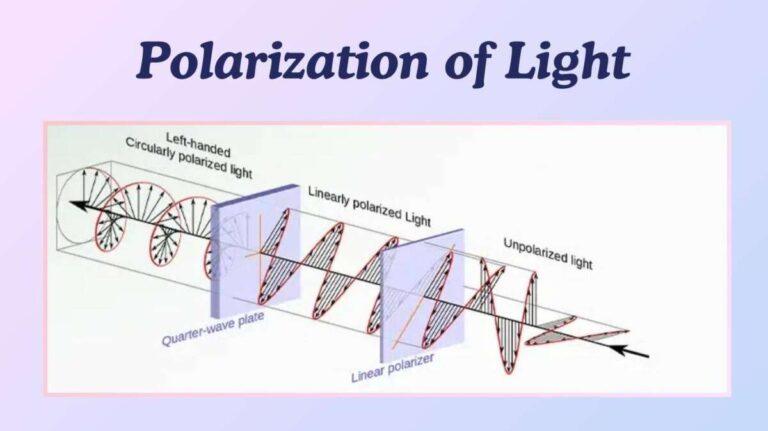
Polarized sunglasses block blinding glare by filtering light waves that vibrate in one direction.
If you have driven near water, skied on a bright day, or walked across fresh snow, you have felt glare turn the world into a harsh mirror. Understanding how do polarizing sunglasses work helps you choose the right lenses, use them safely, and avoid common myths about eye protection.
What Are Polarizing Sunglasses?
Polarizing sunglasses are eyewear with a special filter inside each lens. This filter reduces intense reflected light, known as glare, before it reaches your eyes.
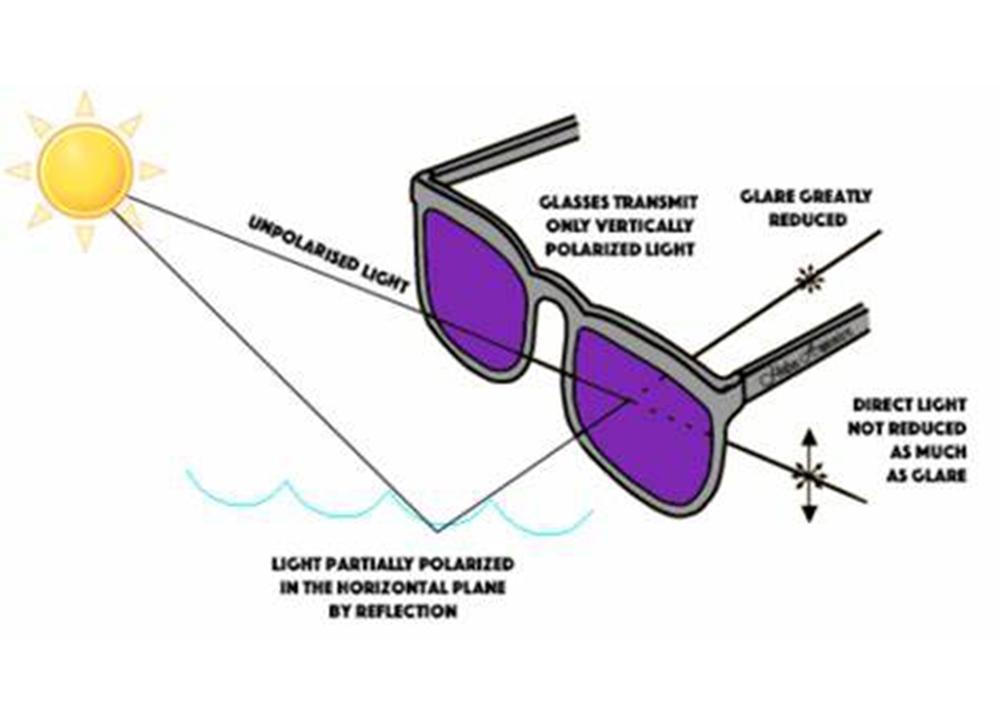
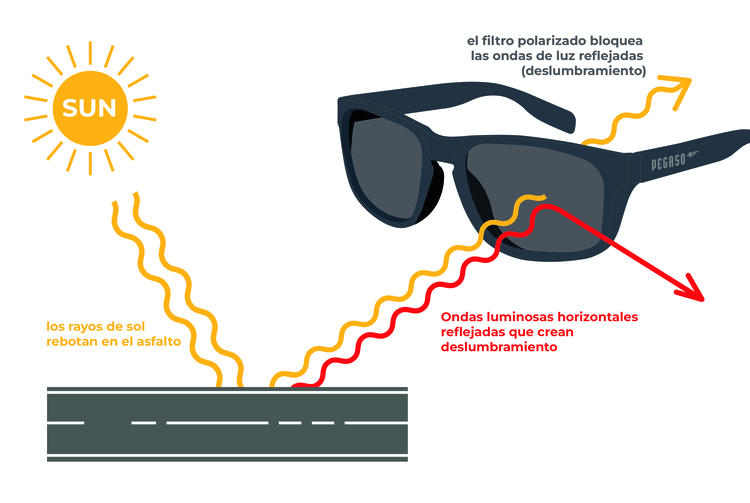
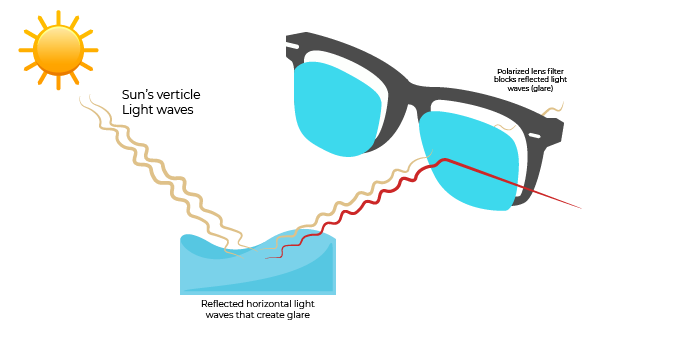
To understand how do polarizing sunglasses work, it helps to know that sunlight travels as waves. These waves move in many directions. When sunlight hits a flat surface, such as water, glass, snow, or a road, much of the reflected light becomes organized in a mostly horizontal direction.
That organized light is the glare you notice as bright streaks or wide patches. A polarizing filter blocks much of this horizontal light while allowing more useful vertical light to pass through.
The result is often:
- Less glare
- Better visual comfort
- Improved contrast
- Fewer squints
- A clearer view of details
Polarized lenses do not make everything darker in the same way. They selectively reduce a type of light that often causes the most visual discomfort.
How Do Polarizing Sunglasses Work?
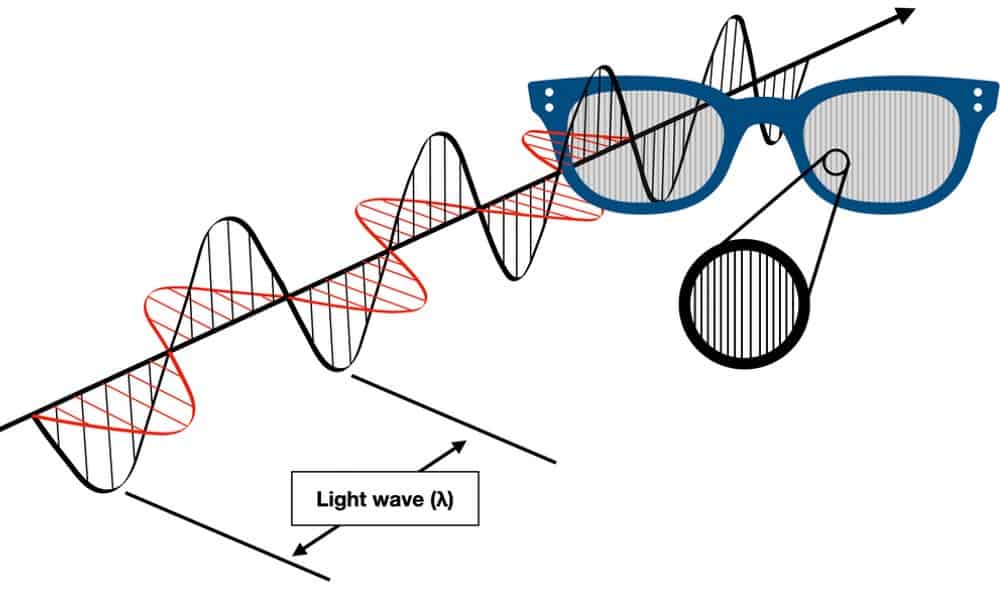
The main working part is a thin polarizing film placed between layers of lens material. This film contains long, aligned molecules that absorb light waves vibrating in one direction.
Think of the filter as a narrow gate. Light waves moving in the blocked direction cannot pass well. Light waves moving in the allowed direction pass through with less resistance.
Here is the process in simple steps:
- Sunlight travels toward a surface.
- The surface reflects some of that light.
- A flat surface tends to organize reflected light horizontally.
- The polarized lens blocks much of that horizontal light.
- Your eyes receive less glare and more useful visual information.
This is the basic answer to how do polarizing sunglasses work. They do not remove all light. They reduce a specific pattern of reflected light.
Polarization works best when glare comes from a broad, flat surface. That is why polarized sunglasses can feel highly effective near:
- Lakes and oceans
- Wet roads
- Car hoods
- Glass buildings
- Snowfields
- Sand and pale pavement
They are less effective against light from a cloudy sky, a rough wall, or a small bright point. Those surfaces scatter light in many directions, so the filter cannot block all of it.
Why Reflected Light Creates Glare
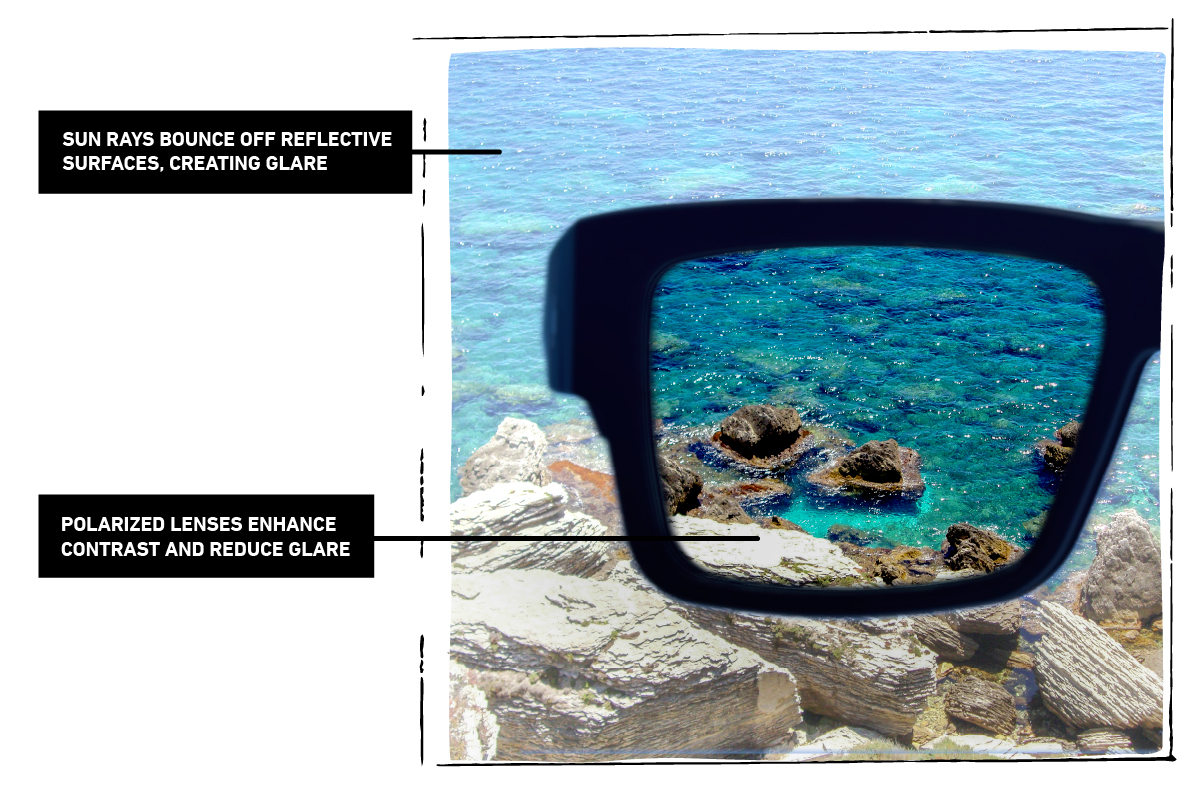
Glare is more than simple brightness. It is stray light that enters your eyes and reduces the difference between light and dark areas.
Imagine trying to read a road sign while a flashlight shines toward you. The light does not just look bright. It makes nearby details harder to see. Reflected sunlight can create the same problem on a larger scale.
Water is a classic example. Sunlight hits the surface, reflects toward you, and creates a broad, shimmering path. Wet pavement can do this after rain. Snow can be even more intense because its bright surface reflects a large amount of sunlight.
This explains how do polarizing sunglasses work in daily life. The lenses target the reflected light that washes out visual details.
Glare can also cause:
- Eye strain
- Squinting
- Headaches in sensitive people
- Temporary loss of visual comfort
- Difficulty seeing hazards
Polarized lenses may make driving, boating, fishing, hiking, and skiing more comfortable. Still, they cannot remove every visual risk. You must continue to use safe speeds, proper lighting, and good judgment.
Polarized Versus Nonpolarized Sunglasses
Regular tinted sunglasses reduce the total amount of light entering the eyes. They may make the scene darker, but they do not usually target the direction of reflected light.
Polarized sunglasses combine tint with a glare filter. This difference explains why two sunglasses with the same darkness can feel very different outdoors.
A regular gray lens may reduce general brightness. A polarized gray lens may also reduce the harsh reflection from a lake or road.
The key differences include:
| Feature | Regular sunglasses | Polarized sunglasses |
|---|---|---|
| Reduces overall brightness | Yes | Yes |
| Blocks reflected glare | Limited | Stronger |
| Improves comfort near water | Sometimes | Often |
| Helps with road glare | Somewhat | Often |
| Works with every digital screen | Usually | Not always |
Many people ask how do polarizing sunglasses work compared with ordinary tinted glasses. The short answer is that ordinary lenses mainly reduce intensity, while polarized lenses reduce both intensity and a particular direction of light.
Tint color and polarization are separate features. A dark lens is not automatically polarized, and a light lens can still have a strong polarizing filter.
Benefits of Polarized Sunglasses
Better comfort outdoors
Polarized lenses can reduce the need to squint in bright conditions. This may help your eyes feel less tired during long outdoor activities.
For example, anglers often notice less surface sparkle when looking across water. Drivers may also find wet roads less distracting during the day.
Improved contrast
Glare can cover small changes in color and brightness. When the glare drops, objects may look more distinct.
A shoreline, trail edge, lane marking, or floating object may stand out more clearly. This does not guarantee sharper vision, but it can improve the visual scene.
Reduced reflected glare while driving
Bright roads can reflect sunlight directly into your eyes. Polarized sunglasses may reduce that reflection and make the drive feel calmer.
They do not replace a clean windshield. Interior dashboard reflections, dirty glass, and poor wiper blades can still reduce visibility.
More comfortable water and snow activities
Water and snow reflect large amounts of light. Polarized lenses can make these environments easier on the eyes.
Skiers and snowboarders should still check conditions carefully. Polarization can reduce glare, but it cannot reveal every patch of ice, bump, or change in terrain.
Support for comfortable vision
Some people are especially sensitive to bright light. Polarized sunglasses may offer useful comfort for them, although they do not treat a medical eye condition.
If bright light causes ongoing pain, blurred vision, or headaches, an eye care professional should evaluate the cause.
Limitations of Polarized Sunglasses
Polarized sunglasses are useful, but they are not perfect. Knowing their limits is part of understanding how do polarizing sunglasses work.
One limitation is that they can make some liquid crystal display screens look dim, striped, or completely dark. This may happen with:
- Car dashboards
- ATMs
- Smartphones
- GPS devices
- Some watches
- Certain aircraft displays
The effect depends on the screen and the angle of your head. Turning the device or tilting your head may change what you see.
Polarization can also reduce useful reflections in some situations. A pilot, driver, or worker may need to see reflections from a surface to judge moisture, ice, or another condition.
Another point matters even more: polarization does not equal ultraviolet protection. A lens can be polarized without blocking all UVA and UVB rays. Look for clear labeling that says the sunglasses provide 99% to 100% UV protection or UV400 protection.
Darkness alone does not prove safety. In fact, dark lenses without proper UV protection can allow your pupils to open wider while harmful ultraviolet light still enters.
Are Polarized Sunglasses Safe for Driving?
For daytime driving, polarized sunglasses are usually safe and helpful for many people. They can reduce glare from roads, nearby vehicles, and wet surfaces.
Choose lenses that preserve natural color and do not make the scene too dark. Gray and brown tints are common choices because they usually provide balanced vision.
Use extra care in these situations:
- Driving at night
- Entering a tunnel
- Moving between bright and dark areas
- Reading dashboard screens
- Flying an aircraft
- Driving when visibility is already poor
Never use sunglasses that make it hard to see lane markings, signs, or pedestrians. Keep a clear pair in your vehicle for changing conditions.
A practical lesson from comparing sunglasses on long road trips is simple: test them before relying on them. Check your mirrors, dashboard, road signs, and windshield reflections during daylight. If the lenses hide important details, choose another pair.
This is another real-world example of how do polarizing sunglasses work. The filter can reduce glare, but your overall visual needs should guide the choice.
How to Choose the Best Polarized Sunglasses
Start with protection, not style. Look for lenses that clearly state they block 99% to 100% of UVA and UVB radiation.
Then consider these factors:
Lens color
Gray lenses usually keep colors close to natural. Brown or amber lenses can increase the sense of contrast in some outdoor settings. Green lenses offer a middle ground between color balance and contrast.
No color is best for every person or activity. Comfort and visual clarity matter most.
Lens quality
High-quality lenses should provide even color and minimal distortion. Hold the sunglasses at arm’s length and look through them at a straight line. Move the glasses slowly. If the line bends or shifts sharply, the lens may have poor optical quality.
Fit and coverage
Frames should sit comfortably without sliding. Larger lenses and wraparound designs can reduce light entering from the sides.
A good fit also helps block wind, dust, and stray sunlight. However, side coverage does not replace UV-rated lenses.
Impact resistance
For sports and active work, consider polycarbonate or other impact-resistant materials. Safety glasses should meet the correct workplace or sports standard, such as an applicable ANSI rating.
Impact resistance and polarization are different features. A polarized lens is not automatically protective against flying objects.
Prescription needs
Many prescription sunglasses can include a polarizing filter. Ask your optician whether the lens material, curve, and prescription work well together.
How to Test Whether Sunglasses Are Polarized
You can perform a basic home test with another known polarized lens or a compatible LCD screen.
Hold the sunglasses in front of the screen. Slowly rotate the sunglasses or tilt them about 90 degrees. If the screen becomes much darker, the lenses are likely polarized.
This test is useful, but it does not measure lens quality or UV protection. A pair can pass the polarization test and still have poor optics or weak UV labeling.
You can also compare two pairs outdoors. Look at a reflective surface, such as water or a car hood, then rotate your head or switch glasses. A polarized pair should usually reduce the bright reflection more noticeably.
Avoid judging polarization by darkness alone. Very dark nonpolarized sunglasses can look impressive but may offer less glare control.
When people ask how do polarizing sunglasses work, this test gives them a simple visual demonstration. The screen or reflected surface changes because the filter blocks light based on its direction.
Polarized Sunglasses and UV Protection
Ultraviolet radiation is invisible energy from the sun. Long-term exposure can contribute to several eye and skin problems, including damage to the tissues around the eyes.
Polarization mainly manages visible glare. UV protection blocks ultraviolet wavelengths. These functions can exist together, but they are not the same.
Choose sunglasses labeled with one of these claims: