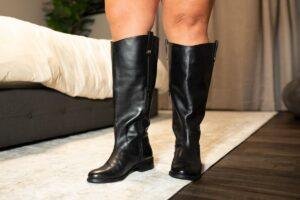
Introduction
To measure for wide calf boots, measure the widest part of your calf while standing, wearing the socks or clothing you plan to wear with the boots. Compare that number with the boot’s shaft circumference, not just a label such as “wide calf.”
Measure both legs, check the boot’s shaft height, and leave enough room for comfort. A correct calf measurement helps prevent tight spots, gaps, sliding, and the frustration of boots that will not zip in the United States.

What You Need Before Measuring
You need only a few basic items:
- A soft measuring tape
- A pen and paper or your phone
- The socks, tights, or pants you plan to wear
- A flat floor and a mirror, if possible
- The boot’s size chart, if you already have a style in mind
Do not measure while sitting. Your calf changes shape when your leg is bent or relaxed in a chair. Stand upright with your weight spread evenly across both feet.
If you do not have a soft tape, wrap a strip of paper, ribbon, or string around your calf. Mark where it meets, then measure that length against a ruler or firm tape measure.
Key Terms to Know
Calf circumference is the distance around the widest part of your calf.
Shaft circumference is the distance around the top opening of the boot. This is the measurement that must fit around your calf.
Shaft height is the distance from the top of the boot shaft to the sole. A tall boot may reach below the knee, while a mid-calf boot stops lower.
Boot shaft means the upper part of the boot that covers your lower leg. It is separate from the foot and ankle area.
A boot may have enough calf room but still feel tight at the ankle, instep, or foot. Check those measurements too when the brand provides them.
How to Measure Your Calf for Boots
Follow these steps for the most useful measurement.
1. Put on your usual socks or clothing
Wear the socks, leggings, jeans, or other layers you expect to wear with the boots. Thick clothing can add noticeable bulk.
For a dress boot worn over bare legs or thin tights, measure with thin socks. For a winter boot worn over jeans, measure over the jeans.
2. Stand in a natural position
Stand straight with your feet about hip-width apart. Keep your legs relaxed, but do not shift all your weight to one side.
Your calf should be in its normal shape. Do not flex the muscle, pull your leg inward, or push the tape into the skin.
3. Find the widest part of your calf
Move the tape up and down your lower leg until you find the widest point. This point is often below the knee, but its location differs from person to person.
Use a mirror or ask someone to help. It can be hard to keep the tape level while checking the measurement.
4. Wrap the tape around your calf
Place the tape around the widest part of your calf. Keep it:
- Level with the floor
- Flat against the clothing
- Snug but not tight
- Free from twists
- Loose enough to avoid pressing into your skin
The tape should touch your leg all the way around. Do not add extra space by pulling it away from your calf.
5. Record the measurement
Write down the result in inches and centimeters if possible. Most U.S. boot charts use inches, but some brands also list centimeters.
For example:
Right calf: 16.25 inches
Left calf: 16.5 inches
Use the larger measurement when comparing your size with a boot chart.
6. Repeat the measurement
Measure each calf at least twice. If the results differ, check your tape position and measure again.
Your legs may not be exactly the same size. This is common. Choose a boot that fits the larger calf, or look for a style with adjustable features such as laces, elastic panels, or a stretch shaft.
How Much Extra Room Should Wide Calf Boots Have?
Choose a shaft circumference that is slightly larger than your calf measurement, but avoid a large gap unless the boot design calls for one.
A practical starting point is about 0.25 to 0.5 inch of extra room for thin socks or tights. You may need more room for thick socks, pants, swelling during the day, or a firm leather shaft with little give.
This is a fitting guideline, not a universal rule. The right amount depends on the material, lining, shaft shape, and how you want the boot to fit.
| Intended wear | Calf measurement | Starting shaft range |
|---|---|---|
| Bare legs or thin tights | 15 inches | About 15.25–15.5 inches |
| Thin socks | 16 inches | About 16.25–16.5 inches |
| Jeans or thick pants | 17 inches | About 17.5–18 inches |
| Thick winter layers | 18 inches | About 18.5 inches or more |
These examples are hypothetical. Always compare your measurement with the specific brand’s chart.
A close fit can look neat, but the boot should not pinch, leave deep marks, or make sitting and walking uncomfortable. If you prefer to tuck pants into boots, measure over the pants you will wear.
How to Compare Your Measurement With a Boot Size Chart
Look for the boot’s shaft circumference or opening circumference. Compare it with your larger calf measurement.
For example, suppose your larger calf measures 16.5 inches:
- A 15.5-inch shaft is likely too small.
- A 16.5-inch shaft may fit closely, depending on the material.
- A 17-inch shaft gives about 0.5 inch of extra room.
- An 18-inch shaft may feel loose unless the boot has a wider shape or you wear thick layers.
Do not assume that the label “wide calf” means the same thing across brands. One company may define wide calf as 16 inches, while another may offer 18 inches or more.
Check whether the listed shaft measurement applies to your shoe size. Some brands list a shaft circumference for one sample size and increase or decrease it for other sizes. A boot opening may be wider in a larger shoe size.
Also check how the brand measures the shaft:
- At the very top opening
- At a stated distance from the sole
- With the boot flat
- With the shaft stretched or unstretched
- At a particular shoe size
If the method is unclear, contact the brand before ordering. A measurement without a method is harder to compare.
Measure More Than Your Calf
Calf circumference is the main measurement, but it is not the only one that affects fit.
Foot length and width
Measure your foot according to the brand’s instructions. A boot can fit your calf and still feel too short or narrow in the foot.
Check whether the style comes in wide or extra-wide foot widths if you need more room across the toes or ball of the foot.
Ankle circumference
Some tall boots taper sharply from the calf to the ankle. Measure around the narrowest part of your ankle if the brand provides an ankle chart.
This is especially useful for boots with a fitted shaft. A boot with a large calf opening may still feel loose at the ankle.
Instep height
The instep is the top part of your foot. A high instep can make pull-on boots difficult to put on, even when the foot length is correct.
Pull-on styles may need more room across the instep than zip-up styles. Look for stretch panels, adjustable laces, or a side zip if you often struggle to get boots over your foot.
Shaft height
Measure from the floor beside your leg to the point where you want the boot to end. Compare this with the listed shaft height.
A shaft that ends directly at the widest part of your calf may feel tighter than one that ends above or below it. The boot’s shape matters as much as the number.
Measuring for Different Boot Materials
The boot material changes how much room you need.
Leather boots
Leather may soften with wear, but it should not be expected to stretch enough to correct a major size mismatch. A boot that is clearly too small can remain uncomfortable.
Choose a size that fits without strong pressure from the start. Leather stretching also varies by leather type, lining, seams, and construction.
Stretch fabric or elastic panels
Stretch fabric can accommodate small differences in calf size. Read the product details carefully to see whether the measurement is the unstretched or expanded circumference.
Stretch does not always mean unlimited room. Overstretching can place pressure on the zipper or seams and may cause the boot to lose its shape.
Rubber and synthetic materials
Rubber and many synthetic materials may have limited stretch. Flexible rubber can feel different from stiff molded rubber, so rely on the listed measurements rather than the material name alone.
Lace-up and adjustable boots
Lace-up boots offer more control over fit. They can be useful when one leg is larger or when you want to change the fit for different clothing layers.
Adjustable buckles, gussets, and elastic inserts can also help. Still, measure first. Adjustability does not replace enough base room in the shaft.
When Should You Measure Your Calves?
Measure when your legs are at their largest during normal wear.
For many people, this means measuring later in the day rather than immediately after waking. Standing, walking, heat, and daily activity can change how your legs feel and fit inside clothing.
If your leg size changes because of swelling, measure at the time you expect to wear the boots. Do not force a boot that causes pain, numbness, tingling, skin color changes, or strong pressure.
If you have ongoing or unexplained leg swelling, ask a qualified health professional for guidance before choosing tight footwear. A boot measurement guide cannot determine the cause of swelling or tell you what level of compression is safe.
What to Do if Your Boots Do Not Fit
The problem can usually be narrowed down by checking where the boot feels wrong.
The zipper will not close
First, confirm that you measured the widest part of your calf and that the boot is sitting at its intended height. Then compare your measurement with the boot’s actual shaft circumference.
If your calf is larger than the listed opening, do not force the zipper. Consider a larger shaft, a stretch panel, or an adjustable style.
The boot fits at the top but feels tight lower down
The shaft may taper too much at the ankle or instep. Check the ankle and foot measurements, not only the top opening.
A different shaft shape may solve the problem better than simply choosing a larger calf size.
The boot closes but feels too tight
A closed zipper does not prove a good fit. Walk, sit, and bend your knee. The boot should not cause pain, pinching, numbness, or deep marks.
Try the boots with your normal socks and clothing. If they remain tight, exchange them for more room rather than hoping they will stretch substantially.
The boot feels loose and slides down
The shaft may be too large, too smooth inside, or too short for your leg shape. A fitted style, adjustable closure, or removable boot insert may help.
Do not add bulky layers that create pressure around the calf. If the boot slides because the top is much wider than your calf, choose a narrower opening or a style with a more shaped shaft.
One boot fits and the other does not
Use the larger calf as your main measurement. Look for adjustable closures or stretch materials when the difference is significant.
If the difference is new, marked, or linked with pain or swelling, seek medical advice rather than treating it only as a boot-sizing issue.
Common Measuring Mistakes to Avoid
Avoid these errors when measuring for wide calf boots:
- Measuring while seated: Your calf may be smaller or shaped differently.
- Measuring the wrong spot: The ankle or knee is not the calf’s widest point.
- Pulling the tape tight: This produces a measurement that is too small.
- Ignoring clothing: Jeans and thick socks add real bulk.
- Measuring only one leg: The other calf may be larger.
- Using calf width instead of circumference: Boot charts usually list the distance around the opening.
- Trusting the word “wide”: Width labels are not standardized across brands.
- Ignoring shaft height: The opening may sit at a wider part of your leg.
- Forcing a zipper: This can damage the boot and create painful pressure.
- Assuming leather will solve a poor fit: Natural materials may soften, but major sizing errors remain.
The goal is not the smallest measurement that lets the zipper close. The goal is a boot that fits while you stand, walk, sit, and wear your normal layers.
Quick Measurement Checklist
Before ordering wide calf boots, confirm that you have:
- Measured while standing
- Found the widest part of each calf
- Worn your usual socks or pants
- Recorded both measurements
- Used the larger calf measurement
- Checked shaft circumference
- Checked shaft height
- Reviewed ankle, instep, foot length, and foot width details
- Allowed practical room for movement and clothing
- Read the brand’s return and exchange rules
Keep your measurements in your phone. You can reuse them when comparing different U.S. brands and boot styles.
FAQs About Measuring for Wide Calf Boots
Should I measure my calf in the morning or at night?
Measure when your legs are likely to be at their largest during normal wear. For many people, that is later in the day. If you plan to wear the boots at a specific time, measure under similar conditions.
How much bigger should wide calf boots be than my calf?
A small amount of extra room is usually more useful than an exact, skin-tight match. About 0.25 to 0.5 inch can be a starting point for thin layers, while pants, thick socks, or changing leg size may require more. The boot material and shape can change the result.
Do wide calf boots fit wide feet?
Not necessarily. “Wide calf” describes the lower-leg opening. It does not automatically mean the boot has a wide toe box, wide footbed, or extra instep room.
Can I measure my calf with a regular tape measure?
Yes, if the tape can wrap around your leg without bending or cutting into the skin. A soft sewing tape works best. You can also use string or paper and measure it afterward.
What if my calf is between two sizes?
Choose based on the larger measurement and the layers you plan to wear. If the boot has elastic, laces, or an adjustable gusset, the smaller option may work in some cases. If the material is stiff and non-adjustable, more room is usually safer for comfort.
Conclusion
To measure for wide calf boots, stand up, wear your usual layers, and measure around the widest part of both calves. Use the larger number, compare it with the boot’s shaft circumference, and check the shaft height, ankle, instep, and foot measurements before ordering.
If the boot feels painful, causes numbness, or leaves strong marks, it does not fit correctly even if it zips. Measure again, choose a different shaft shape or opening, and use adjustable features when your legs differ in size.
Rubel Miah is the Senior Editor at MyStyleGrid.com, where he brings a sharp editorial eye and an unshakable love for fashion to everything he does. A true style addict, Rubel lives and breathes trends, from streetwear to high fashion, and has a knack for turning inspiration into impactful stories. With years of experience in fashion journalism and digital media, he curates content that empowers readers to express themselves through style. When he’s not editing features or forecasting the next big thing, you’ll find him hunting down vintage pieces or capturing street style moments around the city.