The H in a shoe size usually refers to a wide or extra-wide shoe width, but its meaning varies by brand and country.
If you have ever seen a label such as “10H” or “8 H” and wondered what it means, you are not alone. Shoe width letters are not fully standardized, so the answer depends on the sizing system, the shoe brand, and where the letter appears. This guide explains what the H means in shoe size, how it compares with other width codes, and how to choose a better fit with confidence.
What does the H mean in shoe size?
In most shoe size charts, H describes a wide, extra-wide, or very wide shoe width. It usually refers to the space across the ball of the foot, not the length of the shoe.
For example, a shoe marked “9H” may mean:
• Size 9 in length
• H width across the forefoot
• A fit made for feet that need more room than a standard width
However, what does the H mean in shoe size can change from one brand to another. One company may use H for extra wide, while another may use it for a special width, a half size, or an internal product code.
The most important clue is the position of the H:
• If the H comes after the number, such as 9H, it often describes width.
• If the H appears in a product name, it may be a model or style code.
• If the listing says “half,” the brand may use H to describe a half size, though this is less common.
• If the shoe is from the United Kingdom, Europe, Japan, or another market, the width system may differ from the U.S. system.
In everyday U.S. footwear shopping, H most often signals a wide or extra-wide fit. Still, you should check the brand’s own size chart before ordering.
Is H a shoe size or a shoe width?
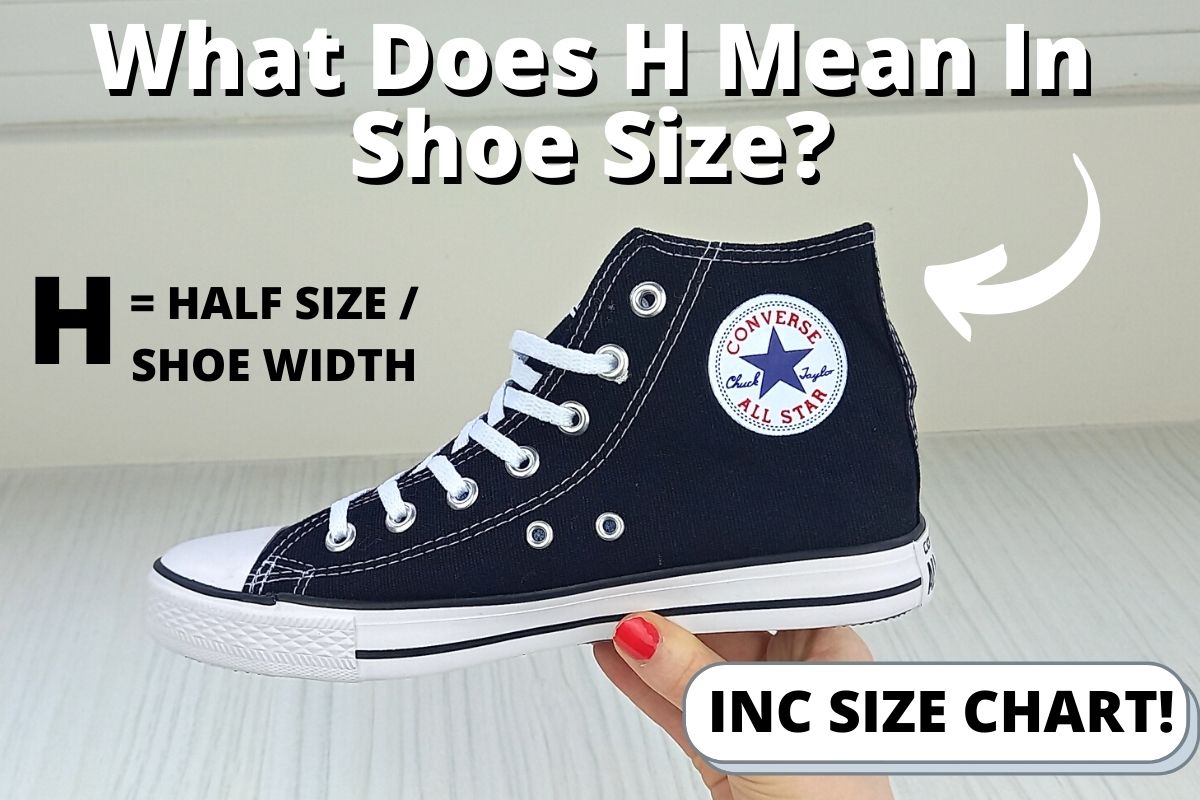
H is usually a shoe width, not a shoe length. The number shows the length, while the letter shows how wide the shoe is.
Think of shoe sizing like buying a pair of jeans. The number may show the waist size, while another measurement shows the leg length. Shoes work in a similar way. A size 10 shoe can come in narrow, medium, wide, or extra-wide widths.
For example:
| Shoe marking | Common meaning |
|---|---|
| 8D | Size 8, standard men’s width |
| 8B | Size 8, narrow or standard women’s width |
| 8E | Size 8, wide width |
| 8EE or 8 2E | Size 8, extra-wide width |
| 8H | Size 8, wide or extra-wide width in some systems |
The exact meaning depends on the manufacturer. This is why knowing what does the H mean in shoe size is helpful, but it is not enough by itself to guarantee a good fit.
A letter does not tell you the full shape of the shoe. Two shoes with an H width can still differ in toe room, arch shape, heel width, and upper height.

How H width compares with other shoe width letters
Shoe width letters can feel like a secret code. In reality, they show how much room a shoe offers across the foot. The challenge is that brands do not all use the same code.
Common U.S. width letters
In the United States, these letters are common:
• AAA or 3A: Very narrow
• AA or 2A: Narrow
• A: Narrow, often used in women’s shoes
• B: Standard women’s width
• C: Slightly wide in some women’s charts
• D: Standard men’s width
• E: Wide
• EE or 2E: Extra wide
• EEE or 3E: Very wide
• 4E and 6E: Extra-wide and specialty widths
H is not used consistently in every U.S. shoe chart. Some brands use H after E, while others stop at 4E or use another code for extra width.
H width in United Kingdom sizing
British shoe widths often use letters in a sequence such as F, G, and H. In many U.K. charts:
• F may represent a standard or medium width
• G may represent a wide width
• H may represent an extra-wide width
This is not a universal rule. Some U.K. makers use different fittings for men, women, children, and specific shoe styles.
European shoe sizing
European shoe sizes usually focus on foot length. Many European brands do not use a simple letter system like U.S. shoes.
A European brand may use:
• A separate width word
• A numerical width code
• A letter such as W for wide
• A manufacturer-specific fitting system
When buying European shoes, do not assume that H has the same meaning as it does in a U.S. or U.K. size chart.
Why shoe width letters are not fully standardized
The main reason is that shoe sizing is not governed by one worldwide system. Different companies measure lasts, uppers, and widths in different ways.
A shoe last is the mold used to shape the shoe. Even when two shoes show the same size and width, their lasts may have different forms. One may have a broad toe box and a narrow heel. Another may have a round toe and a roomy midfoot.
This means the answer to what does the H mean in shoe size is only a starting point. You also need to consider:
• The country where the shoe was made
• The brand’s width chart
• Whether the shoe is for men, women, or children
• The shoe’s material and construction
• The shape of your foot
• Whether the shoe is athletic, dress, work, or casual footwear
Leather may soften over time, but it should not be expected to stretch several sizes. Synthetic materials often stretch less. A shoe that feels painfully tight in the store is unlikely to become truly comfortable later.
Industry sizing guidance commonly recommends measuring both feet and fitting the larger foot. Feet can also swell during the day, so an afternoon or evening fitting may provide a more realistic result.
How to tell whether you need an H-width shoe
You may need an H-width shoe if standard footwear presses against the sides of your feet. Width problems often appear at the ball of the foot, near the little toe, or across the upper part of the foot.
Common signs include:
• Red marks along the sides of your feet
• Numbness or tingling in your toes
• A little toe that rubs against the shoe
• Blisters near the widest part of the foot
• Pain after standing or walking
• Your foot spilling over the edge of the sole
• Laces that seem too tight even when the shoe is the right length
A shoe that is too long can also feel tight if your foot slides forward. Before choosing a wider size, check the length. Your toes should have enough space to move, but your heel should not lift heavily with each step.
A simple home check can help:
- Place your foot on a sheet of paper while standing.
- Trace around the foot, keeping the pencil upright.
- Measure the longest point for length.
- Measure the widest point for width.
- Repeat the process for the other foot.
- Compare both measurements with the brand’s chart.
Your feet are often slightly different sizes. That is normal. Choose the size that fits the larger foot, then use a thin insole or heel grip if the other shoe feels loose.
What does the H mean in shoe size for men and women?
For men, H commonly indicates a wide or extra-wide fit in systems that use H as a width code. A standard men’s width is often D, while E, EE, or H may provide more room.
For women, H may also mean wide or extra-wide, but the comparison can differ. A standard women’s width is often B, and a women’s wide width may be labeled D or W. Some brands use H for a much wider fit.
This difference matters because a men’s D and a women’s D do not always provide the same fit. Width letters are linked to the shoe’s size and intended sizing category. A D in a women’s chart may be wide, while D in a men’s chart is commonly medium.
Always look for labels such as:
• Men’s medium
• Women’s wide
• Extra wide
• U.K. fitting H
• U.S. 2E or 4E
• Brand-specific width code
The letter alone cannot tell you everything. The chart must show how that brand defines the width.

What does the H mean in shoe size for children?
In children’s shoes, H may refer to a wide or extra-wide fit, but children’s sizing can be especially inconsistent. Some brands use letters such as M, W, XW, or H. Others use a color system or words instead of letters.
Children’s feet change quickly. A child may need more width because of a broad forefoot, a high instep, or natural foot growth. However, buying a much larger shoe to allow growth can cause slipping, tripping, and poor support.
When checking a child’s fit:
• Leave about a thumb’s width of space in front of the longest toe.
• Check that the heel stays in place while walking.
• Look for red marks after the child removes the shoe.
• Make sure the toes can spread naturally.
• Recheck the fit every few months.
Children may not always explain that shoes hurt. Watch how they walk and whether they remove the shoes often. A child who avoids active play may be reacting to poor footwear.

Does H mean half size in shoes?
In most modern shoe charts, H does not mean half size. Half sizes are usually written with a decimal, such as 8.5, or with a fraction, such as 8½.
Still, some sellers or manufacturers may use unusual codes. An H could appear as part of an internal product number, a factory code, or a regional sizing label.
To avoid confusion, inspect the full listing:
• Is the H next to the size number?
• Does the product page mention width?
• Is the shoe listed as wide or extra wide?
• Does the brand provide a width chart?
• Is the size shown as 8H, 8½, or H8?
If the listing is unclear, ask the retailer before buying. This small step can prevent the hassle of returns and an uncomfortable pair of shoes.

How to choose the right H-width shoe
Once you know what does the H mean in shoe size, the next step is checking whether that width matches your foot. The best fit should feel secure without squeezing or forcing your toes together.
Use this practical process:
- Measure both feet while standing.
- Measure them late in the day when they are largest.
- Wear the socks you plan to use with the shoes.
- Check the brand’s length and width chart.
- Try both shoes and walk on a firm surface.
- Check the toe room, heel grip, and side pressure.
- Keep the shoes on for several minutes before deciding.
The widest part of your foot should sit over the widest part of the shoe. Your toes should not touch the front, and the upper should not create deep pressure lines.
For running shoes, hiking boots, and work shoes, also check the fit during movement. Feet can swell and slide during long walks. A shoe that feels fine for two minutes may feel too tight after an hour.
From common fitting mistakes, one lesson stands out: people often choose a longer shoe when they really need a wider one. That extra length can make the heel slip and increase the risk of blisters. If your toes have plenty of room but the sides feel tight, compare wider widths before going up in length.
Common mistakes when buying H-width shoes
Understanding what does the H mean in shoe size helps, but several mistakes can still lead to a poor fit.
Assuming every H width is the same
An H shoe from one brand may not feel like an H shoe from another. The shoe shape, materials, and measurement method all affect the final fit.
Ignoring the shoe’s intended use
A dress shoe may have less flexibility than a walking shoe. A work boot may need extra room for thick socks. Choose the width for the activity, not just the label.
Measuring only one foot
Many people have one foot that is slightly longer or wider. Measuring both feet gives you a more accurate starting point.
Relying on break-in time
Some shoes soften, but they should feel comfortable from the start. Persistent pressure can lead to blisters, corns, and other foot problems.
Buying from a chart without checking returns
Online charts are useful, but they cannot show how a shoe’s last feels. A clear return policy is valuable when trying a new brand or width.