A US men’s 8.5 usually equals EU 42, while a US women’s 8.5 usually equals EU 39.
Understanding what is 8.5 shoe size in Europe is important when buying shoes online, traveling, or shopping from an international brand. The answer depends on whether the size is from the US men’s or women’s chart, and fit can also change by brand, shoe shape, and foot width. This guide explains the conversion clearly so you can choose with confidence.
What Is 8.5 Shoe Size in Europe?
The most common conversion is:
| US shoe size | Typical EU size | Common use |
|---|---|---|
| US men’s 8.5 | EU 42 | Men’s shoes |
| US women’s 8.5 | EU 39 | Women’s shoes |
So, what is 8.5 shoe size in europe? For men, it is usually EU 42. For women, it is usually EU 39.
These values are not universal. Some brands may label a US men’s 8.5 as EU 41.5 or 42. Some women’s shoes may list US 8.5 as EU 38.5, 39, or 40. The difference often comes from the brand’s size chart and the shape of the shoe.
European shoe sizes use a different system from US sizes. They are based on the Paris point, a unit equal to about two-thirds of a centimeter. This means EU sizing increases in fairly small steps, but it does not directly match US half sizes.

US Men’s 8.5 to European Size
A US men’s 8.5 most often converts to EU 42. This is one of the most common answers to the question, what is 8.5 shoe size in europe?
A US men’s 8.5 may also appear as EU 41.5 in certain athletic, luxury, or European brands. The shoe may still fit similarly, but the label can vary because brands use different lasts, measuring methods, and rounding rules.
For men’s shoes, the general conversion is:
• US men’s 8.5: EU 42
• US men’s 8.5: UK 7.5
• Approximate foot length: about 26.5 to 27 centimeters
• Common width options: medium, wide, or extra-wide, depending on the brand
Foot length is helpful, but it is not the only factor. A person with a wide forefoot may need a larger size in a narrow dress shoe but remain comfortable in the usual size in a wide running shoe.
When researching what is 8.5 shoe size in europe for men, always check whether the brand lists US, UK, or EU sizing. A page that says “8.5” without naming the system is incomplete.

US Women’s 8.5 to European Size
A US women’s 8.5 usually converts to EU 39. This is the standard answer for what is 8.5 shoe size in europe when discussing women’s shoes.
However, women’s footwear may show EU 38.5, EU 39, or EU 40 for the same US size. High heels, pointed shoes, boots, and fashion sneakers often have different fits, so the printed conversion should be treated as a starting point.
For women’s shoes, the general conversion is:
• US women’s 8.5: EU 39
• US women’s 8.5: UK 6.5
• Approximate foot length: about 25 to 25.5 centimeters
• Common width options: narrow, medium, wide, or extra-wide
Women’s shoe sizing can feel less consistent than men’s sizing because many brands design shoes around different shapes. A pointed toe can make a shoe feel smaller, while a rounded sneaker may feel roomier.
This is why the answer to what is 8.5 shoe size in europe should always include the gender category or the brand’s sizing system. Without that detail, the conversion can be misleading.

Why the Conversion Changes by Brand
Shoe sizes are not as exact as clothing sizes. A size label tells you the maker’s intended range, but it does not guarantee the same fit across every shoe.
Several factors can change how a shoe fits:
• Brand sizing: One brand may run large, while another runs small.
• Shoe shape: A narrow toe box can make the same size feel tighter.
• Shoe type: Running shoes often allow more room than formal shoes.
• Material: Leather may soften, but it should not be expected to stretch several sizes.
• Foot width: A wide foot may need a wider model rather than a longer shoe.
• Socks: Thick socks can change the fit of boots and athletic shoes.
• Foot swelling: Feet often expand during the day, especially after walking or standing.
A useful rule is to treat EU 42 for men and EU 39 for women as likely starting points. Then compare the brand’s foot-length chart before placing an order.
In my experience with shoe-size research, the most common mistake is trusting a single conversion table without checking the product page. Two charts may give different answers because one uses internal shoe length and the other uses recommended foot length.

How to Measure Your Feet at Home
Measuring your feet is the best way to improve your odds of choosing the right size. It takes only a few minutes and works for both men’s and women’s shoes.
Follow these steps:
- Place a sheet of paper on a hard floor.
- Stand on the paper while wearing the socks you plan to use.
- Keep your heel lightly against a wall.
- Ask someone to mark the end of your longest toe.
- Mark the widest part of your foot if you need width information.
- Measure from the wall edge to the longest-toe mark.
- Measure both feet and use the larger measurement.
- Compare the result with the brand’s chart.
Do not measure while sitting. Your foot spreads slightly when you stand, and that change can affect the result.
Measure at the end of the day if possible. Feet may swell after normal activity, so an evening measurement often gives a more realistic fit for everyday shoes.
If your measurement falls between sizes, consider the shoe type. For running shoes and hiking boots, a little extra toe room can be useful. For sandals or dress shoes, too much length may cause slipping.

Choosing Between EU 41, 42, and 43
If you are asking what is 8.5 shoe size in europe because you are between sizes, compare your foot length and the shoe’s fit notes.
For US men’s 8.5, EU 42 is usually the safest starting point. EU 41 may work for a shorter foot or a brand that runs large, while EU 43 may be better only when the model runs very small or you need extra room.
For US women’s 8.5, EU 39 is the usual starting point. EU 38.5 may suit a narrow or shorter foot, while EU 40 may help with a wide foot, thick socks, or a small-fitting brand.
Do not size up simply because a shoe feels tight across the toes. Extra length will not always solve a width problem. It may cause your heel to slide, create blisters, or change your walking pattern.
Look for these fit signs:
• Your longest toe has about 0.5 to 1 centimeter of space.
• Your heel stays in place while walking.
• Your toes can move without touching the upper.
• The widest part of your foot matches the widest part of the shoe.
• There is no painful pressure on the sides or top of your foot.
A well-fitting shoe should feel secure but not restrictive. Think of it like a firm handshake: supportive, but never crushing.
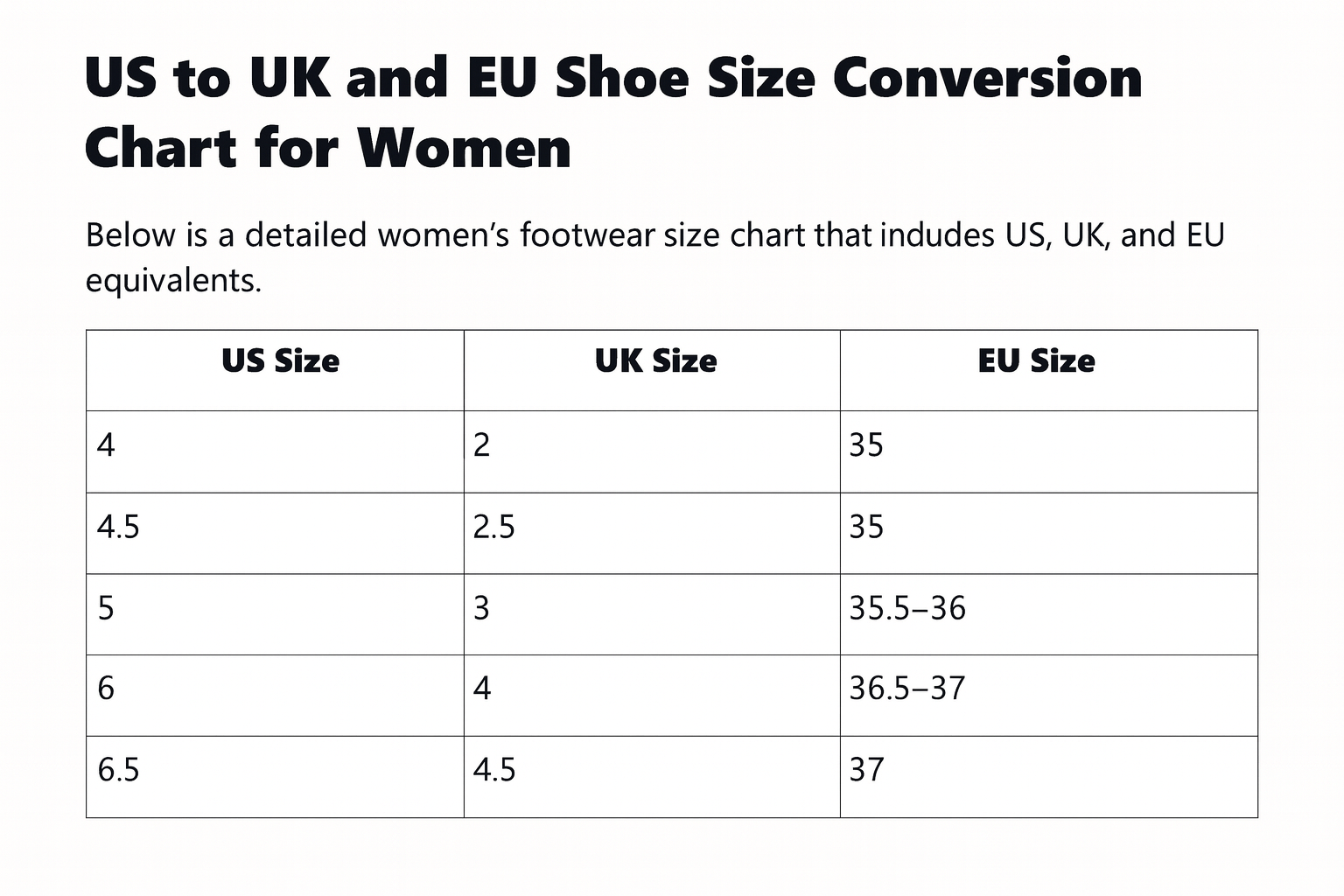
European Shoe Size Charts and Their Limits
European shoe sizing is often presented as one shared system, but it is not perfectly uniform. Brands may use different internal measurements, shape their shoes differently, or round sizes in different ways.
Some important limits include:
• EU sizing does not clearly separate men’s and women’s sizes in the label itself.
• A men’s EU 42 and a women’s EU 42 may have different width and shape.
• Children’s and adult sizing can use related labels but different proportions.
• Italian, French, German, and Spanish brands may have small fit differences.
• Sneakers, boots, sandals, and dress shoes often use different fit standards.
The term “EU size” is useful, but it should not be treated as an exact measurement. The most reliable information is usually the maker’s own chart, especially when it lists centimeters or millimeters.
When checking what is 8.5 shoe size in europe, compare three details: the original US category, the European size, and the recommended foot length. Using all three is more accurate than using the number alone.

Tips for Buying European Shoes Online
Buying shoes online can be easy when you use a clear process. Start by identifying the original size system. A US 8.5, UK 8.5, and EU 8.5 are not interchangeable.
Use these practical tips:
- Confirm whether the listing uses US men’s or US women’s sizing.
- Find the brand’s official size chart.
- Check the foot-length measurement in centimeters.
- Read reviews for comments about narrow, wide, large, or small fit.
- Review the return and exchange policy.
- Consider the socks and activity you will use with the shoes.
- Measure both feet before ordering.
- Avoid assuming the same EU size will fit every model.
One lesson many shoppers learn the hard way is that a familiar brand can still change size between product lines. A running shoe may fit well in EU 42, while a leather loafer from the same company may require a different size or width.
If you are ordering expensive shoes, buying from a seller with free returns can reduce risk. A size chart is helpful, but the ability to test the shoe at home is even better.

Common Conversion Examples
Here are simple examples that show how the conversion works:
Example 1: Men’s running shoes
A runner wears US men’s 8.5 and wants a European size. EU 42 is the most likely choice, but the runner should check the brand’s foot-length chart and allow extra room at the toe.
Example 2: Women’s casual sneakers
A shopper wears US women’s 8.5 and is buying European sneakers. EU 39 is the normal starting point, but EU 40 may be more comfortable in a narrow model or when wearing thick socks.
Example 3: Men’s dress shoes
A person normally wears US men’s 8.5 in sneakers but finds formal shoes tighter. EU 42 may still be correct, but a wider fit or a different shoe shape may solve the problem better than choosing EU 43.
Example 4: Women’s high heels
A US women’s 8.5 may convert to EU 39, but pointed heels can feel shorter and narrower. The shopper should check the toe shape, heel design, and return policy before ordering.
These examples show why what is 8.5 shoe size in europe has a general answer, not one perfect answer for every foot and shoe.

What Is 8.5 Shoe Size in Europe for Different Shoe Types?
The conversion can stay the same while the fit changes by shoe type. A sneaker, boot, sandal, and dress shoe may all use EU 42 or EU 39, yet feel very different.
Running shoes often include extra space near the toes. Hiking boots may need room for thicker socks and foot movement. Dress shoes usually have a firmer upper and may feel snug even when the length is correct.
Sandals create another issue. An open design makes extra length more noticeable, while straps can create pressure across the foot. In this case, width and strap placement may matter more than moving up one full size.
For work shoes, comfort and safety should guide the choice. A shoe that slips, pinches, or lacks support can cause discomfort during long shifts. If you have diabetes, circulation problems, or ongoing foot pain, consult a qualified health professional before choosing footwear.
Frequently Asked Questions About What Is 8.5 Shoe Size in Europe
Is a US men’s 8.5 the same as EU 42?
Usually, yes. A US men’s 8.5 most often converts to EU 42, although some brands may list EU 41.5.
Is a US women’s 8.5 the same as EU 39?
Usually, yes. A US women’s 8.5 commonly converts to EU 39, but the exact result can vary between EU 38.5 and EU 40.
What is 8.5 shoe size in europe in centimeters?
A US men’s 8.5 generally suits a foot around 26.5 to 27 centimeters long. A US women’s 8.5 generally suits a foot around 25 to 25.5 centimeters long, but brand charts should take priority.
Should I choose EU 42 if I wear US 8.5?
Choose EU 42 if you wear US men’s 8.5 and the brand follows standard conversion. If you wear US women’s 8.5, EU 39 is usually the better starting point.
Can EU shoe sizes differ between brands?
Yes. Brands may use different shoe shapes, internal measurements, and rounding methods. Always compare the brand’s chart with your foot measurement.
Is EU 42 a men’s or women’s size?
EU 42 can be sold in both men’s and women’s footwear. The label does not show the complete fit, so width, shape, and the brand’s design also matter.
Should I size up for wide feet?
Not always. A wider shoe or wide-width version is often better than choosing a longer size, which can cause heel slipping and poor support.
Conclusion
The answer to what is 8.5 shoe size in europe depends on the US category. US men’s 8.5 usually equals EU 42, while US women’s 8.5 usually equals EU 39. Brand differences, shoe shape, width, and foot measurements can change the best choice.
Measure both feet, check the maker’s chart, and compare centimeters before ordering. Use EU 42 or EU 39 as a starting point, not an absolute rule. If this guide helped, use it when shopping for your next pair and share your own sizing experience in the comments.

Madison Clark is a footwear expert and the voice behind MyStyleGrid.com. She specializes in honest shoe reviews, style tips, and practical guides to help readers find the perfect pair for any occasion. With years of experience in blogging and content creation, Madison makes footwear knowledge simple, stylish, and easy to follow.