The best glasses balance your face shape, proportions, personal style, bridge fit, and prescription needs.
Learning how to choose the best glasses for your face is about more than matching frames to a simple shape chart. Face shape helps, but frame width, eye position, nose fit, lens height, color, comfort, and lifestyle matter just as much. This guide brings those details together so you can shop with confidence and avoid frames that look good online but feel wrong in real life.

Why Face Shape Matters When Choosing Glasses
Your glasses sit at the center of your face, so they can change how your features look. The right pair can add balance, define your eyes, or soften strong angles. The wrong pair may feel too wide, too small, or out of proportion.
Face shape is a useful starting point, not a strict rule. Most people have a blend of shapes, and factors such as hairstyle, facial hair, skin tone, and personal style also affect the final look.
When learning how to choose the best glasses for your face, look for contrast and balance. Rounded frames can soften angular features, while structured frames can add definition to softer features. However, comfort and proper fit should always come before a style rule.
A frame should:
• Sit evenly on your face without leaning
• Keep your eyes near the center of each lens
• Match the width of your face or sit slightly wider
• Rest comfortably on your nose
• Avoid touching your cheeks when you smile
• Stay in place when you move your head
I have found that people often focus on color first. In practice, the frame’s size and bridge fit usually make a greater difference. A beautiful frame still looks wrong if it slides down or presses behind your ears.
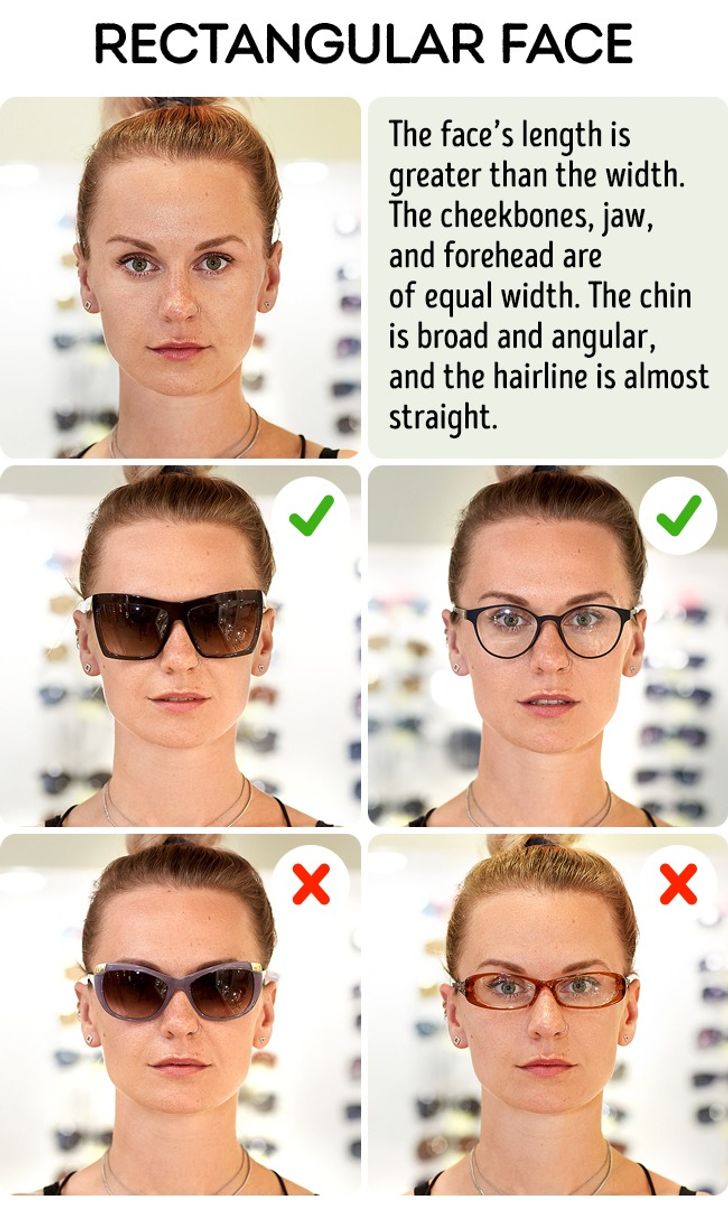
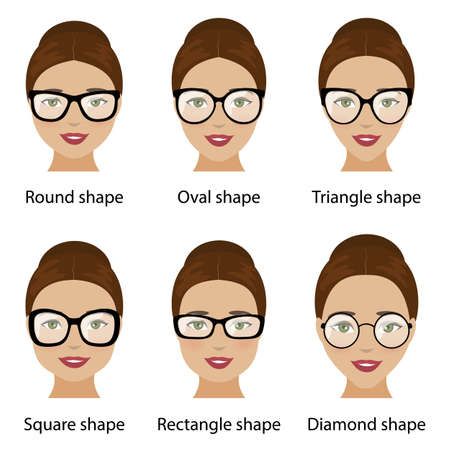
Identify Your Face Shape
Before you shop, study your face in a mirror or take a straight-on photo. Pull your hair away from your face, relax your expression, and compare the width of your forehead, cheekbones, and jaw.
Your face may not fit one category perfectly. That is normal. Use the shape that best describes your overall outline.
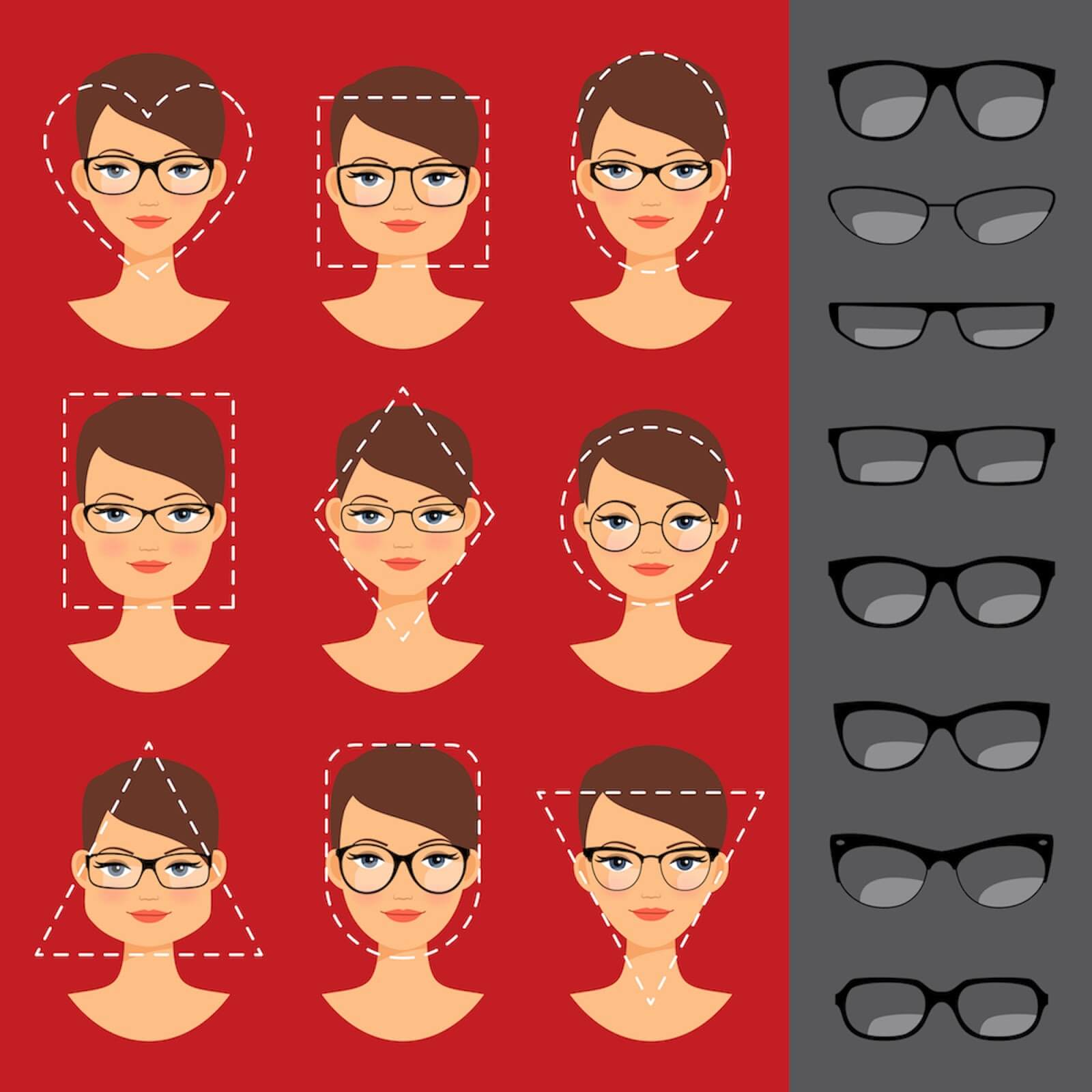
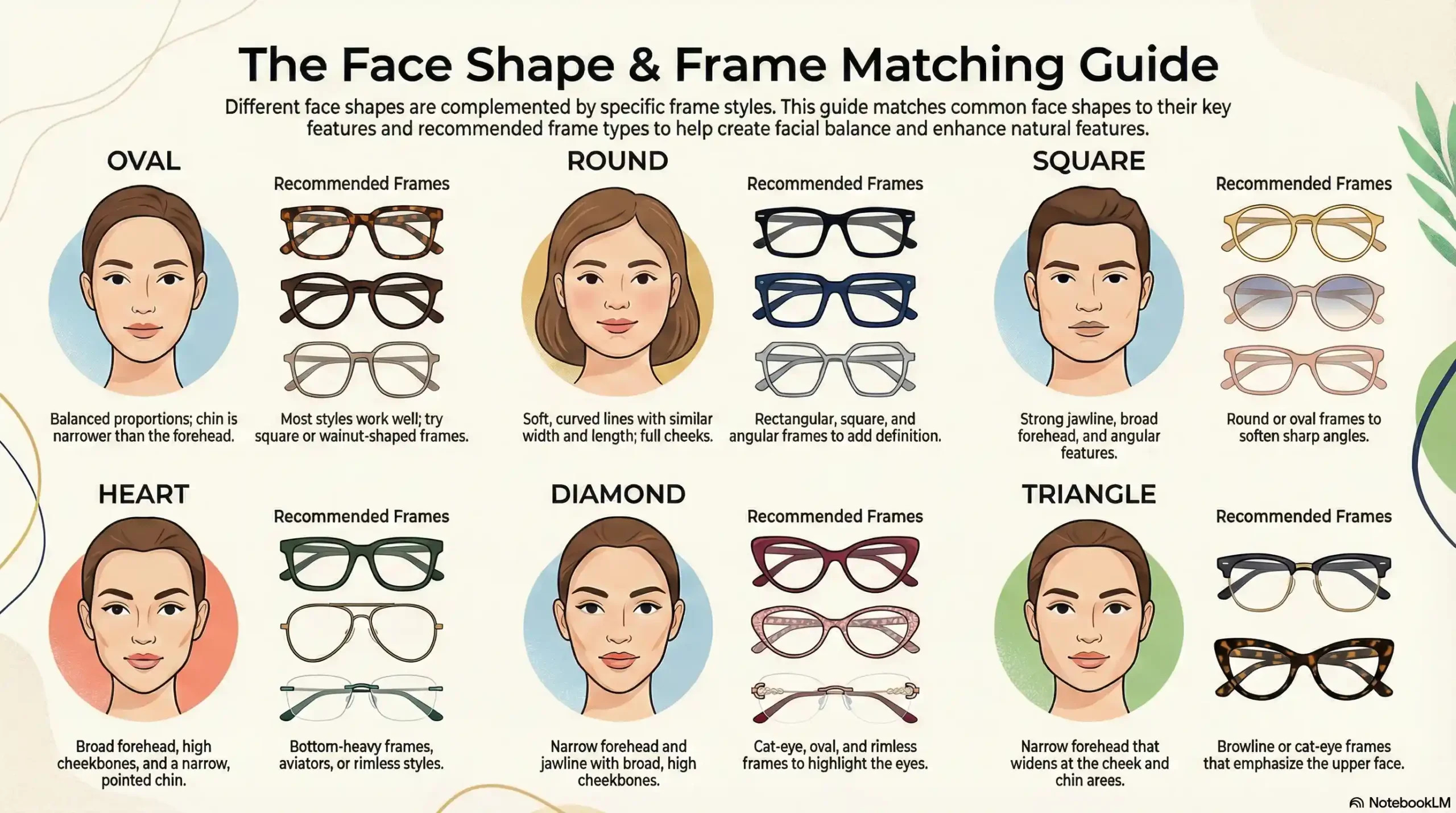
Oval face
An oval face often has balanced proportions, gently curved cheekbones, and a jaw that is slightly narrower than the forehead.
Most frame styles can work well with an oval face. Look for frames that are as wide as, or slightly wider than, the broadest part of your face.
Good choices include:
• Wayfarer frames
• Soft square frames
• Browline frames
• Round frames
• Geometric frames
Very narrow frames may make the face look longer. Extremely oversized frames can also cover your natural balance.
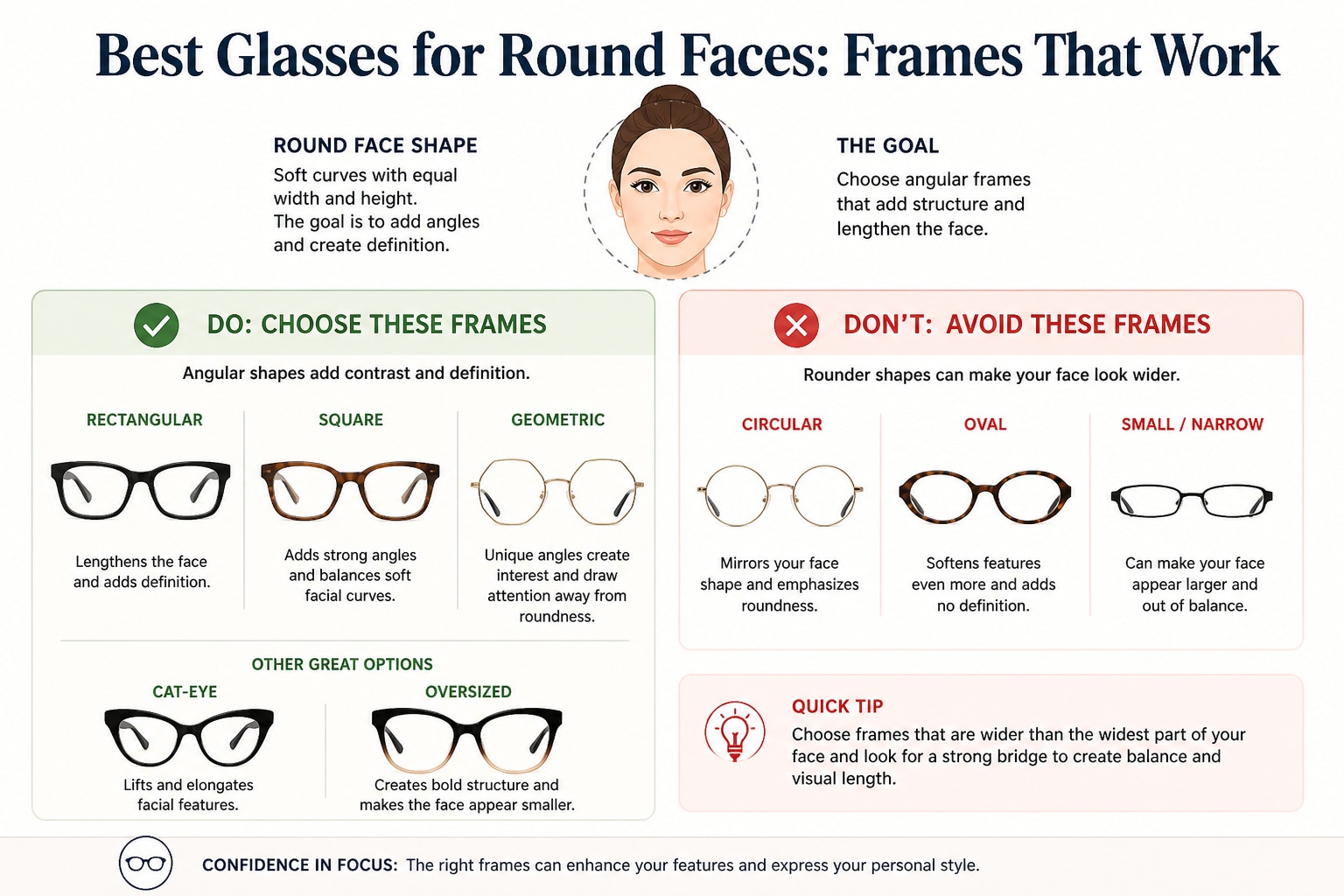
Round face
A round face usually has similar width and length, with soft cheeks and a curved jawline.
Angular frames can add structure and make the face appear longer. Rectangular, square, and geometric frames are often strong choices.
Try to avoid frames that repeat the same round shape if you want more definition. Round frames are not forbidden, though. A thin, slightly oversized round frame can create a relaxed and artistic look.
Square face
A square face often has a broad forehead, strong cheekbones, and a defined jaw. The width and length may be similar.
Round or oval frames can soften the appearance of sharp angles. Thin metal frames and gently curved styles may also create balance.
If you prefer a bold look, choose a square frame with softer corners. This keeps the structure of your features without making the overall appearance too severe.
Heart-shaped face
A heart-shaped face is often wider at the forehead and narrower at the chin. Some people also have prominent cheekbones or a widow’s peak.
Frames that are wider at the bottom can help balance the upper face. Light colors, rimless frames, oval frames, and rounded shapes may work especially well.
Avoid frames that add too much height or visual weight to the forehead unless that is the look you want.
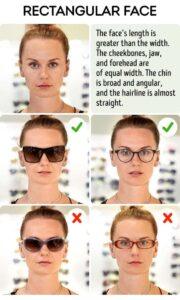
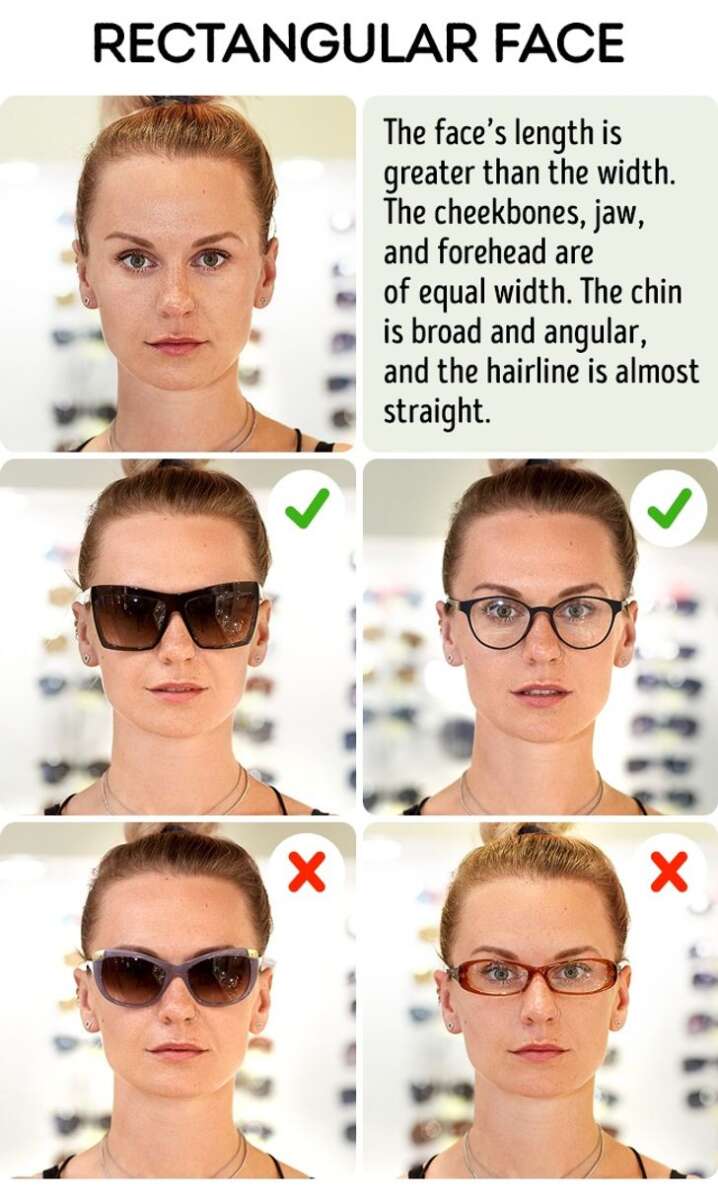
Long or oblong face
A long face tends to have more length than width. The forehead, cheeks, and jaw may have similar widths.
Frames with greater lens depth can make the face look more balanced. Tall rectangular, softly rounded, and bold browline frames can work well.
Avoid very narrow lenses. They may make your face appear even longer.
Diamond face
A diamond face is often narrow at the forehead and jaw, with wider cheekbones.
Oval and cat-eye frames can highlight the eyes and soften the cheek area. Rimless styles may also look light and balanced.
Choose frames with gentle curves or details near the brow. Avoid overly narrow frames that draw attention only to the widest part of your face.
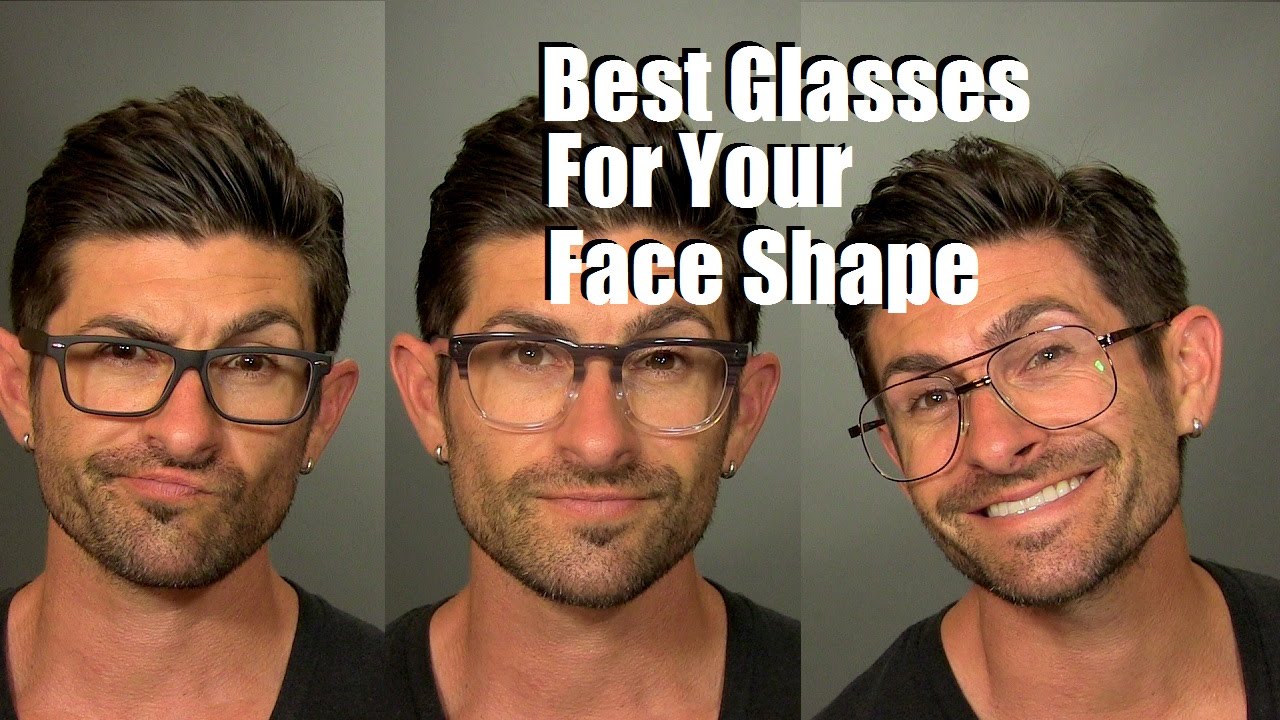
Match Frame Shape With Your Features
Face shape is only one part of the answer to how to choose the best glasses for your face. Your features also affect how a frame looks.
Think of your glasses as a picture frame. The frame should support the picture rather than overpower it.
Consider your eyebrows
Your eyebrows guide the visual expression of your face. A browline frame may echo their shape, while a low frame can create more space above the eyes.
Your eyebrows do not need to sit perfectly inside the top rim. Still, the frame should not cut across them in a way that makes your expression look tense.
Consider your nose and bridge
The bridge is the part of the frame that rests over your nose. A poor bridge fit can cause sliding, pressure, or red marks.
People with a low nose bridge may find that frames slide down or sit too close to the cheeks. Low-bridge-fit frames often include a wider nose area, adjustable nose pads, or a modified frame shape.
People with a narrow nose may need a smaller bridge measurement. Adjustable nose pads can improve fit, especially with metal frames.
Consider your cheekbones
If the frame touches your cheeks when you smile, it is likely too deep, too low, or too large. This can make the glasses rise during normal facial movement.
Smile, speak, and look down when trying on frames. A frame should stay stable without pressing into your cheeks.
Consider your eyes
Your pupils should sit close to the center of the lenses. If your eyes sit too close to the inner edges or too close to the outer edges, the frame may be the wrong size.
This matters for both appearance and prescription lenses. Optical centers help the lenses work as intended, especially with stronger prescriptions.
Learn How Frame Measurements Work
Understanding frame measurements makes online shopping much easier. Most glasses show three numbers inside the temple arm, such as 52-18-140.
These numbers usually mean:
• 52 millimeters: lens width
• 18 millimeters: bridge width
• 140 millimeters: temple arm length
These measurements are a useful guide, but they are not a guarantee. Two frames with the same numbers can fit differently because of their shape, curve, thickness, and hinge design.
Measure a frame you already like
If you own comfortable glasses, check the numbers printed inside the arm. Use them as a starting point when comparing new frames.
You can also measure the front of the frame:
-
Measure the widest horizontal part.
-
Measure the bridge area.
-
Check the temple length if it is listed.
Stay within a few millimeters of your current pair. A small difference may be fine, but a large change can affect comfort and appearance.
Check the frame width
The front of the frame should align closely with your face. The temples should not flare outward sharply, and the frame should not squeeze your head.
As a general guide:
• A narrow face often suits small or medium frames.
• A medium face can suit most standard sizes.
• A wide face may need larger frames or flexible temples.
Do not choose oversized glasses only because they are fashionable. Oversized frames can be comfortable, but they may also slide, cover your eyebrows, or make your eyes look too close together.
Understand lens height
Lens height matters for style and vision. Deep lenses can create a bold look and may work well on longer faces. Shallow lenses can look sleek but may not provide enough room for some progressive lenses.
If you need progressive lenses, ask your optician about minimum fitting height. The frame must provide enough vertical space for the prescription to work properly.
Choose the Right Frame Color
Color can brighten your face, soften your features, or create a strong statement. There is no single correct color for a specific skin tone, but some shades tend to create easy harmony.
Warm undertones
Warm undertones may suit:
• Gold
• Bronze
• Tortoise
• Warm brown
• Olive
• Cream
Cool undertones
Cool undertones may suit:
• Silver
• Black
• Gray
• Blue
• Clear crystal
• Cool tortoise
Neutral undertones
Neutral undertones can often wear both warm and cool colors. Soft black, translucent gray, brown, and classic tortoise are flexible choices.
You can check your undertone by looking at the veins on your wrist in natural light. Greenish veins may suggest warm undertones, while blue or purple veins may suggest cool undertones. This method is not exact, so use it as a guide rather than a test.
When deciding how to choose the best glasses for your face, also think about your wardrobe. If you wear simple colors, a bold frame can become a useful accent. If your clothes already include bright patterns, a neutral frame may feel more balanced.
Clear frames are popular because they add shape without strong color. They can look modern and light, but some clear materials may show makeup, skin oils, or yellowing over time.
Select Materials That Match Your Lifestyle
Frame material affects weight, flexibility, durability, and style. The best option depends on how and where you wear your glasses.
Acetate frames
Acetate is a plant-based plastic known for rich colors and strong construction. It often feels more substantial than basic injection-molded plastic.
Acetate frames can be a good choice if you want:
• Bold colors
• Tortoise patterns
• A sturdy feel
• A thicker frame profile
Metal frames
Metal frames often have a light, clean appearance. Titanium is especially valued for its light weight, strength, and corrosion resistance.
Metal frames can work well if you want:
• A minimal look
• Adjustable nose pads
• Thin rims
• A lightweight feel
Some people are sensitive to certain metals, including nickel. If you have skin reactions, ask about titanium, stainless steel, or hypoallergenic options.
Flexible materials
Flexible frames can help active adults, children, and anyone who drops or bends their glasses often. They are not unbreakable, however.
Even flexible frames need regular adjustment. Hinges, nose pads, and lenses can still become damaged.
Rimless and semi-rimless frames
Rimless glasses create a light, understated look. Semi-rimless frames use less material around the lenses.
These styles may suit someone who wants glasses to blend into the face. They can be less visually strong, but they may require careful handling and specialized lens edges.
Think About Your Prescription
Your prescription should influence your frame choice. Style matters, but the wrong frame can make lenses thicker, heavier, or less comfortable.
Strong nearsighted prescriptions
For stronger nearsighted prescriptions, smaller round or oval frames may reduce lens thickness at the edges. Aspheric lenses and high-index materials may also create a thinner profile.
Large frames can require more lens material. Ask your optician whether a smaller eye size would improve weight and appearance.
Farsighted prescriptions
Farsighted lenses can be thicker at the center. Smaller frames may help reduce the amount of visible lens thickness.
A well-fitted frame also helps keep the optical center in the correct position.
Progressive lenses
Progressive lenses provide distance, intermediate, and near vision in one lens. They need enough vertical space and careful measurements.
Choose a frame that:
• Does not slide down
• Has enough lens height
• Fits securely behind the ears
• Allows your eyes to sit in the correct position
Small, shallow frames may limit the usable area of a progressive lens. Your optician can explain the minimum height required for your design.
Blue-light lenses and lens coatings
Blue-light filtering lenses are widely marketed for digital eye strain, but evidence does not show that blue-light lenses consistently prevent eye fatigue or improve sleep for everyone. Glare, dry eyes, poor lighting, and long periods without breaks are often bigger concerns.
Anti-reflective coating can reduce reflections and improve lens clarity. Scratch-resistant coatings may help, but no lens coating makes glasses scratch-proof. Clean lenses with suitable spray and a microfiber cloth rather than a shirt or paper towel.
Use Your Lifestyle to Guide Your Choice
The best glasses for daily office wear may not be the best glasses for sports, travel, or outdoor work.
For computer use, choose a frame that stays in place and supports a comfortable working distance. If you spend time outdoors, consider prescription sunglasses, polarized lenses, or photochromic lenses.
For exercise, look for:
• Secure temple arms
• Lightweight materials
• Flexible hinges
• Impact-resistant lenses
• A shape that does not slip when you sweat
For frequent travel, consider a durable frame and a hard protective case. Pack a backup pair if you rely on glasses every day.
If you work with tools, chemicals, or flying debris, regular everyday glasses may not provide enough protection. Use safety eyewear that meets applicable impact standards.
I once saw a shopper choose a very thin fashion frame for an active job. It looked excellent in the mirror but kept sliding during movement. A slightly wider frame with adjustable pads solved the problem. That experience highlights a key lesson: the best frame is the one that works during your real day, not just during a five-minute fitting.
Try Frames the Right Way
Trying on glasses is a small skill. A few simple checks can prevent most fit problems.
Use this process:
-
Start with the frame size, not the color.
-
Check whether your pupils sit near the lens centers.
-
Smile and speak to see whether the frame touches your cheeks.
-
Look down to test whether the glasses slide.
-
Turn your head from side to side.
-
Check the temples for pressure.
-
Inspect the bridge for pinching or gaps.
-
Take a front and side photo in natural light.
-
Wear the frame for several minutes before deciding.
Do not judge a frame only from a straight-on mirror view. Look at your profile and three-quarter angle too. Glasses are part of your appearance from every direction.
Online shoppers should check the retailer’s return policy, virtual try-on limits, warranty terms, and measurement guide. Virtual tools can show general shape and color, but they may not accurately predict bridge comfort or lens thickness.
Common Mistakes to Avoid
Many poor glasses choices come from rushing the process. These mistakes are easy to prevent.
Choosing a frame that is too wide
A frame that extends far beyond your face may slide and make your eyes look closer together. It can also create pressure behind your ears.
Choosing a frame that is too narrow
A narrow frame may pinch your temples and make the lenses feel visually crowded. Red marks near the sides of your head are a warning sign.
Ignoring the bridge
A frame can have the perfect width and still fit poorly because the bridge does not match your nose. If the glasses slide, ask about a different bridge design rather than tightening the arms too much.
Following face-shape rules too strictly
Face-shape charts are helpful, but they cannot account for every face, style, and prescription. Use them to explore options, not to eliminate frames you love.
Buying for trend alone
Fashion changes quickly. If you wear glasses every day, choose a frame that suits your lifestyle and feels comfortable for long periods.
Forgetting maintenance
Loose screws, bent temples, and worn nose pads can change the fit. Have your glasses adjusted by an optical professional instead of bending them at home.
A Simple Method for How to Choose the Best Glasses for Your Face
If you want a clear shopping plan, follow these steps.
-
Identify your general face shape.
-
Measure a pair you already wear comfortably.
-
Decide whether you want contrast or harmony.
-
Select a frame width that matches your face.
-
Check bridge fit and eye position.
-
Consider your prescription and lens needs.
-
Choose a material that fits your routine.
-
Compare colors with your skin tone and wardrobe.
-
Test the frame while smiling, talking, and moving.
-
Confirm the return policy before ordering.
This method makes how to choose the best glasses for your face less confusing. It also keeps style, comfort, vision, and value in the same conversation.
The most flattering pair may not be the one that follows every traditional rule. It may be the frame that makes you feel comfortable, looks balanced, and supports your daily needs.
How to Choose the Best Glasses for Your Face With a Professional
An optician can check details that are difficult to judge at home. These include pupillary distance, optical center placement, bridge fit, temple alignment, and progressive lens measurements.
A professional fitting is especially useful if you:
• Have a strong prescription
• Need progressive lenses
• Have a narrow or low nose bridge
• Experience frequent slipping
• Have unequal pupil distances
• Need specialty lenses
• Have had trouble with glasses before
Bring your current glasses and explain what you like and dislike about them. Say if they slide, pinch, feel heavy, or cause blurry vision. Clear feedback helps the optician find a better match.
A professional cannot replace your personal style. Their role is to make sure your preferred look works safely and comfortably.
Frequently Asked Questions
What glasses look best on my face shape?
The best glasses create balance with your features. Angular frames can add structure to round faces, while round or oval frames can soften square faces, but fit, comfort, and personal style matter more than a strict shape rule.
Should glasses be wider than your face?
Glasses should usually match your face width or extend only slightly beyond it. If the frame is much wider, it may slide and look oversized; if it is too narrow, it can pinch your temples.
How do I know if glasses fit correctly?
Your eyes should sit near the center of the lenses, and the frame should stay level without sliding. It should not pinch your nose, press behind your ears, or touch your cheeks when you smile.
Are round or square glasses better for a round face?
Square, rectangular, and geometric frames often add helpful contrast to a round face. You can still wear round glasses if you prefer them, especially when the frame has a slightly larger size or a strong color.
What frame is best for a strong prescription?
Smaller frames with round or oval lens shapes may help reduce lens thickness and weight. High-index lenses and aspheric designs may also help, but an optician should recommend the best option for your prescription.
Can I choose glasses online?
Yes, you can choose glasses online if you know your measurements and have a reliable return policy. Online tools are useful for shape and color, but an in-person fitting is better for bridge comfort, prescription accuracy, and progressive lenses.
Should my eyebrows show above my glasses?
Your eyebrows do not have to sit fully above the frame. The key is that the frame should not cut across them in a way that makes your expression look uncomfortable or unbalanced.
Conclusion
Choosing the right glasses starts with face shape, but it does not end there. Frame width, bridge fit, eye position, lens height, prescription needs, material, color, and lifestyle all help determine whether a pair truly works.
Use face-shape advice as a guide, then test the frame through real movements and daily needs. When learning how to choose the best glasses for your face, prioritize clear vision and lasting comfort alongside style. Try a few carefully measured options, ask an optician for help when needed, and explore more eyewear guides before making your final choice.

Rubel Miah is the Senior Editor at MyStyleGrid.com, where he brings a sharp editorial eye and an unshakable love for fashion to everything he does. A true style addict, Rubel lives and breathes trends, from streetwear to high fashion, and has a knack for turning inspiration into impactful stories. With years of experience in fashion journalism and digital media, he curates content that empowers readers to express themselves through style. When he’s not editing features or forecasting the next big thing, you’ll find him hunting down vintage pieces or capturing street style moments around the city.