To learn how to find sunglasses that fit your face, check frame width, bridge fit, lens size, and comfort.
Learning how to find sunglasses that fit your face is about more than choosing a trendy color. The right pair should balance your features, block bright light, stay secure, and feel comfortable for hours. This guide combines face-shape advice, simple measurements, lens facts, and real fitting lessons so you can shop with confidence.
Start with the basic fit
The best way to learn how to find sunglasses that fit your face is to treat the frame like a well-fitted shoe. It should feel secure, but it should not pinch, slide, or leave deep marks.
A good pair of sunglasses should meet these basic points:
• The frame sits evenly on your face.
• Your eyes sit near the center of each lens.
• The frame does not touch your cheeks when you smile.
• The temples rest comfortably along your head.
• The bridge does not pinch your nose.
• The frame does not slide when you look down.
Frame width matters most. In general, the outside edge of the frame should be close to the widest part of your face. A frame that is much wider may look loose. A frame that is too narrow can pinch your temples and make your face look wider.
Your sunglasses should also stay still when you move. Turn your head, bend down, and smile while trying them on. If they shift at once, they may need adjustment or a different bridge design.
Measure your face before shopping
A few simple measurements can make how to find sunglasses that fit your face much easier. You do not need special tools. A mirror, a ruler, and a phone camera are enough.
Stand in front of a mirror with your hair pulled back. Keep your head straight and your face relaxed. Measure from the left side of your face to the right side at the widest point, often near the cheekbones.
You can also measure these areas:
• Face width: Measure across your cheekbones.
• Face length: Measure from the center of your hairline to the bottom of your chin.
• Forehead width: Measure across the widest part of your forehead.
• Jaw width: Measure across the widest part of your jaw.
• Temple width: Measure the space between the points where the frame arms will rest.
If you already own a pair that fits well, look inside the temple arm. You may see three numbers, such as 52-18-140. The first number is the lens width in millimeters. The second is the bridge width. The third is the temple arm length.
These numbers are a useful starting point, not a strict rule. Two frames with the same numbers can fit differently because of their shape, curve, nose pads, and materials.
Use a photo for a second opinion
Take a straight-on photo in good light. Keep the camera at eye level and avoid a wide-angle selfie, which can change the shape of your face.
Place a clear ruler beside your cheek in the photo if you need a rough scale. This will not replace an in-person fitting, but it can help you compare frame sizes when shopping online.
 shopping”
style=”max-width: 100%; height: auto; border: 2px solid black; border-radius: 10px; display: block; margin: 0 auto;”
loading=”lazy”
/>
Match sunglasses to your face shape
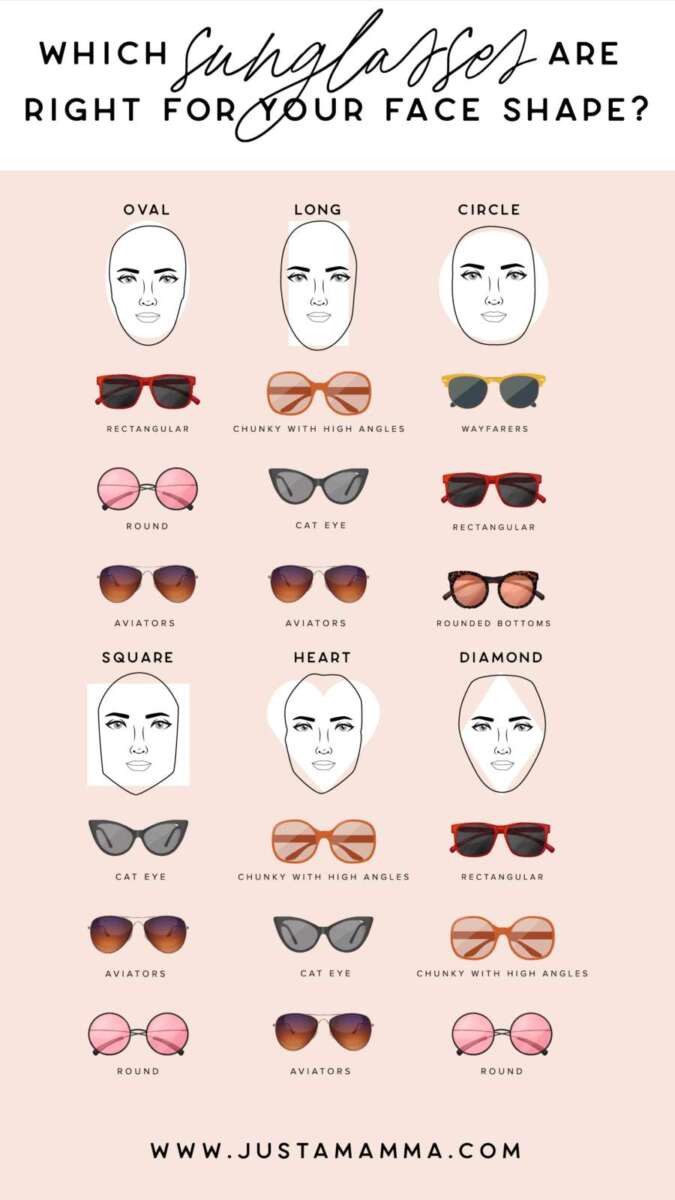
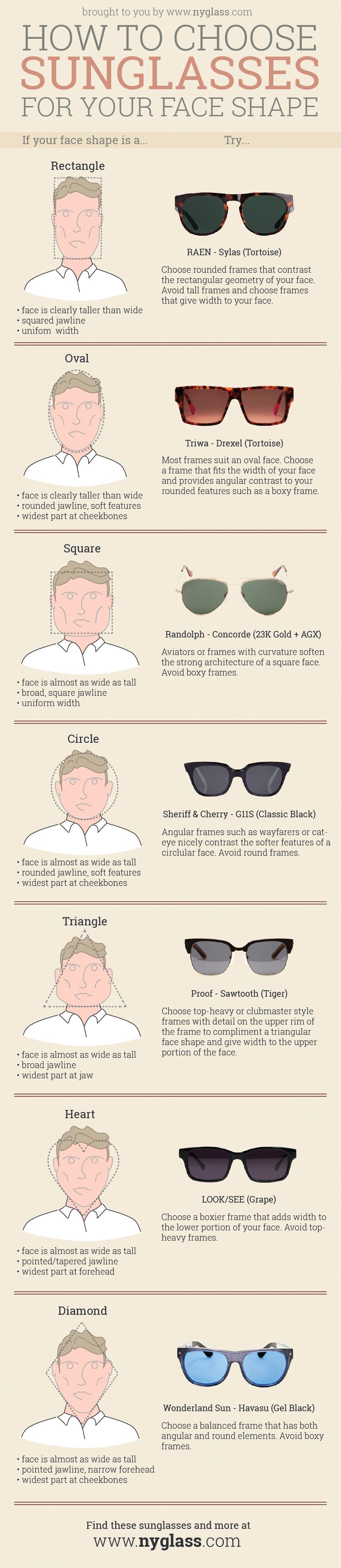
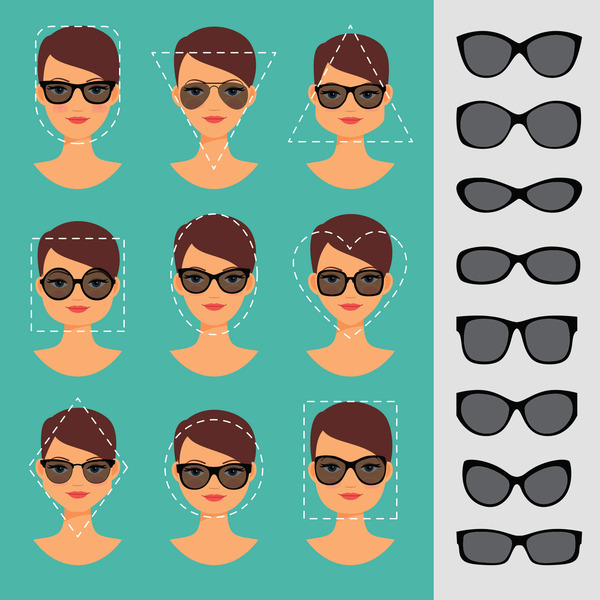
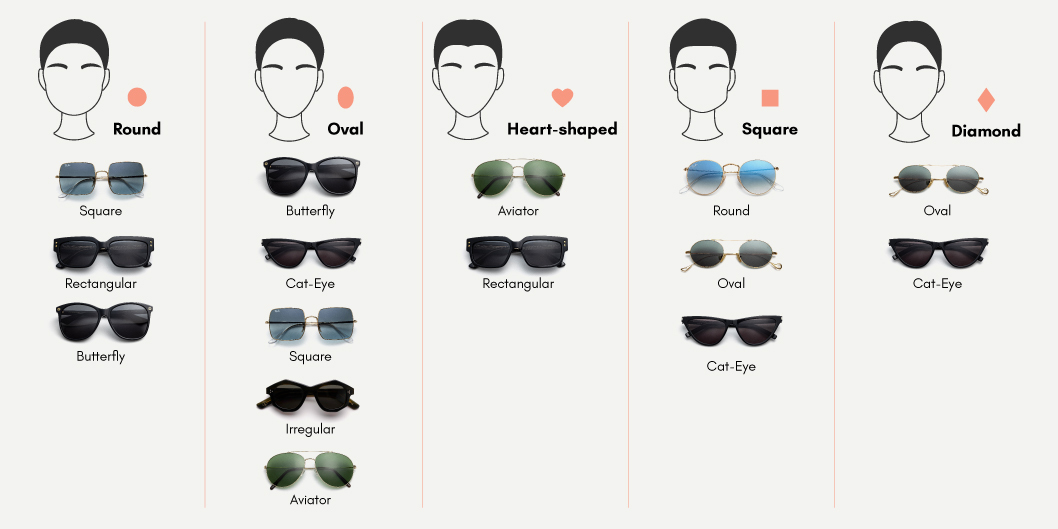
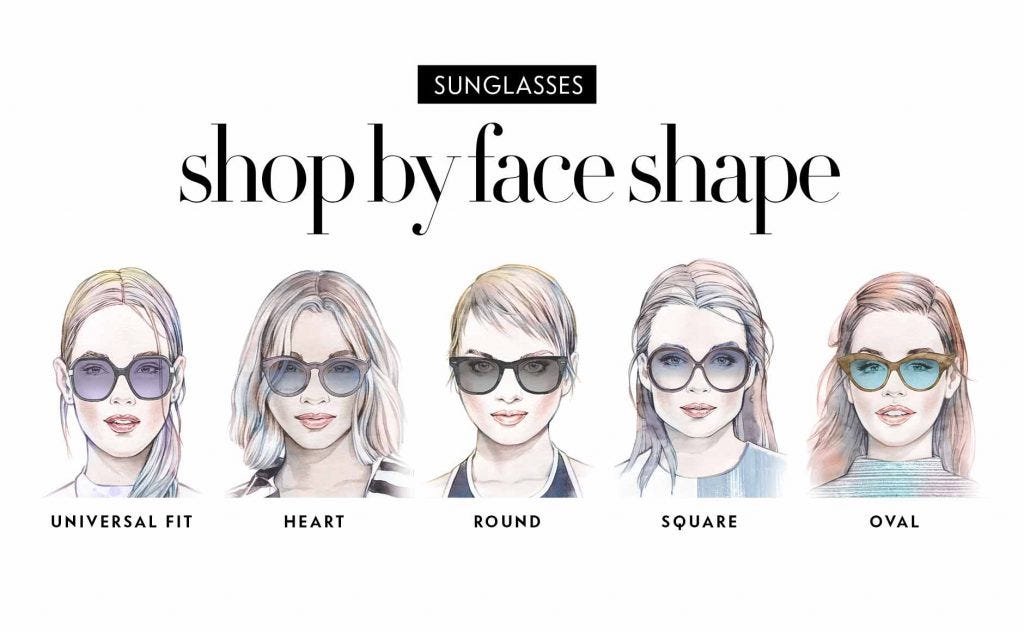
Face shape can guide your choice, but it should not limit you. Most people have a mix of features rather than one perfect shape. Use these suggestions as a starting point.
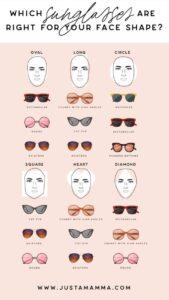
Oval face
An oval face usually has balanced proportions, a softly rounded jaw, and cheekbones that are slightly wider than the forehead or chin.
Most frame shapes work well. Look for sunglasses that are as wide as, or slightly wider than, the broadest part of your face.
Good choices may include:
• Square frames
• Rectangular frames
• Aviators
• Round frames
• Cat-eye sunglasses
Avoid frames that are much too large. Oversized sunglasses can hide your features instead of complementing them.
Round face
A round face often has a similar width and length, with full cheeks and a curved jaw.
Angular frames can add contrast. Square and rectangular sunglasses may make the face look longer and more defined.
Try:
• Wayfarer-style frames
• Browline frames
• Geometric frames
• Tall rectangular lenses
Very small, round frames may make the face look rounder. That does not mean you cannot wear them. Choose a larger round frame with a firm brow line if you want a softer style.
Square face
A square face often has a broad forehead, strong cheekbones, and a defined jaw with similar width at each area.
Round or oval lenses can soften sharp lines. Thin metal frames may also create a lighter look.
Consider:
• Round sunglasses
• Oval sunglasses
• Aviator frames
• Soft cat-eye styles
Very boxy frames can repeat the angles of the face. This can look bold and stylish, but it may not create the softer balance some people want.
Heart-shaped face
A heart-shaped face often has a wider forehead, high cheekbones, and a narrower chin.
Frames that are wider at the bottom can help balance the face. Light colors and slim designs can also reduce visual weight near the forehead.
Try:
• Bottom-heavy frames
• Round frames
• Oval frames
• Light-colored aviators
• Rimless or semi-rimless sunglasses
Very heavy brow bars may draw too much attention to the upper face. Still, personal style matters, so use this advice as a guide rather than a rule.
Long or rectangular face
A long face is often longer than it is wide, with a straight cheek line and a longer chin area.
Tall lenses and deeper frames can make the face look more balanced. A strong brow line can also add width.
Good options include:
• Oversized frames
• Deep square lenses
• Round sunglasses
• Browline frames
• Bold acetate styles
Narrow, short lenses may make the face look longer. If you like a narrow frame, choose one with a taller lens or a strong design detail.
Diamond-shaped face
A diamond-shaped face often has prominent cheekbones, a narrower forehead, and a narrow jaw.
Oval and cat-eye frames can complement the cheekbones. Rimless designs and curved frames may also work well.
Try:
• Oval sunglasses
• Cat-eye sunglasses
• Browline frames
• Rimless styles
• Soft rectangular frames
The key is to avoid too much width at the cheekbone if that is already the strongest part of your face.
Check the frame width and bridge
When people ask how to find sunglasses that fit your face, frame width is often the most useful answer. The frame should not extend far beyond your temples, and it should not press against them.
Look straight ahead in a mirror. The outer edge of the frame should sit close to the side of your face. A small amount of extra width can work, especially with oversized styles, but the frame should still look intentional and feel stable.
The bridge is just as important. It connects the two lenses and rests on your nose. A bridge that is too wide may make the sunglasses slide. A bridge that is too narrow may leave pressure marks.
Low-bridge and high-bridge fit
People with a lower nose bridge may find that standard sunglasses slide down or touch their cheeks. Low-bridge-fit sunglasses often have:
• A shorter bridge
• More adjustable nose pads
• A deeper frame shape
• A higher lens position
People with a higher nose bridge may prefer a frame with a wider or taller bridge. The right design lets the sunglasses sit on the nose without pressing hard on either side.
Do not judge the bridge by appearance alone. Put the glasses on and look down. If they move quickly, the bridge may not match your nose.
Look at the eye position
Your eyes should sit close to the center of each lens. If your eyes sit too close to the inner edge, the frame may be too wide. If they sit near the outer edge, the frame may be too narrow or the lens shape may not suit you.
This detail affects both appearance and vision. It is especially important for prescription sunglasses, where lens placement can affect optical accuracy.

Choose lenses for protection and clear vision
A frame may look perfect and still fail its main job if the lenses do not protect your eyes. When choosing sunglasses, look for lenses that block 99% to 100% of UVA and UVB rays, or that carry a UV400 label.
The American Academy of Ophthalmology and other eye-care groups recommend UV protection because ultraviolet exposure can harm the eyes over time. Sunglasses can also reduce glare and help protect the sensitive skin around the eyes.
Lens color affects how the world looks, but it does not prove UV protection. Dark gray lenses are not automatically safer than light brown lenses. A clear statement about UV protection matters more than the shade.
Common lens types
• Gray lenses: They reduce brightness with little color change and work well for daily use.
• Brown or amber lenses: They can increase contrast and may feel useful in changing light.
• Green lenses: They offer balanced color and can reduce glare.
• Polarized lenses: They reduce reflected glare from water, roads, and snow.
• Photochromic lenses: They darken in sunlight and become clearer indoors, although they may not darken fully inside a car.
Polarized lenses are helpful for driving, boating, fishing, and outdoor sports. However, they do not replace UV protection. Check for both features.
Polarization can also make some phone screens, car displays, and aircraft instruments harder to read at certain angles. This is a small limitation, but it is worth knowing before you buy.

Pick the right style for your daily needs
Knowing how to find sunglasses that fit your face also means thinking about how you will use them. A fashion frame may work for a short walk but feel heavy during a full day outside.
For everyday wear, choose a light frame with reliable hinges. Acetate can feel solid and comes in many colors. Metal frames may feel light, but they can need more adjustment around the nose and ears.
For sports, focus on grip and coverage. Look for curved temples, rubber nose pads, and lenses that cover the sides of your eyes. Wraparound sunglasses can reduce side glare, but they should not press against your eyelashes or cheeks.
For driving, choose lenses that reduce glare without making the view too dark. Gray polarized lenses are a common choice, but always check whether the lenses affect your car’s dashboard display.
For prescription sunglasses, ask an optician to confirm the frame can support your prescription. Strong prescriptions may need smaller lenses, thinner materials, or a specific frame shape.
Try sunglasses on the right way
The most reliable way to learn how to find sunglasses that fit your face is to test them during movement, not just while standing still.
Use this fitting routine:
-
Put the sunglasses on without pushing them into place.
-
Check whether the frame sits level.
-
Smile and see whether the frame touches your cheeks.
-
Look down to test for slipping.
-
Turn your head from side to side.
-
Check that your eyelashes do not brush the lenses.
-
Look in a mirror from the front and both sides.
-
Wear them for several minutes before deciding.
A comfortable frame should not cause pain at the temples, nose, or ears. Red marks may mean the frame is too tight, although a light mark from nose pads can happen after long use.
A common mistake is buying sunglasses that feel tight because they seem secure. Tight frames often become painful later. A better solution is a frame with the correct width and adjustable nose pads.
Another mistake is choosing a frame based only on its front view. The side profile matters too. Thick temples, curved lenses, or a deep frame can change how the sunglasses sit on your face.

Shop online with less guesswork
Online shopping makes it harder to judge fit, but you can still make a smart choice. Start by finding the measurements of a pair you already own and like.
Compare these details:
• Lens width
• Bridge width
• Temple length
• Total frame width
• Lens height
• Return policy
A clear return policy is important. Fit can vary between brands, even when the measurements look similar.
Read reviews for details about sliding, tight temples, nose marks, and actual frame size. Reviews with photos can be useful, but remember that a frame may look different on your face than on another person.
If a store offers a virtual try-on tool, use it as a style guide, not a final fit test. Camera angle and facial measurements are not always precise.
When the sunglasses arrive, keep the packaging until you test them outdoors and indoors. Do not remove labels or protective film until you know the frame feels right.
Avoid these common fitting mistakes
Understanding how to find sunglasses that fit your face also means knowing what often goes wrong. Many poor choices come from focusing on style before comfort and protection.
Avoid these mistakes:
• Choosing a frame that is too narrow because it looks sharp.
• Buying oversized sunglasses that slide down your nose.
• Assuming a dark lens offers UV protection.
• Ignoring cheek contact when smiling.
• Selecting a bridge that does not match your nose.
• Forgetting that prescription lenses need proper optical placement.
• Keeping a frame that causes headaches or pressure.
• Buying online without checking frame measurements.
• Treating face-shape rules as strict laws.
Your face does not need to match a fashion chart. The best sunglasses are the ones that fit well, protect your eyes, and make you feel comfortable. Style advice should open up choices, not remove them.
In my experience, the biggest improvement often comes from adjusting a frame rather than replacing it. An optician can warm and reshape some frames, adjust nose pads, and fine-tune the temple arms. Do not try to bend valuable sunglasses at home, since heat and pressure can damage the frame or lenses.
Build a simple sunglasses checklist
Use this checklist when you want a fast answer to how to find sunglasses that fit your face:
• Is the frame close to the width of your face?
• Do your eyes sit near the center of the lenses?
• Does the bridge rest comfortably?
• Do the sunglasses stay in place when you look down?
• Do the lenses touch your cheeks when you smile?
• Do the temple arms feel secure without pressure?
• Do the lenses offer 99% to 100% UVA and UVB protection?
• Does the lens color suit your main activity?
• Can you return or adjust the sunglasses if needed?
If you answer yes to most of these questions, you are close to a good fit. If the frame looks great but fails two or three comfort checks, keep searching.
A useful shopping habit is to compare three different shapes in the same size. This shows whether the issue is the measurement or the frame design. For example, one square frame may pinch while an oval frame with the same width feels comfortable.
Frequently Asked Questions
How do I know if sunglasses fit my face?
Sunglasses fit well when they sit level, stay in place, and do not pinch your nose or temples. Your eyes should be near the center of the lenses, and the frame should not touch your cheeks when you smile.
Should sunglasses be wider than your face?
Sunglasses can be slightly wider than your face, especially if you want an oversized look. However, they should not extend so far that they slide, create gaps, or look unstable from the side.
What sunglasses are best for a round face?
Angular frames, such as square or rectangular sunglasses, can add contrast to a round face. Larger round frames can also work if they have enough structure and do not sit too close to the cheeks.
How can I find my sunglasses size?
Look inside the temple arm of a pair that fits you. The numbers usually show lens width, bridge width, and temple length in millimeters, which you can compare with the measurements of new frames.
Do dark sunglasses protect your eyes better?
No. Lens darkness does not prove UV protection, and very dark lenses without UV protection can still expose your eyes to harmful rays. Choose sunglasses labeled UV400 or marked as blocking 99% to 100% of UVA and UVB rays.
Are polarized sunglasses better for everyone?
Polarized sunglasses are useful for reducing glare from roads, water, and snow. They do not provide extra UV protection by themselves, and they may make some digital screens harder to see.
Can an optician adjust sunglasses that do not fit?
Often, an optician can adjust the nose pads, temple arms, or frame alignment. The amount of adjustment depends on the material and design, so avoid bending the frame yourself.
Conclusion
Learning how to find sunglasses that fit your face becomes simple when you check four things: frame width, bridge comfort, eye position, and lens protection. Face shape can guide your style choice, but comfort and UV protection should always come first.
Measure a pair you already like, compare frame details, and test new sunglasses with movement and a smile. Take your time, use the return policy when shopping online, and ask an optician for help with adjustments or prescription lenses.
Now try these steps with your next pair of sunglasses, and share your best fitting tip or favorite frame style in the comments.

Rubel Miah is the Senior Editor at MyStyleGrid.com, where he brings a sharp editorial eye and an unshakable love for fashion to everything he does. A true style addict, Rubel lives and breathes trends, from streetwear to high fashion, and has a knack for turning inspiration into impactful stories. With years of experience in fashion journalism and digital media, he curates content that empowers readers to express themselves through style. When he’s not editing features or forecasting the next big thing, you’ll find him hunting down vintage pieces or capturing street style moments around the city.